Understanding cats

Just like any other animal, cats have a wide range of personalities from very shy and demure to the warrior cat who likes to attack and chase everything in sight.  It is very difficult to evaluate a cat or kitten’s true personality before selecting one to take home. This is especially true for cats and kittens that are being adopted from a rescue or shelter because they will not have the opportunity to exhibit their true personality in that environment. 

What can a cat owner do if their cat is the warrior cat who likes to get into and chase everything, even your feet when you walk? The first thing to do if it has not already been done is to spay or neuter your cat which will help calm the cat.

Next, be sure that your cat is on a high quality diet. It is has been my experience that nothing you buy at the super market is a high quality brand of food. I personally recommend Wysong or Annamaet.

What many people fail to understand is that a cat needs quality time with you playing with toys. Do not allow the cat to play with any part of your body or on your body. If your cat does try to do this, gently put them off of your body and say no. If your cat bites or claws you say “ouch” in a high pitched voice and remove the cat. Make sure that you ignore the cat for a few minutes after that. Only interact with your cat if the cat plays gently, which reinforces gently play.

If your cat does something you do not like, distract the cat from doing it by offering a favorite toy. When the cat focuses his attention on the toy instead of the bad behavior, praise the cat in a soothing voice.

Some cats like to have play sessions in the middle of the night and will wake their owners to join in the fun. If you do not want this to become a daily habit, do not get up. It is best to pretend to be asleep and ignore the cat. It may take a few nights but the cat will eventually give up trying to engage you in play.

What can help is to have a tiring (for the cat) play session before you go to bed, but pick a time that is convenient for you because it may become a daily habit and cats do not like changes in their routine.

A very busy cat might enjoy having another cat (or dog) as a companion. I always felt that adopting two kittens or cats at the same time works out the best rather than try to introduce a new adult cat later. Often cats are kept together in the rescue or shelter and have already bonded enough to live successfully together. Having a familiar companion can help the adopted cats’ make the transition to a new home easier. If you do adopt two cats, be sure to have at least two litter boxes for them. However, it is important that the litter boxes not be kept in the same location, or the cat will view the two boxes as one.

With a little planning, you can help your cat be everything you want him to be. Contrary to popular myth, cats can be trained and are happier when they understand the house rules. Consider purchasing one of the books available about clicker training cats. It is a very successful method to train cats.

Do you really want a dog?

There are many reasons why people decide to get a dog (or any other pet). It is important to think it through before making a decision. Although this article focuses on dogs, it applies to any type of pet.

Consider the following:

  1. Do I have the time to care for a dog? Training, housebreaking, exercise, grooming and daily interaction.
  • Can I afford the cost of the dog throughout its lifetime? Costs include purchasing or adopting the dog, food, veterinary bills, grooming, spay/neuter, boarding, possibly fencing and space for the dog.
  • Do I have time for the extra housework a dog will cause? Some breeds shed a great deal, muddy paws, accidents.
  • Is it OK to have a dog where I live and will live in the future? Does my job require frequent moves, if I rent, am I allowed to have a dog, do I travel a lot, what about vacations?
  • Are any family members willing to help care for the dog? Are there family members who would be hindered by a dog running around the house?
  • Am I willing to make the commitment to care for the dog for its lifetime? Nothing is worse than abandoning a family pet, isolating the dog or neglecting its needs. Dogs are social animals and suffer mentally the same as a person would if they are neglected.
  • Be sure you understand the type or breed of dog that you want. Not all dogs will fit into your lifestyle or home. Know what training requirements, grooming, exercise, and medical issues that are involved with that type of dog.

If you decide to add a dog to your home, it is important to be educated about where to get the dog.

  1. Animal shelters or rescue groups

These are often the first place a person will look for a dog. Keep in mind that neither of these agencies may know the history of the dog(s) that they have for adoption. A dog that is housed in a shelter or rescue group will not behave the same as when it is adopted. It takes about six months for a dog to adjust to a new home. The first six months is the “honeymoon” period and the dog’s behavior may change after six months. Also keep in mind that some people do not tell the truth about why they have given the dog up for adoption. They believe that someone else will be able to fix the dog’s behavior issues. That being said, it is possible to get an excellent pet from these agencies.

  • Friends, neighbors, newspaper ads, pet shops or the internet

These are the riskiest places to get a dog. A good, quality breeder will not allow their puppies to be sold through these venues. Most breeders have waiting lists for puppies. The above-mentioned sources are often backyard breeders or commercial breeders who have little or no knowledge about breeding quality dogs. Pet shops and newspaper/internet ads often get their dogs from puppy mills where the dogs are bred at every heat, forced to live in horrible conditions, receive no socialization or handling by people, are not tested for genetic diseases, are malnourished, are not true to the breed and are often not purebred.

That means the dog may not behave or look like it is supposed to. The latest trend are designer dogs which are cross-bred dogs. These do not adhere to any standard and there is no proof other than a DNA test to ensure that they are the mix advertised.

Some of these sources will provide AKC or other types of “papers” with the dog but papers are often forged or misrepresent the dog they are issued with. No registry organization guarantees that the dog is a quality dog or even that it is pure. Often pet shops purchase their puppies from a broker who is a middleman. The price is inflated and the poor-quality puppy may cost more than a well-bred dog from a reputable breeder. The other disadvantage of getting a dog from these sources is that the seller is in the business of making a profit, therefore they will sell a puppy to anyone without discussing the characteristics of the breed or try to match the buyer with the right type of dog.

What about papers?

         Many people think that if the dog is registered that the papers ensure that the dog is top quality. The reality is that few dogs bred by quality breeders are show quality. Some breeders only produce working lines but even then, there is no guarantee that the dog will perform as expected. Some people can falsely report the number of puppies in a litter and then give an unrelated puppy registration papers. Unfortunately, there are registries that specialize in registering puppy mill dogs and dogs that did not have papers to begin with.

These registries help breeders that cannot meet the national registry requirements or have been banned from registering dogs because they are puppy mills. Papers on a dog are only as good as the information reported to the registering body, the registering body does not check the breeder or dogs.

Puppy Mills

         Some people do not understand that puppy mills exist throughout the world. All puppy mills operate under the same basic conditions.

  1. Dogs are bred indiscriminately without regard to health, breed characteristics, temperament, and physical type for the breed. Often the puppies are not pure. Many of these dogs are inbred for many generations causing severe health issues.
  • After a lifetime be being bred every six months in horrible conditions, such as overcrowding, poor shelter, living in their own waste, lack of good food, water and veterinary care, these dogs are killed when they cannot produce puppies.
  • Many of the puppies are shipped through a broker and suffer the stress of a long trip, often in the back of a hot or freezing truck/van, and suffer physical and mental health issues as a result. They are taken from their mother too young.

Getting a purebred puppy

         Be sure to research the breed or type of dog that you want. Understand the physical aspects of the breed, (for example some breeds drool a lot), the health issues, exercise requirements, training requirements, and grooming needs.

         Once you have narrowed down the type of dog you want, find a good quality reputable breeder. Nationally recognized registries are a good place to start. Some breeds such as the Australian Shepherd and Border Collie have their own internationally recognized registries. Each country has its nationally recognized registry such as the American Kennel Club, United Kennel Club, Canadian Kennel Club, and so on. Some states have a Federation of Dog Clubs which is another excellent source of information. (If anyone wants a free brochure that I have written about how to select the right dog and breeder please feel free to contact me for a copy).

         It would be to your advantage to hire a certified canine behavior consultant (iaabc.org) to help you evaluate a potential litter/puppy. It is true that puppies go through developmental stages, but a good behavior consultant can often pick out potential problems if any exist.

         Be wary if a breeder has multiple litters at the same time or the dogs live in a kennel and do not receive much attention. These breeders may keep their dogs in better conditions than a puppy mill, but the dogs are still neglected in a number of ways. Also avoid situations where the dogs are bred by people who put out a handmade sign advertising puppies for sale. There are cultural/religious groups who run puppy mills as a source of income.

Getting an adult dog

         Some people do not have the patience or desire to go through the first year of raising and training a puppy. The advantage of getting an older dog is that what you see is what you get for the most part. Many adult dogs are in need of a good home because of their owner’s situation, not because the dog has a major problem. Often breeders retire dogs after their show career and when they are too old to breed any longer. A good breeder may retire a bitch after two or three litters. That means that the dog is still young. A potential show dog that did not make it may also be available for adoption.

In many cases if a dog’s owner cannot keep their dog, they will return the dog to the breeder to be placed. And again, a shelter or rescue group may also have wonderful dogs for adoption. It is a great kindness to adopt a senior dog who may have been given up because the owner had to retire to a facility where they could not have the dog. This will ease the pain of separation for both the owner and the dog if the dog finds a loving home.

Contracts

         It is not unusual for a breeder or an organization to require that you sign a contract to purchase or adopt a dog. Make sure that you read the contract carefully and better yet, take it to a lawyer for review. Some commercial breeders will give you a bitch at no cost if you promise to let them breed the dog a number of times. Often the dog’s owner must pay for all of the expenses and then they cannot have a puppy from the breeding to sell to recoup the cost of birthing and raising the litter. What happens is that after the dog’s owner has met the required number of litters, they will breed the bitch themselves to make some money. At no time is the bitch evaluated to be worthy of breeding or are the puppies judged to be a good quality. It is simply a way to mass produce puppies and claim that they are “home raised.”

         Another clause in a contract may say that the breeder will withhold registration papers until the dog is either neutered or spayed. This is to ensure that non-show quality puppies are not bred. This is actually a good thing to promote the breeding of quality dogs only.

         Be careful when reading a contract and look for empty guarantees. They will look something like this: “We guarantee that this puppy (fill in the blank).” There is no statement as to what the breeder will do if the puppy does not turn out as it was guaranteed. While it sounds nice on paper, it is an empty guarantee. Or the guarantee will require that you return the dog to the breeder for another puppy. The breeder knows that most people will be too attached to their dog to give them up, therefore they get out of their guarantee. If the dog develops a severe problem, would you want another puppy from that breeder? I would hope not. The bottom line is that no breeder can honestly guarantee anything about a puppy since genetics is not that exact and the breeder has no control about how the owner has treated or taken care of the puppy/dog. The breeder can guarantee that at the time you receive the puppy it is healthy. Make sure to take the puppy to a veterinarian within days after bringing the puppy home.

         Almost all shelters and rescue groups will require an adoptive owner to sign a contract that guarantees that the puppy/dog will be neutered or spayed and often, if you cannot keep the dog, that it will be returned to the agency that adopted it to you. This is a good thing.

Training the dog

         Regardless of how old your dog or puppy is when you bring him home, you should take it for training. If you have adopted an older dog, the training may not be necessary for the dog, but it will help you and your dog bond and learn to understand each other. Everyone handles a dog differently so your dog needs to learn about you as much as you need to learn about the dog. Puppies of course, need training. The best time to start a puppy is about two weeks after you bring him home. You can start teaching a puppy basic rules until he is old enough to go to a puppy kindergarten class. Do not wait until your puppy is six months old to start training. Even if you do not formally train your dog right away, your puppy/dog will be learning anyway and often he will make up the rules to suit his own needs and desires.  With careful thought and consideration, getting a dog can be one of the most enjoyable things in your life. It would be wise to review this article each time you want to add a pet to your household. Feel free to ask me any questions

Breed Specific Legislation -Bully Breeds

Breed specific legislation has become a worldwide phenomenon, targeting for the most part the American Pit Bull terrier and any dog that resembles a Pit Bull or what is sometimes called a Bully breed. What is even sadder is that after over ten years of this prejudice, it continues. Many shelters will not adopt dogs that fit this description and often people who are interested in adopting a dog will avoid dogs that are labeled a Bully breed or look like one.

The fallacy of this attitude is that the behavior of an individual dog cannot be completely determined by its breed. Ironically, the Pit Bull Terrier and the Staffordshire Terrier are the only breeds that were bred not to bite their handlers in a situation where redirected aggression would likely occur.  

Because of breed specific legislation dogs that are labeled as Bully breeds often are killed or misused. The owners of these dogs are penalized if they try to get homeowners insurance or rent a place to live. The real tragedy is that dogs are often judged by how they look. A recent study has shown that veterinarians and shelter workers are often asked to identify what breed(s) a dog is, and the dog is labeled accordingly. DNA tests on the dogs classified as Bully breeds have shown that they were mislabeled up to 48% of the time. The study also showed that dogs labeled as a Bully breed often dramatically decreased their chances of being adopted.

This is very sad because most of the assessments were done by merely looking at the dog. It is often very difficult to determine what a dog is just by looking at it. For example, what would a Boxer/Labrador mix look like? Or a Boxer mixed with two or three other breeds. Consider what a Bull Terrier or even a Boston terrier mix would look like or a Bulldog mix. Even consider what a Rottweiler mix could look like.

The chances of a dog being a mix of something other than a Pit Bull is very likely.   Consider the fad of creating “designer” dogs. Keep in mind that designer dogs are a fancy name for mixed breed dogs that are usually a cross breed.

free clip art

Why then does it seem that the Bully breeds or Pit bulls have more attacks and sometimes fatal attacks on people? The answer is twofold. One it has to do with the way the dog was raised. Often the dog is purchased for protection, dog fighting, or as a status symbol. In many cases the dog’s owner does not know how, or care to properly train and socialize the dog. Two, poor breeding and improper breeding can create a litter of dogs that are more aggressive than the breed standard dictates. If you add a lack of proper socialization to that, there is a high risk that the puppies from that litter will have behavior problems, aggression being one of them. This is also true for any other breed or mixed breed of dog.

Also consider that many small dog bites are not reported because they do not do the damage that a larger dog bite does. If a small dog bites and it is reported, the media does not sensationalize it the way they do if it is a Pit Bull or Bully breed attack. What this means is that statistically there may be many more dog bites from other breeds of dogs.

Throughout history various dogs had the reputation of attacking people. There was a time that people feared the Doberman Pinscher, the German Shepherd and the Rottweiler. Today it is the Pit Bull and Bully breeds.

I recall years ago when I was showing my red Doberman that a teenage girl came up and was loving and kissing my dog, who was kissing her back and wiggling with delight. She asked me if this was a Vizsla? I said no that it was a Doberman. She gasped, quickly pulled back and said, “I’m afraid of them.”

It is interesting that in a day when we have become politically correct to the point of adnauseam, we treat our dogs the complete opposite.  

In conclusion it would seem that until we hold owners more accountable for the behavior of their dogs, and until we properly identify what a breed(s) a dog is, Pit bull and Bully breeds will continue to be a target and suffer as a result. Ironically there are other breeds of dogs that are truly unsafe, yet no one targets those breeds.  

A successful program to help shelter dogs find homes

In previous studies researchers found that taking shelter dogs out of the shelter for a day or keeping them overnight at someone’s home significantly reduced the dog’s stress level. However, a new study conducted by a team at Virginia Tech’s College of Agriculture and Live Sciences found that by implementing shorter-term fostering programs made a big difference in adoptions by increasing the number of dogs adopted.

The study analyzed 51 animal shelters in the United States that included 1,955 dogs that received the fostering program as well as 25,946 dogs that were in shelters and were used as a comparison. The study lasted for four years and typically dogs in the program were adopted within ten days after partaking in the fostering program.

“We saw that the majority of people adopting the dogs weren’t the caregivers that were taking the dogs on outings or letting them stay in their homes. These dogs were being seen in the community, meeting new people, and caregivers were sharing their stories. This increased exposure likely helped the dogs find their adopters.”

An adopted and beloved dog

Sue’s Note: It might help your local shelter if you go to the report, print it and give it to your local shelter. You can organize a group of people to implement the short-term foster program to help the shelter.

Journal Reference:

  1. Lisa M. Gunter, Emily M. Blade, Rachel J. Gilchrist, Betsy J. Nixon, Jenifer L. Reed, Joanna M. Platzer, Ingrid C. Wurpts, Erica N. Feuerbacher, Clive D. L. Wynne. The Influence of Brief Outing and Temporary Fostering Programs on Shelter Dog WelfareAnimals, 2023; 13 (22): 3528 DOI: 10.3390/ani13223528

Cite This Page:

Virginia Tech. “Researchers discover way to boost shelter dog adoptions.” ScienceDaily. ScienceDaily, 15 November 2023. <www.sciencedaily.com/releases/2023/11/231115133200.htm>.

Nurture Your Senior Pet with These Essential Care Strategies

by guest blogger Cindy Aldridge

As your furry companion advances into their senior years, adapting your care approach becomes crucial for their well-being. This stage in their life calls for special attention to health, comfort, and happiness. This detailed guide, courtesy of Susan Bulanda, covers essential strategies to ensure your aging pet enjoys their later years to the fullest.  

Maximize Health with Regular Veterinary Check-Ups

Regular veterinary visits are crucial for senior pets. These appointments allow for early detection of common age-related issues such as arthritis, kidney problems, and vision loss. Timely intervention can significantly improve your pet’s quality of life. Additionally, veterinarians can offer advice on diet and exercise tailored to your senior pet’s specific needs, ensuring they remain healthy and active.

Safeguard Your Pet in the Great Outdoors

Creating a safe outdoor environment is essential for the well-being of senior pets. Installing a robust fence prevents your pet from wandering off and keeps unwanted animals out. Also, consider adding ramps for easy access, which are especially beneficial for pets with mobility issues. 

It’s also wise to document any improvements made to your outdoor space. If you plan to sell your home, taking before-and-after photos and retaining receipts can help demonstrate the added value these enhancements bring to your property. Keeping a close eye on your pet when they are outdoors is crucial too, as older pets may not be as alert to potential dangers, heightening their risk of accidents or getting lost.

Prioritize Dental Health

Effective dental care is a cornerstone of senior pet health. In addition to brushing and dental treats, regular professional cleanings can prevent serious dental issues. Neglecting dental health can lead to complications like heart disease or infections. Integrating dental care into your routine demonstrates your commitment to their overall health.

Maintain Grooming and Hygiene

Grooming is crucial for aesthetics and maintaining your senior pet’s health. Regular grooming sessions allow for the early detection of lumps, bumps, or skin conditions, which are more prevalent in older pets. It also serves as a bonding activity, offering comfort and reassurance. 

Further, these sessions are essential for ensuring your pet’s coat remains free from parasites and matting, which can cause discomfort and skin issues. Grooming is also a great time to check the flexibility and condition of your pet’s skin, which can indicate their overall health.

Ensure Adequate Hydration

Maintaining proper hydration is crucial in supporting kidney function and preventing urinary tract issues in senior pets. Placing multiple water bowls around your home encourages them to drink regularly. Regularly checking these bowls ensures they always have access to fresh water. 

A pet fountain can further encourage drinking by providing a continuous flow of fresh water, making it more appealing. Additionally, monitoring your pet’s water intake can indicate their overall health and alert you to potential issues.

Image via Freepik 

Stimulate Their Minds

Cognitive health is as crucial as physical health in senior pets. Engaging them in regular mental exercises can help delay the onset of cognitive dysfunction, similar to dementia in humans. Training sessions, learning new tricks, or engaging in scent games help keep their minds active and alert. 

These activities stimulate their brains and strengthen their bond with them. Consistent mental stimulation can also help maintain their senses and reflexes, which are vital for their overall well-being and quality of life.

Create a Comfortable Environment

Adapting your home to suit your senior pet’s needs is vital to their comfort. This includes providing orthopedic bedding to support their joints, ensuring easy access to their favorite spots, and maintaining a consistent indoor temperature. Remember that their tolerance for extreme weather conditions diminishes with age, so keeping them comfortable shows your deep understanding and care.

Wrapping Up

Caring for a senior pet means adapting to their changing needs with empathy and understanding. By focusing on these essential care strategies, you can ensure that your beloved companion enjoys their golden years in comfort and happiness. 

Your commitment to their well-being reflects the depth of your bond, making every moment you share even more precious. Remember that the love and care you provide during these years are invaluable, creating a nurturing environment for your senior pet to thrive.

Do you really want a dog?

There are many reasons why people decide to get a dog (or any other pet). It is important to think it through before making a decision. Although this article focuses on dogs, it applies to any type of pet.

Consider the following:

  1. Do I have the time to care for a dog? Training, housebreaking, exercise, grooming and daily interaction.
  • Can I afford the cost of the dog throughout its lifetime? Costs include purchasing or adopting the dog, food, veterinary bills, grooming, spay/neuter, boarding, possibly fencing and space for the dog.
  • Do I have time for the extra housework a dog will cause? Some breeds shed a great deal, muddy paws, accidents.
  • Is it OK to have a dog where I live and will live in the future? Does my job require frequent moves, if I rent, am I allowed to have a dog, do I travel a lot, what about vacations?
  • Are any family members willing to help care for the dog? Are there family members who would be hindered by a dog running around the house?
  • Am I willing to make the commitment to care for the dog for its lifetime? Nothing is worse than abandoning a family pet, isolating the dog or neglecting its needs. Dogs are social animals and suffer mentally the same as a person would if they are neglected.
  • Be sure you understand the type or breed of dog that you want. Not all dogs will fit into your lifestyle or home. Know what training requirements, grooming, exercise, and medical issues that are involved with that type of dog.

If you decide to add a dog to your home, it is important to be educated about where to get the dog.

  1. Animal shelters or rescue groups

These are often the first place a person will look for a dog. Keep in mind that neither of these agencies may know the history of the dog(s) that they have for adoption. A dog that is housed in a shelter or rescue group will not behave the same as when it is adopted. It takes about six months for a dog to adjust to a new home. The first six months is the “honeymoon” period and the dog’s behavior may change after six months. Also keep in mind that some people do not tell the truth about why they have given the dog up for adoption. They believe that someone else will be able to fix the dog’s behavior issues. That being said, it is possible to get an excellent pet from these agencies.

  • Friends, neighbors, newspaper ads, pet shops or the internet

These are the riskiest places to get a dog. A good, quality breeder will not allow their puppies to be sold through these venues. Most breeders have waiting lists for puppies. The above-mentioned sources are often backyard breeders or commercial breeders who have little or no knowledge about breeding quality dogs. Pet shops and newspaper/internet ads often get their dogs from puppy mills where the dogs are bred at every heat, forced to live in horrible conditions, receive no socialization or handling by people, are not tested for genetic diseases, are malnourished, are not true to the breed and are often not purebred.

That means the dog may not behave or look like it is supposed to. The latest trend are designer dogs which are cross-bred dogs. These do not adhere to any standard and there is no proof other than a DNA test to ensure that they are the mix advertised.

Some of these sources will provide AKC or other types of “papers” with the dog but papers are often forged or misrepresent the dog they are issued with. No registry organization guarantees that the dog is a quality dog or even that it is pure. Often pet shops purchase their puppies from a broker who is a middleman. The price is inflated and the poor-quality puppy may cost more than a well-bred dog from a reputable breeder. The other disadvantage of getting a dog from these sources is that the seller is in the business of making a profit, therefore they will sell a puppy to anyone without discussing the characteristics of the breed or try to match the buyer with the right type of dog.

What about papers?

         Many people think that if the dog is registered that the papers ensure that the dog is top quality. The reality is that few dogs bred by quality breeders are show quality. Some breeders only produce working lines but even then, there is no guarantee that the dog will perform as expected. Some people can falsely report the number of puppies in a litter and then give an unrelated puppy registration papers. Unfortunately, there are registries that specialize in registering puppy mill dogs and dogs that did not have papers to begin with.

These registries help breeders that cannot meet the national registry requirements or have been banned from registering dogs because they are puppy mills. Papers on a dog are only as good as the information reported to the registering body, the registering body does not check the breeder or dogs.

Puppy Mills

         Some people do not understand that puppy mills exist throughout the world. All puppy mills operate under the same basic conditions.

  1. Dogs are bred indiscriminately without regard to health, breed characteristics, temperament, and physical type for the breed. Often the puppies are not pure. Many of these dogs are inbred for many generations causing severe health issues.
  • After a lifetime be being bred every six months in horrible conditions, such as overcrowding, poor shelter, living in their own waste, lack of good food, water and veterinary care, these dogs are killed when they cannot produce puppies.
  • Many of the puppies are shipped through a broker and suffer the stress of a long trip, often in the back of a hot or freezing truck/van, and suffer physical and mental health issues as a result.

Getting a purebred puppy

         Be sure to research the breed or type of dog that you want. Understand the physical aspects of the breed, (for example some breeds drool a lot), the health issues, exercise requirements, training requirements, and grooming needs.

         Once you have narrowed down the type of dog you want, find a good quality reputable breeder. Nationally recognized registries are a good place to start. Some breeds such as the Australian Shepherd and Border Collie have their own internationally recognized registries. Each country has its nationally recognized registry such as the American Kennel Club, United Kennel Club, Canadian Kennel Club, and so on. Some states have a Federation of Dog Clubs which is another excellent source of information. (If anyone wants a free brochure that I have written about how to select the right dog and breeder please feel free to contact me for a copy).

         It would be to your advantage to hire a certified canine behavior consultant (iaabc.org) to help you evaluate a potential litter/puppy. It is true that puppies go through developmental stages, but a good behavior consultant can often pick out potential problems if any exist.

         Be wary if a breeder has multiple litters at the same time or the dogs live in a kennel and do not receive much attention. These breeders may keep their dogs in better conditions than a puppy mill, but the dogs are still neglected in a number of ways. Also avoid situations where the dogs are bred by people who put out a handmade sign advertising puppies for sale. There are religious groups who run puppy mills as a source of income.

Getting an adult dog

         Some people do not have the patience or desire to go through the first year of raising and training a puppy. The advantage of getting an older dog is that what you see is what you get for the most part. Many adult dogs are in need of a good home because of their owner’s situation, not because the dog has a major problem. Often breeders retire dogs after their show career and when they are too old to breed any longer. A good breeder may retire a bitch after two or three litters. That means that the dog is still young. A potential show dog that did not make it may also be available for adoption.

In many cases if a dog’s owner cannot keep their dog, they will return the dog to the breeder to be placed. And again, a shelter or rescue group may also have wonderful dogs for adoption. It is a great kindness to adopt a senior dog who may have been given up because the owner had to retire to a facility where they could not have the dog. This will ease the pain of separation for both the owner and the dog if the dog finds a loving home.

Contracts

         It is not unusual for a breeder or an organization to require that you sign a contract to purchase or adopt a dog. Make sure that you read the contract carefully and better yet, take it to a lawyer for review. Some commercial breeders will give you a bitch at no cost if you promise to let them breed the dog a number of times. Often the dog’s owner must pay for all of the expenses and then they cannot have a puppy from the breeding to sell to recoup the cost of birthing and raising the litter. What happens is that after the dog’s owner has met the required number of litters, they will breed the bitch themselves to make some money. At no time is the bitch evaluated to be worthy of breeding or are the puppies judged to be a good quality. It is simply a way to mass produce puppies and claim that they are “home raised.”

         Another clause in a contract may say that the breeder will withhold registration papers until the dog is either neutered or spayed. This is to ensure that non-show quality puppies are not bred. This is actually a good thing to promote the breeding of quality dogs only.

         Be careful when reading a contract and look for empty guarantees. They will look something like this: “We guarantee that this puppy (fill in the blank).” There is no statement as to what the breeder will do if the puppy does not turn out as it was guaranteed. While it sounds nice on paper, it is an empty guarantee. Or the guarantee will require that you return the dog to the breeder for another puppy. The breeder knows that most people will be too attached to their dog to give them up, therefore they get out of their guarantee. If the dog develops a severe problem, would you want another puppy from that breeder? I would hope not. The bottom line is that no breeder can honestly guarantee anything about a puppy since genetics is not that exact and the breeder has no control about how the owner has treated or taken care of the puppy/dog. The breeder can guarantee that at the time you receive the puppy it is healthy. Make sure to take the puppy to a veterinarian within days after bringing the puppy home.

         Almost all shelters and rescue groups will require an adoptive owner to sign a contract that guarantees that the puppy/dog will be neutered or spayed and often, if you cannot keep the dog, that it will be returned to the agency that adopted it to you. This is a good thing.

Training the dog

         Regardless of how old your dog or puppy is when you bring him home, you should take him for training. If you have adopted an older dog, the training may not be necessary for the dog, but it will help you and your dog bond and learn to understand each other. Everyone handles a dog differently so your dog needs to learn about you as much as you need to learn about the dog. Puppies of course, need training. The best time to start a puppy is about two weeks after you bring him home. You can start teaching a puppy basic rules until he is old enough to go to a puppy kindergarten class. Do not wait until your puppy is six months old to start training. Even if you do not formally train your dog right away, your puppy/dog will be learning anyway and often he will make up the rules to suit his own needs and desires. 

With careful thought and consideration, getting a dog can be one of the most enjoyable things in your life. It would be wise to review this article each time you want to add a pet to your household. Feel free to ask me any questions.

What you feed your puppy can cause adult skin problems

A team of researchers from the University of Helsinki have studied over 4000 dogs to determine how the food a puppy eats influences their likelihood of having skin allergies as an adult dog.

They found that a diet that does include raw tripe, organ meats and human meal leftovers resulted in the adult dog being less likely to have skin issues. Puppies that ate only prepared food such as kibble, heat dried meat, canned food, sausage packed food and fruit had a tendency to have more adult skin problems.

According to the research, it only takes adding 20% of raw food and human leftovers in a puppy’s diet to help protect the puppy from adult skin issues.

While the study did say that sweet fruit is included as a negative for puppy’s, it does not mention vegetables. I personally have always fed my dogs raw vegetables and some fruit as well as leftovers. No pet food has the human grades prime meat that humans eat, so leftovers are healthy for a dog to eat and should be added to the diet.

It is also very important to feed you dog and any other pet the highest quality food that you can find. I personally like Wysong and Annamaet.

Cats often get a bad rap

Many people think that cats are asocial. Quite the opposite is true. Cats are very social animals but their way of showing it is quite different from dogs. Because people are used to dogs, they do not recognize the social behavior in cats. Also, many cat owners have just one cat, therefore they do not see cat to cat social interaction.

            From studying feral domestic cat populations, we have learned quite a bit about the cat’s social structure. Female cats, known as queens, will help each other raise their young. They even act as midwives to a queen giving birth. For example, they will help clean the newborn kitten and nurse them if they are lactating. They will groom and guard the kittens as well. Males, or tom’s will also help defend kittens in their colony.

            Cats will sleep together, touching, even if it is hot, which rules out some assumptions that they only sleep close to each other for warmth. Cats will form special friendships with each other, having preferences in the colony. Cats are very family oriented and are closer to relatives than a stranger. Although the colony will accept a strange cat after a period of time. This takes weeks to months, depending on the situation.

            When cats groom each other, it is almost always in areas that are hard to reach, such as the head, face and neck. It is considered bad cat manners to groom below the shoulders.

Another way cats communicate to each other is by rubbing. Anyone who has owned or seen cats would have seen head bumping, body and tail rubbing. Sometimes cats will wrap their tails together, which is a form of rubbing.

            Adult cats will also monitor the play between kittens. If the kittens get too rough, the adult will break it up. The kittens always listen and will stop their play.

            Cats do not hunt in groups. This is because each cat needs the equivalent of three mice a day to survive. Their hunting technique is to sit quietly, slowly stalk and then pounce. This does not lend itself to sharing the food. It is very rare for more than one cat to hunt together but it has happened, for example when trying to catch a squirrel. Cats will spray to mark their territory so that other cats, even those in the colony do not hunt in another cat’s area.   

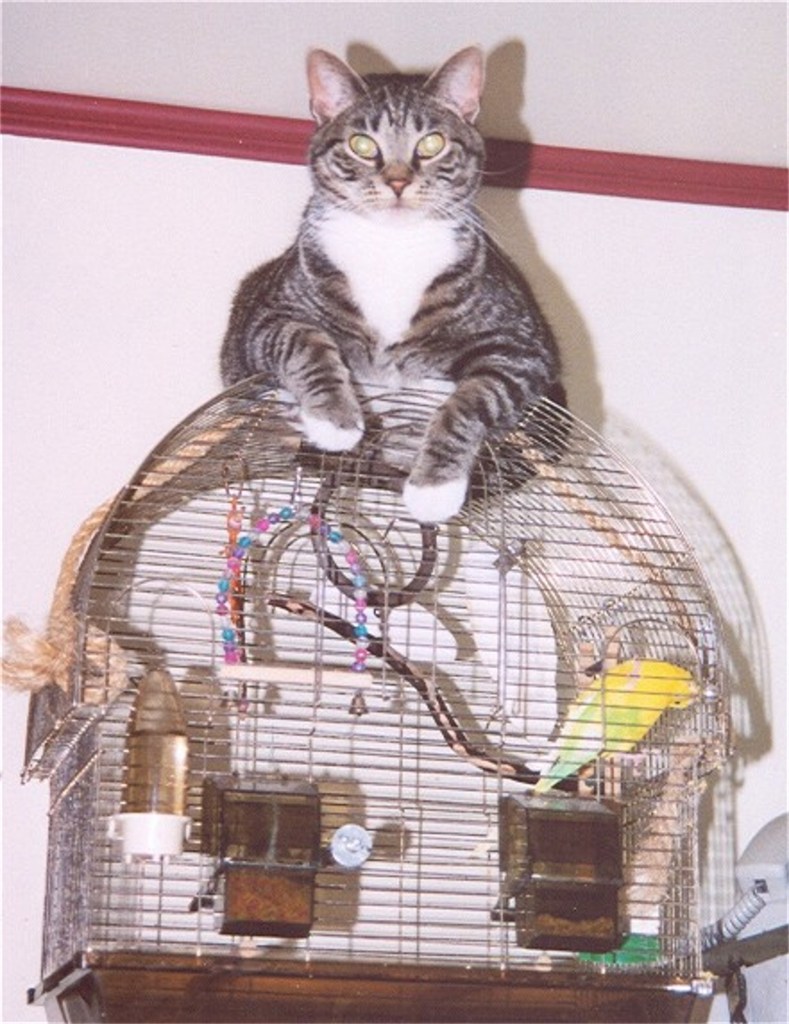
Pluskat and Sunshine (budgie) who are friends

            Kittens need to stay with their litter until they are at least 12 weeks old. They go through developmental stages similar to other animals. They learn how to behave and how to interact with other cats while they are young. If they are taken away from the litter too soon, they do not know how to act like a cat. If the cat owner decides later to get another cat, the resident cat will not know how to accept or interact with the new cat. This is one of the reasons why people have trouble introducing a new cat to the home. It is always better to have two kittens instead of one, and if possible, adopt litter mates. Family is very important to cats.

Mimi

            Like dogs, there are many breeds of cats and there are breed traits. Despite the breed of mix of a cat, each individual will have its own personality. Some cats act more like dogs and some are very aloof. Some cats are bold and some are timid. All cats are different due to breeding, family involvement, early training and experiences. It is important to keep this in mind and not label all cats as having the same personality and temperament. By understanding your cat’s natural social behavior, you can make the quality of life for your cat much better.  

Canine hookworms resistant to treatments

            Hookworms are a common problem in dogs. These worms have a hooklike mouth that attaches to the dog’s intestinal tract. There are serious consequences if a dog in highly infested. Currently the most prevalent breed to have hookworms are Greyhounds. The conditions that they are raised and raced in is conductive to the spread of hookworms.

            Because of the widespread adoption of racing greyhounds’ hookworms are spreading to other dogs as well. A dog does not have to ingest the worms to become infected. The larvae live in the soil and can burrow through the dog’s skin and paws. Also, a female can pass the worm to their puppies through their milk. Hookworms also can infect people.

            What is upsetting is that veterinarian researchers have found high levels of hookworms in dogs that were treated. It is important that dogs are retested after a treatment to ensure that all of the worms have been killed.

            The most upsetting thing about hookworms is that they are becoming resistant to the three medications used to deworm a dog. The researchers are concerned that only the drug resistant hookworms will be left and will spread. Right now, the only deworming medication that is successful in killing the resistant hookworms is emodepside. However, that medication is only approved for cats.

            What a dog owner can do is avoid dog parks, where hookworms can live. Have your dog tested for worms frequently, especially if it is an adopted Greyhound, and make sure if your dog has hookworms, retest after treatment.

Behavior and personality traits identified in cats

With cats being the number one pet, there is surprising little research about their personality and behavior traits, especially in relation to cat breeds. This study has managed to explore the world of cats. They studied 4300 cats in 26 breed groups. Their study was the most extensive and significant to date and opens the door for further research.

By using questionnaires in an efficient manner, the researchers at the University of Helsinki have identified the following:

  • Activity/playfulness
  • Fearfulness
  • Aggression towards humans
  • Sociability towards humans
  • Sociability towards cats
  • Litterbox issues (relieving themselves in inappropriate places, precision in terms of litterbox cleanliness and substrate material)
  • Excessive grooming
Turkish Angora – Bonnie

 According to the study, “The most fearful breed was the Russian Blue, while the Abyssinian was the least fearful. The Bengal was the most active breed, while the Persian and Exotic were the most passive. The breeds exhibiting the most excessive grooming were the Siamese and Balinese, while the Turkish Van breed scored considerably higher in aggression towards humans and lower in sociability towards cats.”

The result of this study coincided with a previous study, giving it more validity.

Author’s Note: It is just as important for anyone who plans to add a cat to their home to be aware of the personality traits of cats as it is for future dog owners to select the right type of dog for their living arrangements. Even if a cat is a mixed breed, certain physical characteristics can give the potential cat owner an idea of the breed group it comes from, helping them make a selection.