Many people tend to overfeed their dogs. This is especially a risk when there are children in the household. Dogs are very willing to eat all dropped food and older children tend to sneak their dog treats or share what they are eating with them. Guess what, adults do the same thing as well.
If the dog is a large dog, they can often handle the extra food. But small dogs cannot and quickly become overweight. Because owners do not weight their dogs at home, the weight can slowly accumulate until one day the owner notices that the dog has gotten fat.
The other contributing factor to overweight in dogs is that owners often do not exercise the dog as much as they need. Bigger dogs need longer exercise sessions since their stride covers more ground than a small dog. Many people do not have the stamina or space to properly exercise a large dog.
Just like people, dogs suffer health issues from being overweight. It can be hard for an owner to put their dog on a diet. Those begging eyes are hard to resist when you know that your dog is hungry because you have put them on a diet.
The good news is that a study conducted at the University of Illinois, Urbana-Champaign campus has found that by putting a dog on a reduced calorie – high protein and fiber diet for 24 weeks reduced weight in dogs. It also showed that dogs body composition and inflammatory markers changed for the better and they did not lose muscle mass.
Keep a close watch on your dog, especially if family members tend to share their food with the dog to make sure that they are not gaining too much weight. If they do, consult with your veterinarian to determine which dietary food your dog should be on. With extra care, you can help your dog live a long, healthy life.
Researchers at the Osaka Prefecture University have identified potential candidates for those parts of the molecules that result in allergic reactions to dogs. If they develop this new finding, there could be an allergy shot to help people who otherwise cannot own or be near dogs enjoy dog ownership.
The long-range result may be that less dogs will be surrendered for adoption due to allergies to them and children may be able to grow up with that special companion.
The added benefit of this new discovery is that it could lead to other new allergy shots that will benefit people. Any progress in curing allergic reactions is a plus for overall health. Those people who suffer from allergies often suffer year-round. It is like having a constant cold.
Note: This article is my opinion, based on my experiences with many dogs, cats and birds.
Pet owners spend a considerable amount of money on toys for their pets. Toys are important for pets; they give pets something to do and, in some cases, build the bond between the pet and owner. While I will refer mostly to dogs, this article applies to all pets.
It is important to realize that there is no regulatory body for pet toys. What that means is that manufacturers can use whatever material they choose to make pet toys. Unfortunately, many of the products that are available are not safe, either because of a chewing or a toxic substance risk.
When picking a toy for your pet, you should consider the type of animal it is and what it likes to do. Dogs like to fetch, toss and chew and shred toys. This satisfies their natural hunting instinct. Cats like to chase, pounce, carry and sometimes tear up toys.
Birds generally like to tear apart, peck and toss toys. Although many birds play with toys in various ways. I had a budgie who liked to “herd” plastic balls into a tight group.
When considering a toy for a pet, keep in mind that if there is a risk associated with the toy, the risk increases if the pet is small. This is because it takes less material to block their intestines and less toxins to make them sick or kill them. This is why a pet owner should carefully evaluate what toy they give their pet.
I feel that toys for dogs pose the most risks because dogs tend to chew and eat pieces of their toys more than other pets. Know how your dog likes to play with a toy before you pick one out for him. Some dogs will totally destroy a stuffed toy or a plastic one. Other dogs like to carry a toy around and will not destroy it. Many dogs are obsessed with getting the squeaker out of a toy that has one. My Parsons Russell Terrier is a squeaker killer. He will work on a toy almost endlessly until he gets the squeaker out. Then for the most part, he loses interest in the toy.
Puppies almost always chew a toy until it is destroyed and they are more likely to eat the pieces of the toy. For this reason, plastic toys are a higher risk for puppies. Regardless if your dog is a puppy or an adult, plastic toys in general are the highest risk.
Because dogs like to chew and destroy toys, they are less likely to play with the chew-proof variety of toy. Some of the nylon toys are coated with a scent and when the coating wears off, the dog loses interest in the toy. Stuffed toys pose a problem because the stuffing, which can be ingested and not digested. The stuffing in most dog and cat toys are fiber fill which is a form of plastic.
If a dog owner is going to give their dog one of the many products on the market designed to clean the dog’s teeth while they chew the toy, be sure to check the ingredients. Most dental chews for dogs are only 96% digestible. What is the other 4%? Some of these products have plastic in them to make them last longer.
Those chew products that are designed to be eaten, should break down in five to ten minutes when placed in water, if not, it is a high risk for your dog. These types of products can block a dog’s intestines. Because of a dog’s short digestive tract, these products do not have enough time to break down if they can break down at all.
This is also true of any rawhide product. I personally do not approve of any animal product such as cow hooves, pig’s ears and rawhide. These products are often treated with formaldehyde as a preservative. Many people think that rawhide comes from a butcher, but in reality, rawhide comes from a tannery. Also, keep in mind that any wild domestic canine does not eat bones, skin or hooves.
This is evident when you see a dead deer along the roadside. After everything, animal, bird and insect are finished feeding on the carcass, the things left are hide, hooves and bones. The main risks for letting a dog eat rawhide are contamination, choking hazard, and intestinal blockage. A number of pet related organization discourage giving dogs rawhide. However, dried chicken feet and antlers are a better alternative than rawhide, pig’s ears and cow hooves.
Rope toys are acceptable if your dog does not chew them and swallow the threads. The safest rope toy is one made of cotton instead of nylon. Cotton has a better chance of breaking down if it is ingested whereas the nylon will not.
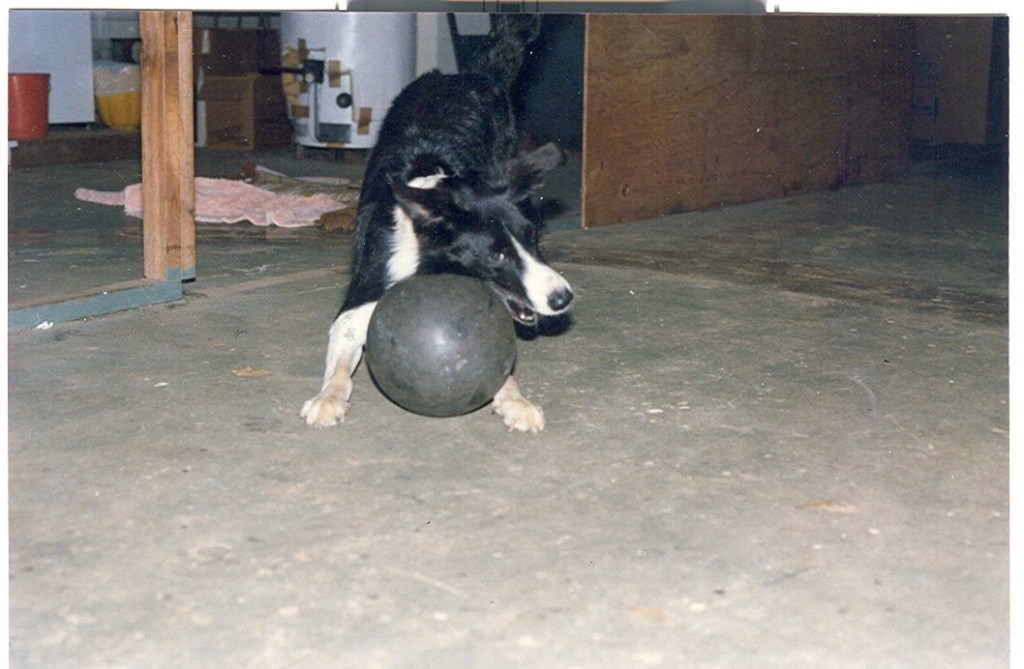
Ness’s favorite toy, an old bowling ball
It is never a good idea to give a dog old shoes or slippers because of the chemicals used to make them. It is especially difficult for a puppy to understand that old shoes and slippers, and rawhide products are OK to play with but new shoes and slippers are not. Keep in mind that rawhide comes from a tannery and dogs have a very sophisticated sense of smell. Therefore, a dog of any age can smell the similarity between rawhide and other leather products, which include furniture, gloves, jackets and briefcases.
Bones are not a good choice for dogs either. Again, it is not natural for dogs to eat bones. Many of the “natural” bones have bacteria on them that can harm both dogs and people who handle them. Some of the stuffed bones that are treated can be safer for a dog who likes bones. The danger associated with bones are splinters from the bone and bacteria.
The bottom line is knowing your dog. If a toy becomes small enough to swallow it should be taken away from the dog. By knowing your dog’s play habits you will be able to decide what toy is safe for them to play with. The best toy is one that allows you to interact with your dog, playing fetch games, chase games or whatever your dog likes. If you understand your dog’s breed, it will guide you to selecting the right toy for your dog. All dogs can benefit from puzzle toys and treat dispensing toys. Also think outside the box, you never know what a dog will take a fancy to as illustrated by our dog Ness.
An extensive research project led by palaeogeneticist Laurent Frantz from the Ludwig-Maximilian-Universität Müchen determined that dogs from Siberia resulted from cross-breeding with dogs from Eurasian populations over 2000 years ago. His findings along with artifacts found at ancient sites, shows extensive trading. Dogs were an important trade item between the Siberian people and people from the Eurasian steppe and Europe.
For example, he goes on to say that although a large percent of the Samoyed genome can be traced to original Artic bloodlines, it also shows more Western influence than the husky. This finding helps to explain why the Samoyed can herd reindeer yet the husky does not. According to his findings the Samoyed as a breed has had little changes since the Middle Ages.
It is also interesting to note that according to Frantz, although there was an exchange and inbreeding of Siberian dogs, there was no indication that the people intermarried. The human genomes stayed very stable over the same period.
A team of researchers from the University of Helsinki have studied over 4000 dogs to determine how the food a puppy eats influences their likelihood of having skin allergies as an adult dog.
They found that a diet that does include raw tripe, organ meats and human meal leftovers resulted in the adult dog being less likely to have skin issues. Puppies that ate only prepared food such as kibble, heat dried meat, canned food, sausage packed food and fruit had a tendency to have more adult skin problems.
According to the research, it only takes adding 20% of raw food and human leftovers in a puppy’s diet to help protect the puppy from adult skin issues.
While the study did say that sweet fruit is included as a negative for puppy’s, it does not mention vegetables. I personally have always fed my dogs raw vegetables and some fruit as well as leftovers. No pet food has the human grades prime meat that humans eat, so leftovers are healthy for a dog to eat and should be added to the diet.
It is also very important to feed you dog and any other pet the highest quality food that you can find. I personally like Wysong and Annamaet.
The weather is cooling, and although most four-legged creatures enjoy a break from summer’s heat just as much as us two-legged creatures do, fall and winter can also pose certain dangers to our furry friends. Not all animals are equally equipped for cool temperatures, and your pet might need a little extra help to stay healthy and comfortable.
While a great fitting jacket or cozy pjs can be a great start on cold weather comfort, there is often more to it than that. With that in mind, Certified Animal Behavior Consultant Susan Bulanda presents some tips for giving them what they need without breaking the bank:
Stock Up on Basics
One important step towards keeping your furry friends safe in the cooler season is to stock up on basic supplies like food and any medications your pet needs. If you wind up stuck in inclimate weather, having a stockpile set aside can keep your pet happy and your stress levels low. Moreover, buying in bulk might cost more up front, but it can save you money in the long run.
Look for discounts online like a Chewy promo code to build a budget-friendly pet supply stockpile. Keep extra food somewhere cool and dry so it stays fresh for your pal. If your pet takes any medications, talk to your vet about getting extra before the cold season hits.
Stay On Top of Grooming
Many animals go through a cool-season shed. This allows them to grow out their thick winter coats. Although this is a vital tool for keeping them warm and cozy, it can be tough on them without proper grooming. Long-hair pets in particular can develop mats and hairballs, both of which are uncomfortable and have the potential to cause serious problems.
Some animals will need professional grooming once a season to remove blown-out coats. Look for affordable groomers in your area to find a good fit for your budget. If your buddy gets anxious at the groomers, try a natural relaxation technique like massage or essential oils to help them calm down for their big salon day.
Dress Your Pet for the Weather
Dogs in sweaters aren’t just extremely adorable – they’re also well-prepped for harsh temps. If your dog isn’t a cool-weather breed, it’s important to make sure they’re properly dressed for cold weather when you take them out for walks. This means doggy jackets and well-fitting boots. The dog-lovers over at Cuteness remind us that dogs can easily get frostbite on their paws if they’re not properly protected – after all, you wouldn’t want to walk barefoot in the snow, would you?
If you have a very young or senior pet, it’s especially important to get them something cozy when it’s cold. According to Dogster, these animals don’t have the ability to regulate body temperature their counterparts have, so their body temperature can drop dangerously in chilly conditions. If you have the skills, a great way to save money on pet clothes is to DIY your own designs. There are a ton of knitting, crocheting, and sewing patterns out there for the interested crafter.
If you want to give your pet a little extra coziness this winter, an indoor dog house may do just the trick. Just make sure you read up on the different available products to ensure you’re getting one suited to your dog’s size and temperament. The last thing you want is to spend money on something your pet will destroy in a matter of days.
Get a Checkup
Finally, consider scheduling your pet’s yearly check up for the start of fall. This will give you the chance to make sure they’re in good shape for the winter, as well as an opportunity to ask your vet if there are any other steps you can take to keep them healthy over the cooler months. Regular checkups keep your pet (and your wallet) safe by catching issues before they’re too serious, and more expensive to treat.
Keeping your furry friend healthy during winter is just one way to show them how much you love them. Think ahead before the weather gets rough so you have a plan for any possibility. You and your pet deserve to have a wonderful winter together!
A study in the Veterinary Record, has reported a few cases of dogs and cats contracting the SARS-CoV-2 variant in England. In these cases, the pets caught the variant from their owners who had shown symptoms several weeks before the pets became ill. Heart problems were manifested in the pets who contracted the variant.
While this is not widespread and actually rare, it is a good idea for pet owners to be aware of the possibility since COVID-19 is so widespread. At this point the research does not indicate that people can catch the variant from pets.
We all know that some dogs seem to be more stressed than other dogs. Part of the reason is the genetics of the dog. Certain breeds tend to be more noise sensitive than others. But all dogs can be stressed by certain types of noise. Researchers at the University of California found that dogs are often stressed by common household noise. Particularly noises that are high frequency or very loud. Examples are smoke detectors, microwave ovens, and vacuum cleaners.
Many loud and high pitches noises actually hurt a dog’s ears. Most owners recognize obvious signs of fear or stress, such as trembling, hiding, howling, barking and running away. However, owners often miss a dog’s more subtle signs and therefore do not help their dog when stressed. Some of the subtle signs are panting, licking their lips, turning their head away, a rigid body, ears turned back or flattened against the head, and lowering their head below their shoulders.
By watching your dog or cat carefully you can learn to recognize their relaxed body language. This will help you recognize when your pet is not relaxed.
Babs, totally relaxed
Whenever a stressful noise occurs, a concerned owner will remove the dog from the area. It is important to watch the dog’s body language to see how far away the dog needs to be to avoid being stressed.
Cats are also stressed by noises therefore cat owners should also be aware if noise bothers their cat.
Researchers at Washington State University conducted a study of first year (freshmen) college students who owned pets and their level of separation anxiety. What they found is not surprising to those of us who are pet owners and lovers.
The students were tested before leaving for college and during their first two weeks on campus. Prior mental issues were accounted for so that they did not influence the results of the study. What the researchers found was that students who treated their pets more like people suffered more. It also seems that dog owners suffered the most rather than cat owners and people with other types of pets.
My soul mate, Scout
The importance of this study shows that programs that allow pets to visit campus to help students that are stressed, are beneficial. What this study made me think of are all of the elderly people who are forced to give up their pets, who were their companions for many years, because they had to move to a care facility. Young people are active and seem to be able to adjust more readily than the elderly. This also brings to mind how important it is to bring certified therapy pets to nursing homes and assisted living facilities. No matter how young or old a person is, losing a pet for any reason is often very traumatic. Your heart can ache for the loss for many years.
A study has shown that rats determine the direction of the wind with their whiskers. Since many other animals such as dogs, foxes, coyotes and cats also have whiskers that are similar to those of a rat, is it possible that they also use their whiskers to determine the direction of the wind?
All wild animals also have to be aware of the direction of the wind to either find food or avoid being detected by predators. Therefore, the ability to determine the direction of the wind or even a slight breeze is a life and death skill.
cat whiskers
It seems reasonable that that they would use their whiskers as well as the movement of their fur to detect the direction of air movement. As a person who has trained many working dogs, I have seen dogs learn how to use the direction of the wind to find scent. It is quite an amazing thing to watch, and another example of how intelligent animals are.





 A Blog by Susan Bulanda