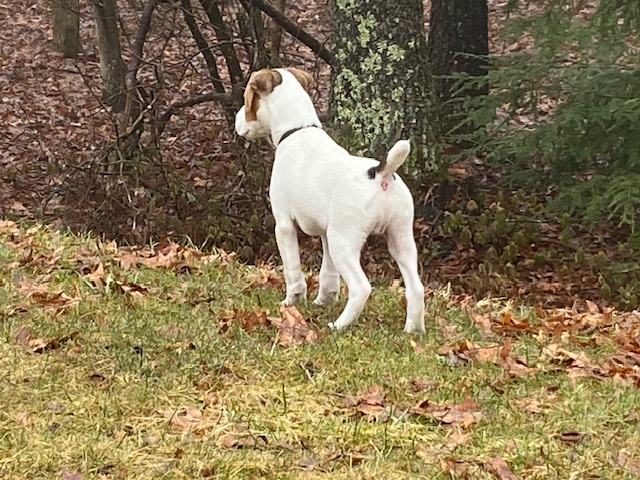
Dog tails, often misread

Many children are taught that if a dog’s tail is wagging that it is safe to approach the dog and pet him. This is one reason why children are sometimes bitten. First, a child should be taught to never approach any animal without first asking permission to do so. If the child is alone and there is no one around to ask, they should avoid all animals.

I recall being at a dog show with my young Doberman and a young girl ran up to my dog and gave him a big hug. Fortunately my dog was safe and liked all people. I did tell the child that she should always ask first since all dogs are not safe. She looked at me, thought a minute and said, “I have a way with dogs” and left. She was at the age where she should have known better, but obviously someone had told her this and she thought that she was safe from all harm. How sad. At the same show with the same dog, an adult couple approached and started to pet my dog, giving him kisses and hugs. Being a red Doberman and young, he was rather slender. They looked up with love in their eyes and asked if he was a Vizsla. I said, “No, he’s a Doberman.” They collectively gave a gasp of horror, quickly backed away saying “I’m afraid of Dobermans!” Fortunately my dog ignored their behavior.

But the fact is that many adults think that if a dog is wagging his tail, that he is safe to approach. Some behavior consultants feel that the tail is not an indicator of a dog’s mental state at all and not a reliable means of determining how a dog feels. To a point this is true. The tail should always be included with other body language. This includes the dog’s posture, facial expressions, vocalizations and spatial proximity to the object of his interest.

What makes it difficult to determine the meaning of a dog’s tail are physical factors such as a dog who has no tail or a small stubby tail like a Doberman. Dogs whose tails are naturally carried in a certain position, such as the high tail of a Beagle, or breeds that normally carry their tails low such as a Greyhound as well as those dogs who have very curly tails such as a Husky.

However, there are some general rules that a person can use to determine if the tail is a warning rather than an invitation.

1) A slow wag that is lower than the back of the dog is often a dog that is insecure. An insecure dog may fear-bite.

2) A tail tucked between the dog’s legs or even curled between the dog’s legs and tucked all the way to the dogs stomach. This means the dog is very fearful.

3) A slow high wag is often a dog that is assertive and willing to fight. If the dog is barking he could be aggressive.

4) A tail that is very high, erect, and stiff is also a sign of high alert or aggression.

With a little bit a caution and common sense, a person can avoid being bitten or being confronted by a dog that would rather be left alone.

Dog fur vs dog hair. What is the difference? Does it matter to people who are allergic to dogs?

Dogs have a wide range of coat types, from very short with no undercoat to very long with dense undercoats to everything in between. Their fur can be silky soft to wiry hard.

The truth is that chemically, both dog hair and fur are the same, so what is the difference?  Dog hair has a longer growth cycle, similar to a person’s hair that will grow long if not trimmed. Dog fur always stays the same length. For example, you never see a long haired Boxer or Pointer and you never have a Poodle that does not need a haircut.

One difference between fur and hair is the texture. Hair is finer, often softer and usually wavy or curly. When you have a dog with hair that does not have an undercoat, is wavy or curly, the hair will trap the shedding hair and dander inside the coat, giving the impression that the dog does not shed and is allergen-free.

Dogs that have silky coats, regardless if they have a longer growth cycle or not, have a greater risk of having their coats mat, the longer the coat, the greater chance that it will mat. This means that the dog’s owner must groom their dog on a daily basis.

Mats are caused by the individual hairs twisting and forming a dense tangle of hair. Often the mats work themselves into such tight clumps close to the skin that the base of the hair will constantly pull, causing considerable pain for the dog. The closer the mat works itself to the skin, the more difficult it is to remove it and the greater risk there is in nicking the dog’s skin while trying to remove the mat. Maybe some of you remember as a child having tangles in your hair and how it hurt to pull them out. A mat in a dog’s coat hurts even more than that.

The most common places for mats to form are behind the ears, in the “arm pits” by the front legs and between the dog’s toes.

When you consider what type of dog to own, it is important to consider the grooming needs of the dog based on the type of coat it has. For those people who purchase mixed breed dogs, such as Labradoodles, or any Poodle mix, there is no way to tell what type of coat the dog will have. These dogs are not hypoallergenic as some people claim.

If a person is looking for a dog for themselves or family who has allergies, it is best to check with a doctor that is an ENT-Allergist or a doctor that specializes in allergies to see what preventative measures can be taken. It would be a good idea to spend time with the breed of dog you are considering to see if there is an allergic reaction. Sometimes people can tolerate a very short haired dog such as a terrier but cannot tolerate a short haired dog in the hunting group.

Breeds of dogs that are bred to be water dogs, such as Labradors, typically have more oil in their coats to protect them from the water, which can trigger an allergic reaction in some people. Another factor to consider which only a doctor can test for is the degree that you are allergic to dogs. Some people have a mild allergic reaction and medication can keep it in control. Some people cannot tolerate dogs at all. Also keep in mind that part of living with a dog when you have an allergy to dogs is keeping your house what I call, allergy clean. The dog dander and hair can build up in a home, especially in carpet, which can contribute to a person’s allergic reaction over time.

With a little bit of research and by knowing the truth about dog hair/fur, someone who wants a dog but is allergic to them, or wants a mixed breed dog can determine what type of dog to get. For those with allergies it is always safer to stick with a purebred dog because you can be sure of what you are getting. Most quality purebred dogs cost the same and sometimes less, than the over-priced “designer” mixed breed dogs that are available which are no more hypoallergenic than any other dog.

Chiari malformation in dogs

Chiari malformation is a painful skull malformation that affects many small breeds of dogs. This disorder is caused by the premature fusion of skull bones which causes parts of the brain to push through the opening of the back of the skull. This then causes fluid to build up in the spinal cord. It also affects 1 in about 1200 humans.

Researchers at the University of Surrey teamed up with a breeder of Brussel Griffon’s in the Netherlands to study an accidental breeding between her Brussels Griffon and her Australian Terrier.

The four-year study using MRI images of the canine family of Brussels Griffons, showed that with a onetime cross breeding and careful selection of future breeding for head shape, that the inherited problem could be corrected.

The resulting study, published in the PLOS journal, resulted in the Surrey researches teaming up with the geneticists at the University of Montreal to link the results with the dog genome.

What is promising is that the study will be linked to studies in humans, offering hope to the people who are affected by this disorder.

It is interesting to note that backcrossing a breed is not a new concept. It has been done with Dalmatians in an attempt to lower high uric acid in Dalmatians. Another goal of the backcrossing was to decrease the level of deafness found in Dals. 

http://www.dogheirs.com/dogheirs/posts/58-chiari-malformation-and-syringomyelia-symptoms

http://www.ninds.nih.gov/disorders/chiari/detail_chiari.htm

http://www.dalmatianheritage.com/about/schaible_research.htm

http://www.dalmatianheritage.com/about/nash_research.htm

Breed Specific Legislation -Bully Breeds

Breed specific legislation has become a worldwide phenomenon, targeting for the most part the American Pit Bull terrier and any dog that resembles a Pit Bull or what is sometimes called a Bully breed. What is even sadder is that after over ten years of this prejudice, it continues. Many shelters will not adopt dogs that fit this description and often people who are interested in adopting a dog will avoid dogs that are labeled a Bully breed or look like one.

The fallacy of this attitude is that the behavior of an individual dog cannot be completely determined by its breed. Ironically, the Pit Bull Terrier and the Staffordshire Terrier are the only breeds that were bred not to bite their handlers in a situation where redirected aggression would likely occur.  

Because of breed specific legislation dogs that are labeled as Bully breeds often are killed or misused. The owners of these dogs are penalized if they try to get homeowners insurance or rent a place to live. The real tragedy is that dogs are often judged by how they look. A recent study has shown that veterinarians and shelter workers are often asked to identify what breed(s) a dog is, and the dog is labeled accordingly. DNA tests on the dogs classified as Bully breeds have shown that they were mislabeled up to 48% of the time. The study also showed that dogs labeled as a Bully breed often dramatically decreased their chances of being adopted.

This is very sad because most of the assessments were done by merely looking at the dog. It is often very difficult to determine what a dog is just by looking at it. For example, what would a Boxer/Labrador mix look like? Or a Boxer mixed with two or three other breeds. Consider what a Bull Terrier or even a Boston terrier mix would look like or a Bulldog mix. Even consider what a Rottweiler mix could look like.

The chances of a dog being a mix of something other than a Pit Bull is very likely.   Consider the fad of creating “designer” dogs. Keep in mind that designer dogs are a fancy name for mixed breed dogs that are usually a cross breed.

free clip art

Why then does it seem that the Bully breeds or Pit bulls have more attacks and sometimes fatal attacks on people? The answer is twofold. One it has to do with the way the dog was raised. Often the dog is purchased for protection, dog fighting, or as a status symbol. In many cases the dog’s owner does not know how, or care to properly train and socialize the dog. Two, poor breeding and improper breeding can create a litter of dogs that are more aggressive than the breed standard dictates. If you add a lack of proper socialization to that, there is a high risk that the puppies from that litter will have behavior problems, aggression being one of them. This is also true for any other breed or mixed breed of dog.

Also consider that many small dog bites are not reported because they do not do the damage that a larger dog bite does. If a small dog bites and it is reported, the media does not sensationalize it the way they do if it is a Pit Bull or Bully breed attack. What this means is that statistically there may be many more dog bites from other breeds of dogs.

Throughout history various dogs had the reputation of attacking people. There was a time that people feared the Doberman Pinscher, the German Shepherd and the Rottweiler. Today it is the Pit Bull and Bully breeds.

I recall years ago when I was showing my red Doberman that a teenage girl came up and was loving and kissing my dog, who was kissing her back and wiggling with delight. She asked me if this was a Vizsla? I said no that it was a Doberman. She gasped, quickly pulled back and said, “I’m afraid of them.”

It is interesting that in a day when we have become politically correct to the point of adnauseam, we treat our dogs the complete opposite.  

In conclusion it would seem that until we hold owners more accountable for the behavior of their dogs, and until we properly identify what a breed(s) a dog is, Pit bull and Bully breeds will continue to be a target and suffer as a result. Ironically there are other breeds of dogs that are truly unsafe, yet no one targets those breeds.  

How Pets Heal Hearts and Brighten Lives: The Science of Their Amazing Impact

By Guest Blogger, Cindy Aldridge

cindy@ourdogfriends.org

Pet ownership is more than just a source of joy—it’s a gateway to better health and a more fulfilling life. From reducing stress levels to promoting physical activity, the bond between humans and their pets profoundly impacts overall well-being. This article explores how pets contribute to a healthier, happier lifestyle, showcasing their unique role in enriching our lives.

The Mutual Benefits of Pet Interaction

Spending time with pets like dogs and cats can be a delightful way to unwind and reduce stress. Engaging in regular playtime and maintaining a consistent routine with your furry friend can help lower cortisol levels, a key stress hormone. This benefits your health and positively impacts your pet’s well-being, as your stress can affect them, too. Consider working from home occasionally or arranging for a pet sitter if your pet shows signs of stress. These steps can create a more harmonious environment, enhancing your and your pet’s health and happiness.

Boosting Your Immune System with Pet Companionship

Owning a pet can be a delightful way to boost your immune system. Sharing your home with a pet, especially a dog, exposes you to various microbes that can strengthen your body’s defenses. Research indicates that children raised with pets often develop a more diverse gut microbiome, which is associated with a lower risk of asthma and allergies. This aligns with the hygiene hypothesis, suggesting that early exposure to microbes can help the immune system manage allergens more effectively.

The Mental Health Benefits of Pet Care Routines

Establishing a routine through feeding, grooming, and exercising your pet provides structure and instills a sense of purpose and accomplishment. This routine can be particularly beneficial for those facing mental health challenges, as it encourages regular physical activity and fosters a stable environment. The bond you form with your pet through non-verbal communication can uplift your mood and alleviate anxiety. Studies suggest that over 60% of dog owners achieve recommended exercise levels, highlighting the physical benefits of pet ownership.

How Therapy Animals Help with Mental Health

Therapy animals have increasingly become a vital component of mental health care, offering comfort and support to individuals facing challenges such as PTSD and autism. Their calming presence can significantly enhance social skills, reduce anxiety, and promote emotional stability across diverse groups. For example, equine-assisted therapy involves interactions with horses and is particularly effective in building trust and facilitating emotional healing. Additionally, service dogs are trained to address specific needs, such as providing mobility support or detecting health issues like low blood sugar, enhancing independence and quality of life.

The Health Benefits of Pet Ownership

Delving into the science of the human-animal bond reveals its significant impact on health and well-being. Engaging with pets can lower blood pressure and ease anxiety, mainly due to releasing hormones like oxytocin and dopamine, which foster happiness and relaxation. The companionship of a pet can alleviate loneliness and depression, enhancing your overall quality of life. Understanding these dynamics lets you appreciate how pets contribute to a healthier, more fulfilling life.  

freepik

Pets are more than just companions; they are catalysts for improved health and happiness. Their presence can transform daily routines, offering emotional support and fostering a sense of purpose. As we continue to explore the profound connections between humans and animals, it becomes clear that pets play an integral role in enhancing our lives. Embrace the unique benefits they bring, and let these bonds enrich your journey toward well-being.

Discover the fascinating world of canine intelligence and groundbreaking research at Susan Bulanda’s Blog, (website) sbulanda.com where passion for pets meets scientific exploration!

Susan Bulanda’s The Business of Dog Training Earns Spot as DWAA Finalist

by guest blogger Anthony Raymond Michalski

Ms. Bulanda’s The Business of Dog Training Named DWAA Writing Competition Finalist

Wilkes-Barre, PA, January 8, 2025 – Kallisti Publishing is proud to announce that Susan Bulanda’s The Business of Dog Training: How to Succeed as a Professional Dog Trainer has been recognized as a finalist in the 2024 Dog Writers Association of America (DWAA) Writing Competition in the Reference category. This prestigious honor underscores the book’s value as an essential resource for professional dog trainers.

The recognition comes as the DWAA prepares to host its first in-person awards banquet in five years on February 8, 2025, at the historic Hotel New Yorker in New York City. The event, held during Westminster Week, celebrates the accomplishments of writers, journalists, and creators dedicated to the world of dogs. Finalists in each category are eligible to win the coveted Maxwell Medallion, the DWAA’s highest honor, which is awarded by an independent panel of judges.

Written by veteran dog trainer and educator Susan Bulanda, The Business of Dog Training offers readers essential insights on building and growing a successful dog training business, covering everything from business management and marketing to advanced training techniques. “I’ve dedicated my career to helping people and their dogs thrive together,” said Bulanda. “This book is my way of giving trainers the tools they need to succeed not just with dogs, but in the business world too. It’s an honor to see it recognized by the DWAA.”

Founded in 1935, the Dog Writers Association of America is the premier organization for professionals in dog-related media, recognizing excellence and fostering a community that shares a passion for canine companionship.

For more information about The Business of Dog Training or to schedule an interview with Susan Bulanda, please contact Anthony Raymond at Kallisti Publishing Inc.

Kallisti Publishing Inc. makes the “Books You Need to Succeed” — personal development, inspirational, and business books that expand the mind, generate ideas, and grow profits and is the home to prestigious authors who are leaders and experts in their field. Kallisti Publishing Inc. is located in Wilkes-Barre, Pennsylvania and sells traditional books and ebooks through distributors and retailers, direct to the reader, and in bulk to companies and organizations.

Press Contact:   

Anthony Raymond Michalski
ph (570) 825-3598 • editor@kallistipublishing.comhttp://www.KallistiPublishing.com

Sit, Stay, Prosper: How Dog Training Became a Big Business

by guest blogger, Kallisti Publishing

The next time you pass a well-behaved dog walking serenely on a leash, tail wagging in perfect harmony with its owner, take a moment to appreciate the silent partner in that picture-perfect moment: the dog trainer. Behind every happy canine and relieved pet parent, there’s likely a professional who taught Fido how to sit, stay, and maybe even stop chewing the couch cushions.

Dog training has quietly grown from a charming pastime into a booming industry that combines passion, practicality, and profit. As Americans pour billions of dollars annually into their pets, the demand for professional trainers has skyrocketed. For those who love dogs and want to make a career out of that affection, it’s never been a better time to enter the field.

“Dogs are family now,” says Susan Bulanda, a veteran trainer, internationally recognized canine behavior expert, and author of The Business of Dog Training: How to Succeed as a Professional Dog Trainer (Kallisti Publishing, 2024). “People are investing in their pets like never before, and that includes making sure they’re well-trained and happy. This shift has created incredible opportunities for trainers.”

A Pawsitively Booming Industry

Gone are the days when dog training was little more than a niche service. Today, the industry offers a dazzling array of opportunities. Trainers can specialize in everything from puppy socialization and basic obedience to advanced fields like agility sports, therapy dog certification, and service dog training.

Jessica Ramirez, a trainer based in Austin, Texas, discovered this firsthand. “When I started during the pandemic, I thought I’d stick to basic obedience classes,” she says. “But the demand kept growing—puppy owners wanted socialization, working professionals needed help with separation anxiety, and a surprising number of people wanted their dogs to learn fun tricks.”

Ramirez now runs a six-figure business with three employees, offering services that range from one-on-one consultations to group classes and even virtual training. “It’s incredible how many options there are,” she adds. “This isn’t just a job—it’s a lifestyle.”

And it’s a lucrative one. The American Pet Products Association (APPA) reports that spending on pet services, including training, reached over $11 billion in 2023. With 65 million American households owning at least one dog, this number is only expected to grow.

Why Now?

The rise of the dog training industry can be traced to several factors. For one, the pandemic prompted a nationwide “puppy boom.” Millions of Americans adopted pets, often for the first time, and quickly realized they needed help teaching their new companions how to behave.

“Pandemic puppies changed everything,” says Andrew Mitchell, a Denver-based trainer who left his corporate marketing job to pursue his passion for working with dogs. “Suddenly, people were home all day with these energetic animals and had no idea how to handle them. That’s when trainers became essential.”

Urbanization is another driver. As more people move into cities and apartments, the importance of having a well-behaved dog grows. “A barking or aggressive dog can strain relationships with neighbors,” says Bulanda. “Training ensures harmony in these close-quarters living situations.”

Moreover, dogs are no longer seen as just pets—they’re companions, family members, even emotional support systems. “Training isn’t about control anymore,” Bulanda adds. “It’s about communication. People want to connect with their dogs, and trainers help make that possible.”

The Joys and Challenges of Training

Despite the industry’s many rewards, dog training isn’t without its challenges. Trainers must master both canine behavior and human psychology. “Training a dog is often the easy part,” says Mitchell. “The harder part is teaching the owners. You need to be patient, empathetic, and a great communicator.”

For Ramirez, the emotional rewards outweigh the challenges. She recalls working with a rescue dog named Daisy who had a deep fear of loud noises. “Her owners were ready to give up,” Ramirez says. “But after weeks of gradual training, Daisy became a completely different dog—confident and calm. Seeing that transformation is why I do this.”

Bulanda agrees. “Training changes lives—for the dog and the family. It’s one of the most meaningful careers you can have.”

How to Get Started

Starting a dog training business is surprisingly accessible. Most trainers begin with a certification from organizations like the International Association of Canine Professionals or the Certification Council for Professional Dog Trainers. These programs teach foundational skills, from reading canine body language to implementing training techniques.

For those serious about building a career, resources like Bulanda’s The Business of Dog Training offer valuable guidance. The book provides practical advice on everything from understanding dog behavior to marketing services and managing a business. Drawing on decades of experience, Bulanda outlines the path to becoming a successful trainer in an increasingly competitive field.

“You don’t need a huge investment to start,” she says. “A few basic tools, some education, and a lot of dedication can go a long way.”

The Future of Dog Training

The industry’s growth shows no signs of slowing down. As more Americans embrace the human-animal bond, the demand for skilled trainers will only increase. This expansion opens the door for innovation, such as virtual training programs, mobile apps, and training packages tailored to specific breeds or behavioral issues.

“Dogs are incredibly adaptable, and so is this industry,” says Mitchell. “There’s always room for new ideas and approaches.”

For those considering a career change or looking for a side hustle, dog training offers a unique blend of profitability and purpose. It’s a career that allows people to work with animals, help others, and build a business—all while enjoying the companionship of man’s best friend.

“Dogs bring joy, loyalty, and love into our lives,” Bulanda reflects. “As trainers, we have the privilege of helping them thrive while creating lasting bonds with their owners. It’s a career filled with heart, and it’s one I’d recommend to anyone who loves dogs and wants to make a difference.”

A Career That Changes Lives

Whether you’re looking to leave behind the corporate grind or turn your passion for animals into a thriving business, dog training offers endless opportunities. With the right skills, a willingness to learn, and resources like The Business of Dog Training, you can build a career that’s not only financially rewarding but emotionally fulfilling.

So, the next time you see a dog sitting calmly at its owner’s feet or walking politely on a leash, remember: that’s the work of a trainer. And it might just be your next great career move.
New research about overeating

UCLA psychologists have discovered a circuit in the brain of mice that makes them crave food and seek it out, even when they are not hungry. What is interesting about this discovery is that when the group of cells is stimulated, the mice seek fatty and pleasurable foods such as chocolate instead of healthier foods such as carrots.

The area of the brain where the cells are located is called the periaqueductal gray which is in the brainstem. When these cells are stimulated, the mice are so driven to eat that they will endure foot shocks to get to the food. The opposite occurs when the researchers inject a virus that produces a protein that reduces the cells activity even hungry mice foraged less.

“Like mice, humans also possess vgat PAG cells in the brainstem. It could be that if this circuit is overactive in a person, they might feel more rewarded by eating or crave food when not hungry. Conversely, if this circuit is not active enough, they could have less pleasure associated with eating, potentially contributing to anorexia. If found in humans, the food-seeking circuit could become the treatment target for some kinds of eating disorders.”

Sue’s Note: If mice have this cluster of cells, it stands to reason that other animals have it as well. Could this be why some of our pets overeat and some have low appetites?

Journal Reference:

  1. Fernando M. C. V. Reis, Sandra Maesta-Pereira, Matthias Ollivier, Peter J. Schuette, Ekayana Sethi, Blake A. Miranda, Emily Iniguez, Meghmik Chakerian, Eric Vaughn, Megha Sehgal, Darren C. T. Nguyen, Faith T. H. Yuan, Anita Torossian, Juliane M. Ikebara, Alexandre H. Kihara, Alcino J. Silva, Jonathan C. Kao, Baljit S. Khakh, Avishek Adhikari. Control of feeding by a bottom-up midbrain-subthalamic pathwayNature Communications, 2024; 15 (1) DOI: 10.1038/s41467-024-46430-5

Cite This Page:

University of California – Los Angeles. “Craving snacks after a meal? It might be food-seeking neurons, not an overactive appetite.” ScienceDaily. ScienceDaily, 20 March 2024. <www.sciencedaily.com/releases/2024/03/240320122517.htm>.

Heart murmurs in dogs

Researchers at the University of Cambridge have perfected an algorithm that can accurately detect heart murmurs in dogs. A heart murmur is the main indicator of cardiac disease such as mitral valve disease. About one in thirty dogs develop this, especially small dogs such as the King Charles Spaniels. The algorithm was originally designed for use on humans, but the team was able to adjust the program to detect and grade heart murmurs in dogs.

In humans, mitral valve disease can only be corrected by surgery, but medication is available for dogs. This program will allow the general practitioner veterinarian to accurately determine if a dog has heart disease earlier and treat the dog, increasing its quality of life and longevity.   

Journal Reference:

  1. Andrew McDonald, Jose Novo Matos, Joel Silva, Catheryn Partington, Eve J. Y. Lo, Virginia Luis Fuentes, Lara Barron, Penny Watson, Anurag Agarwal. A machine‐learning algorithm to grade heart murmurs and stage preclinical myxomatous mitral valve disease in dogsJournal of Veterinary Internal Medicine, 2024; DOI: 10.1111/jvim.17224

Cite This Page:

University of Cambridge. “AI algorithm accurately detects heart disease in dogs.” ScienceDaily. ScienceDaily, 28 October 2024. <www.sciencedaily.com/releases/2024/10/241028211501.htm>.

Dogs understand words from a soundboard

A new study investigated whether dogs understand the words on a soundboard or if they were responding to cues from their owners. The study was conducted by researchers at the University of California San Diego as well as other institutions and have proven that dogs who are trained with soundboard buttons can comprehend specific words and will perform contextually appropriate responses. The study was led by Federico Rossano who is an associate professor in the Department of Cognitive Science at UC San Diego and is head of the comparative Cognition Lab. This study was the first empirical study from the world’s largest longitudinal or panel study of button-trained pets.

The way the study was conducted removed bias, owner cues, and showed that the dogs truly did understand the words on the sound board. One of the more important findings is that it shows the complexities of dog cognition and communication.

Sue’s Note: Since I first started training dogs and working as a behaviorist, we have come a long way in understanding how intelligent dogs (and other animals) are. One of the key lessons that we as pet owners must keep in mind, is that dogs are much smarter than previously thought and understand much more than most people give them credit for. This is important to keep in mind when training any animal. What you do and how you do it is critical in building your relationship with your dog or other pet and having them understand what you are teaching them or want them to do. This is why it is very important to use the same word for a specific command. For example, do not use the word DOWN to tell your dog to get off you or furniture and then say the same word to tell your dog to lie down.

Journal Reference:

  1. Amalia P. M. Bastos, Ashley Evenson, Patrick M. Wood, Zachary N. Houghton, Lucas Naranjo, Gabriella E. Smith, Alexandria Cairo-Evans, Lisa Korpos, Jack Terwilliger, Sarita Raghunath, Cassandra Paul, Hairou Hou, Federico Rossano. How do soundboard-trained dogs respond to human button presses? An investigation into word comprehensionPLOS ONE, 2024; 19 (8): e0307189 DOI: 10.1371/journal.pone.0307189

Cite This Page:

University of California – San Diego. “Dogs understand words from soundboard buttons.” ScienceDaily. ScienceDaily, 28 August 2024. <www.sciencedaily.com/releases/2024/08/240828154926.htm>.