Entertain your cat while you’re at work

Some cat owners worry that while they are away at work that their cat will sleep all day and become sedentary. There are a few tricks that you can do to entertain your cat during the day or when you are away.

Adopting another cat if you only have one, may be the solution. This works very well if the cat is still a kitten or younger. Two young cats will play and entertain themselves quite nicely. As they get older, they will provide company for each other. If you have an older cat, be sure to introduce the cats by keeping the new cat in a room alone. You will know when it is time to let the two cats get together when the resident cat sits by the door where the new cat is being kept. Do not force the cats to interact, let them do it on their own.  

Cats love to explore boxes and paper bags. You can design a maze of boxes by cutting holes in the sides and attaching them together. You can also leave open paper bags (shopping size) around the house.

Making a window available for a cat, either with a chair, wide window sill or a cat perch designed for a window is also a way for a cat to enjoy being alone. If you hang a bird feeder outside the window the cat will enjoy watching the birds for hours. Make sure that the available window is by a sunny side of the room because cats love to sit in the sun.

If there are no dogs in the house, you can hide cat treats for the cat to find. Do not let the cat see you hide the treats the cat may get wise to the treat hiding game. If your cat gets wise to the game, lock the cat in one room while you hide the treats. Your cat will have a lot of fun hunting for the treats.

Be sure to include lots of toys for your cat to play with. Adding new and different toys will keep the cat interested. You can remove a few toys each week and add different ones, rotating the toys will make the old ones seem new to the cat.

Some cats enjoy soothing music, such as classical music or easy listening music. If your cat likes music play it while you are gone.

With a little thought and planning you can keep your cat happy and entertained while you are away. Your cat will appreciate it and help prevent separation anxiety.

Understanding cats

Just like any other animal, cats have a wide range of personalities from very shy and demure to the warrior cat who likes to attack and chase everything in sight.  It is very difficult to evaluate a cat or kitten’s true personality before selecting one to take home. This is especially true for cats and kittens that are being adopted from a rescue or shelter because they will not have the opportunity to exhibit their true personality in that environment. 

What can a cat owner do if their cat is the warrior cat who likes to get into and chase everything, even your feet when you walk? The first thing to do if it has not already been done is to spay or neuter your cat which will help calm the cat.

Next, be sure that your cat is on a high quality diet. It is has been my experience that nothing you buy at the super market is a high quality brand of food. I personally recommend Wysong or Annamaet.

What many people fail to understand is that a cat needs quality time with you playing with toys. Do not allow the cat to play with any part of your body or on your body. If your cat does try to do this, gently put them off of your body and say no. If your cat bites or claws you say “ouch” in a high pitched voice and remove the cat. Make sure that you ignore the cat for a few minutes after that. Only interact with your cat if the cat plays gently, which reinforces gently play.

If your cat does something you do not like, distract the cat from doing it by offering a favorite toy. When the cat focuses his attention on the toy instead of the bad behavior, praise the cat in a soothing voice.

Some cats like to have play sessions in the middle of the night and will wake their owners to join in the fun. If you do not want this to become a daily habit, do not get up. It is best to pretend to be asleep and ignore the cat. It may take a few nights but the cat will eventually give up trying to engage you in play.

What can help is to have a tiring (for the cat) play session before you go to bed, but pick a time that is convenient for you because it may become a daily habit and cats do not like changes in their routine.

A very busy cat might enjoy having another cat (or dog) as a companion. I always felt that adopting two kittens or cats at the same time works out the best rather than try to introduce a new adult cat later. Often cats are kept together in the rescue or shelter and have already bonded enough to live successfully together. Having a familiar companion can help the adopted cats’ make the transition to a new home easier. If you do adopt two cats, be sure to have at least two litter boxes for them. However, it is important that the litter boxes not be kept in the same location, or the cat will view the two boxes as one.

With a little planning, you can help your cat be everything you want him to be. Contrary to popular myth, cats can be trained and are happier when they understand the house rules. Consider purchasing one of the books available about clicker training cats. It is a very successful method to train cats.

Pet Toys

Note: This article is my opinion, based on my experiences with many dogs, cats and birds.

Pet owners spend a considerable amount of money on toys for their pets. Toys are important for pets; they give pets something to do and, in some cases, build the bond between the pet and owner. While I will refer mostly to dogs, this article applies to all pets.

It is important to realize that there is no regulatory body for pet toys. What that means is that manufacturers can use whatever material they choose to make pet toys. Unfortunately, many of the products that are available are not safe, either because of a chewing or a toxic substance risk.

When picking a toy for your pet, you should consider the type of animal it is and what it likes to do. Dogs like to fetch, toss and chew and shred toys. This satisfies their natural hunting instinct. Cats like to chase, pounce, carry and sometimes tear up toys.

Birds generally like to tear apart, peck and toss toys. Although many birds play with toys in various ways. I had a budgie who liked to “herd” plastic balls into a tight group.

When considering a toy for a pet, keep in mind that if there is a risk associated with the toy, the risk increases if the pet is small. This is because it takes less material to block their intestines and less toxins to make them sick or kill them. This is why a pet owner should carefully evaluate what toy they give their pet.

I feel that toys for dogs pose the most risks because dogs tend to chew and eat pieces of their toys more than other pets. Know how your dog likes to play with a toy before you pick one out for him. Some dogs will totally destroy a stuffed toy or a plastic one. Other dogs like to carry a toy around and will not destroy it. Many dogs are obsessed with getting the squeaker out of a toy that has one. My terrier is a squeaker killer. He will work on a toy almost endlessly until he gets the squeaker out. Then for the most part, he loses interest in the toy.

Puppies almost always chew a toy until it is destroyed and they are more likely to eat the pieces of the toy. For this reason, plastic toys are a higher risk for puppies. Regardless if your dog is a puppy or an adult, plastic toys in general are the highest risk.

Because dogs like to chew and destroy toys, they are less likely to play with the chew-proof variety of toy. Some of the hard nylon toys are coated with a scent and when the coating wears off, the dog loses interest in the toy. Stuffed toys pose a problem because the stuffing, which can be ingested and not digested. The stuffing in most dog and cat toys are fiber fill which is a form of plastic and can block intestines.

If a dog owner is going to give their dog one of the many products on the market designed to clean the dog’s teeth while they chew the toy, be sure to check the ingredients. Most dental chews for dogs are only 96% digestible. What is the other 4%? Some of these products have plastic in them to make them last longer.

Those chew products that are designed to be eaten, should break down in five to ten minutes when placed in water, if not, it is a high risk for your dog. These types of products can block a dog’s intestines. Because of a dog’s short digestive tract, these products do not have enough time to break down if they can break down at all.

This is also true of any rawhide product. I personally do not approve of any animal product such as cow hooves, pig’s ears and rawhide. These products are often treated with formaldehyde as a preservative and cured in arsenic. Many people think that rawhide comes from a butcher, but in reality, rawhide comes from a tannery. Also, keep in mind that any wild domestic canine does not eat bones, skin or hooves.

This is evident when you see a dead deer along the roadside. After everything, animal, bird and insect are finished feeding on the carcass, the things left are hide, hooves and bones. The main risks for letting a dog eat rawhide are contamination, choking hazard, and intestinal blockage. A number of pet related organization discourage giving dogs rawhide.

(https://m.facebook.com/PlanetPawsMedia/photos/a.114414471966777/883417478399802/?type=3&p=30)

Rope toys are acceptable if your dog does not chew them and swallow the threads. The safest rope toy is one made of cotton instead of nylon. Cotton has a better chance of breaking down if it is ingested whereas the nylon will not.

It is never a good idea to give a dog old shoes or slippers because of the chemicals used to make them. It is especially difficult for a puppy to understand that old shoes and slippers are OK to play with, but new shoes and slippers are not. If you insist on giving your dog rawhide remember that rawhide comes from a tannery and dogs have a very sophisticated sense of smell. Therefore, a dog of any age can smell the similarity between rawhide and other leather products, which include furniture, gloves, jackets and briefcases.

Bones are not a good choice for dogs either. Again, it is not natural for dogs to eat bones. Many of the “natural” bones have bacteria on them that can harm both dogs and people who handle them. Some of the stuffed bones that are treated can be safer for a dog who likes bones. The danger associated with bones are splinters from the bone and bacteria.

The bottom line is to know your dog. If a toy becomes small enough to swallow it should be taken away from the dog. By knowing your dog’s play habits you will be able to decide what toy is safe for them to play with. The best toy is one that allows you to interact with your dog, playing fetch games, chase games or whatever your dog likes. If you understand your dog’s breed, it will guide you to selecting the right toy for your dog. All dogs and cats can benefit from puzzle toys and treat dispensing toys. The main thing is to keep your pet safe and happy.
Susan Bulanda’s books

The Business of Dog Training: How to Succeed as a Successful Dog Trainer – will guide you through every aspect of running dog training business from what kind of trainer you want to be to how to deal with clients. This is a must have book for those people who want to become dog trainers as well as those who already have a business.     2024 First Place Dog Writers Association of America – Maxwell Award

Miitary Dogs of WWII – covers all the countries involved in WWII. It names famous dogs as well as mascots. It covers the dogs that served as SAR dogs in England, helping to find buried people in bombed buildings. It explains training methods as well as the missions that the dogs went on and how they saved lives. There are about 100 photos included in the book.      2023 First Place Dog Writers Association of America- Maxwell Award

K9 Obedience Training: Teaching Pets and Working Dogs to be Reliable and Free-Thinking.  This explains how to teach a dog the basic obedience that is the foundation for all other training. The methods used in this book allow the dog the freedom to think for themselves rather than perform robotically where creativity is discouraged. Free-Thinking is necessary for all working dogs. Obedient disobedience is also covered. The book explains what not to do and why. Some fun tricks are included.

K9 Search and Rescue Troubleshooting: Practical Solutions to Common Search-Dog Training Problems – explains the typical SAR dog training problems and offers solutions for the SAR dog handler. The solutions apply to all disciplines in canine search and rescue. It explains how the puppy stages of development can have lasting effects on the behavior and training of a dog. Often people adopt an older dog to train and do not understand why the dog behaves the way it does, this book gives insight to those issues. Although K9 Search and Rescue Troubleshooting: Practical Solutions to Common Search-Dog Training Problems is written for the SAR dog handler, the information contained in it applies to many training issues that are not related to SAR.      2020, Certificate of Excellence, Dog Writers Association of America.      2018, First Place, National League of American Pen Woman.

Soldiers in Fur and Feathers: The Animals That Served in WWI – Allied Forces: A unique, collection of accounts about many different animals that served in WWI. There are many rare photos. What is especially interesting about this book is that it includes many of the mascots that the soldiers kept. Some went into the trenches with the men. For example, there is an account about how a cat saved the life of a soldier, how a pair of geese slated to be Christmas dinner wound up being kept as mascots, and one soldier had a huge Golden Eagle as a pet. WWI was a transitional war from animal power to mechanization, therefore many species of animals served, such as oxen, horses, mules, camels, pigeons, and dogs in many capacities. 2012: Second Place Winner, National League of American Pen Women, Finalist for the Alliance of Purebred Dog Writers Arthur Award,      Certificate of Excellence for the Cat Writers Association of America.

Faithful Friends: Holocaust Survivors Stories of the Pets Who Gave Them Comfort, Suffered Alongside Them and Waited for Their Return: The only book written about the animals of the Holocaust victims, recording a part of history that has been overlooked. Some of the stories are sad and some joyous, but all are a part of history. Learn about Nicholas the French Bulldog owned by a woman who was part of the French resistance, and how he came to tour with the German army. Also, the dogs who somehow survived the war and were reunited with their owners and many other stories about dogs and cats.      2012: Dog Writers Association of America, Maxwell Award,     Certificate of Excellence Cat Writers Association, 2012; National League of American Pen Woman 2nd place  

God’s Creatures: A Biblical View of Animals explains the role that animals play in the Bible and how God uses them. It explores the nature of animals and miracles that involve them. It answers questions such as, do animals go to heaven, do they know and obey God, can they be evil?

Boston Terriers, a book all about this wonderful breed of dog. Learn about their care, training and personality. The book has fun sidebars that give personal accounts of Boston terriers.        2002 – First Place Maxwell Award for the Dog Writers Association of America (only available on Amazon)

Ready: The Training of the Search and Rescue Dog: Adopted worldwide as the training book for SAR dogs. This book has been in print since 1994 and is in its second edition. It gives the SAR dog handler a training plan for all disciplines of canine search and rescue.       First place for the National League of American Pen Woman, 1996. Also nominated best book of the year, 1994 Dog Writers Association.

Scenting on the Wind: Scent Work for Hunting Dogs: helps the hunting enthusiast understand how weather, wind and terrain features affect scent. It is a great aid for people who compete in field trials or who do any kind of scent work with dogs. Only available from the author’s website http://www.sbulanda.com

Real Estate Today, Seller Beware! – explains how to save thousands of dollars when selling your house. Available on Amazon

Noise related seizures in older cats

Many people do not realize that older cats can suffer from noise related seizures. Typically cats between the ages 10 -19 years old, seem to suffer from seizures induced by high pitched noise. The most common culprits are, in order: crinkling tin foil; a metal spoon hitting a ceramic bowl; tapping a glass; crinkling paper or plastic bags; tapping computer keys or a mouse; clinking coins or keys; hammering a nail; and clicking of the owners tongue. Less common causes the sound of breaking tin foil from packaging; mobile phone texting and ringing; digital alarms; Velcro, stove igniting ticks; running water; firewood splitting; the sound of a computer printer; walking across a floor with bare feet; tags on a collar jangling; and squeaky shoes.

This phenomenon was discovered by the veterinarian neurologists at Davies Veterinary Specialists in the United Kingdom when they were approached by a charity, the International Cat Care, for help with older cats that were experiencing seizures. It has been labeled “feline audiogenic reflex seizures or FARS. 

The Veterinarians found that the loudness of the sounds also played a part in triggering the seizures and interestingly, that it affects all cats, both pedigreed and non-pedigreed, but that the Birman cat seemed more likely to suffer from noise induced seizures.

Another study is being conducted to determine the best way to treat noise induced seizures. Currently, it has been found that the medication levetiracetam also known as Keppra, helps the cats.

As a cat ages, it is always a good idea to have a geriatric profile done yearly (ages 7 – 10) to determine the overall health of your cat. This test can show if there are organ/health issues that can be treated before they become life threatening.

http://www.sciencedaily.com/releases/2015/04/150427163638.htm?utm_source=feedburner&utm_medium=email&utm_campaign=Feed%3A+sciencedaily%2Fplants_animals%2Fanimals+%28Animals+News+–+ScienceDaily%29

http://www.diamondbackdrugs.com/levetiracetam-for-seizures-in-pets/

Do it yourself anti-cancer diet for pets

While this article is old, it does have important information for pet owners to consider. According to the article adding the Budwig diet to your pets daily diet can go a long way to prevent cancer in dogs and cats.

Some of the breeds that are more susceptible to cancer are:

Bengals (cats)
Boxers
Great Danes
Labradors and many of the Retriever breeds
Persians (cats)
Rottweilers
Saint Bernards
Scottish Terriers
Siamese (cats)

According to the article the following are some of the contributors to cancer:

Over-vaccination
Overuse of topical chemicals and flea and tick medications
Lawn treatment
Fluoridated water
Obesity
Certain pet food ingredients

Some of these pet food ingredients include:

Ethoxyquin
By-products
Dyes
Molds/fungi
Simple carbohydrates like corn, wheat, and soy

The diet was discovered by Dr. Johanna Budwig a German Biochemist. Dr. Budwig found that two ingredients helped prevent cancer.

Budwig Recipe:

2 tablespoons flaxseed oil, fresh, refrigerated

1/4 cup cottage cheese, organic

Mix together so that the cottage cheese is no longer oily. If it is still oily, add more cottage cheese.

Feed this mixture to your pet two or three times a day every day on an empty stomach. Wait one hour to feed a regular meal.

Every day. Feed 1-2 teaspoons for cats, up to ½ cup twice a day for large breed dogs.

Make fresh at each meal. Flax seeds can be used but should be ground fresh then mixed into cottage cheese.

A DIY anti-cancer recipe for your pet – Truth about Pet Food

Getting a cat used to riding in a vehicle

Many cats do not like to travel in a vehicle of any kind. If their only trip in a car is to the veterinarian once or twice a year, they will learn to dislike the car even more. With a little bit of training, cats can learn to at least, tolerate a car ride.

The best way to train a cat to like riding in a car is to start when they are young around ten weeks old. The kitten should be bonded to you and feel safe with you.

Start by finding a special treat that your cat likes. Have an open carrier in your house that the cat can freely go in and out of. Put the treat in the carrier. When the cat accepts the carrier, close it and let the cat sit in it for a few minutes.  When the cat is OK with this step, gently pick the carrier up, hold it and then put it down and let the cat out.

Once the cat is comfortable being moved in the carrier, put the cat in the carrier and close it, then walk a short distance in your home. Return to the place where the carrier stays and then let the cat out giving the cat a treat.

When you get to the point where you can walk around your home with the cat in the carrier and the cat is comfortable, walk outside of your home with the cat. Stand briefly and then go back into your home letting the cat out of the carrier when you place the carried in its usual place.

Following the same routine, work your way to your car. When you put the carrier in the car, sit with your cat, giving the cat its treat right away. After about three minutes, bring the cat back into the house. Do this as many times a day as you can. As you increase the time in the car, you can play with the cat briefly so that they associate nice things with the car.

Once the cat is comfortable with this step, increase the time you sit in the car with the cat. You do not want your cat to think that they only have to be in the car for a short period of time. Fifteen minutes seems to be the magic number. So when your cat is comfortable for fifteen minutes you can go on to the next step, which is to start the car but do not move or drive the car.

When your cat is comfortable sitting in the car in its carrier with the car running, you can drive the car slowly for a few feet. Then park the car in its original space and then bring the cat back into the house following the same routine that you have established.

When the cat is comfortable feeling the car move, you can take short, one mile or less, drives, gradually increasing the distance as the cat adjusts to riding in a moving car. If your cat is especially nervous avoid high traffic areas, lots of stop and go and car honking if you can.

The last step, which will help your cat, is to drive to your veterinarian office and with approval of your veterinarian, walk into the office with your cat in the carrier, say “Hi” to the receptionist and give your cat a treat and leave. This way the cat will associate going to the veterinarian’s with treats and no stress.

Once you have accustomed your cat to driving, you must maintain the training by taking the cat for a ride. Cats are different and you will have to judge based on your cat if your cat needs a refresher course once a week or once a month. If you get your cat used to the car and then do nothing, the cat will have to go through the training all over again to get used to the car.

Keeping your cat comfortable riding in a car is pleasant for both you and the cat. No one likes to drive to the veterinarian with their cat crying in a carrier. It adds to the stress the cat feels and makes the veterinarian visit hard on you, the cat and the veterinarian.

An added benefit to training a cat to ride comfortably is that in situations where people have to move to a new home, the trip is less stressful for the cat.

Cats need exercise

Everyone knows that dogs need to be exercised, but often people don’t realize that cats need exercise too. When they are young, cats will play and amuse themselves, but as they get older, they tend to play less. It is beneficial for older cat to exercise, and playing with your cat is one way to do this. Cats often prefer toys that move or fly such as toys on a sting. Many cats love to pounce on a plain string that is pulled along the ground. Fortunately there are several toys designed to both play with and exercise your cat. By playing with your cat you also foster a positive bond.

chasing mini snowballs

You may have to experiment with simple toys to see what your cat likes. I have owned cats that loved to play with a wadded tissue tied with a string. A wadded tissue is easy for the cat to pick up and carry and cost next to nothing.  Some cats love the craft puff balls, or ones that make a crackling sound.

Cats that are deaf or blind can also play with toys. If the cat is blind a toy that works best is one that makes some sound, even if it is the sound of it going across the floor.

Cats can benefit from having the ability to go outside for exercise, venting energy and soaking up some sun. This is especially beneficial for the multi-cat household, since letting cats exercise can help them get along. However, the main problem in letting cats go outdoors is keeping them safe and at home. Purr…fect Fence offers a solution to this problem by offering an easy to install poly mesh system. They also offer a converter kit to make existing 5 – 6-foot fences cat proof. 

Many people are surprised that you can train a cat to do tricks and obey basic commands. The best way to train a cat is to use the clicker training method. Cats enjoy interaction with their owners. Clicker training also helps cats that have been adopted and may have been feral for a period of time. Many zoo animals have been easier to handle after they are clicker trained.

Cats are very social and enjoy the company people and other animals. However, some cats are more social than others, they have as many different personalities as dogs.

Cat fence information:  www.purrfectfence.com, email info@purrfectfence.com or call 888-280-4066

Getting Started: Clicker Training for Cats by Karen Pryor

Cats love boxes, bags and warm laundry

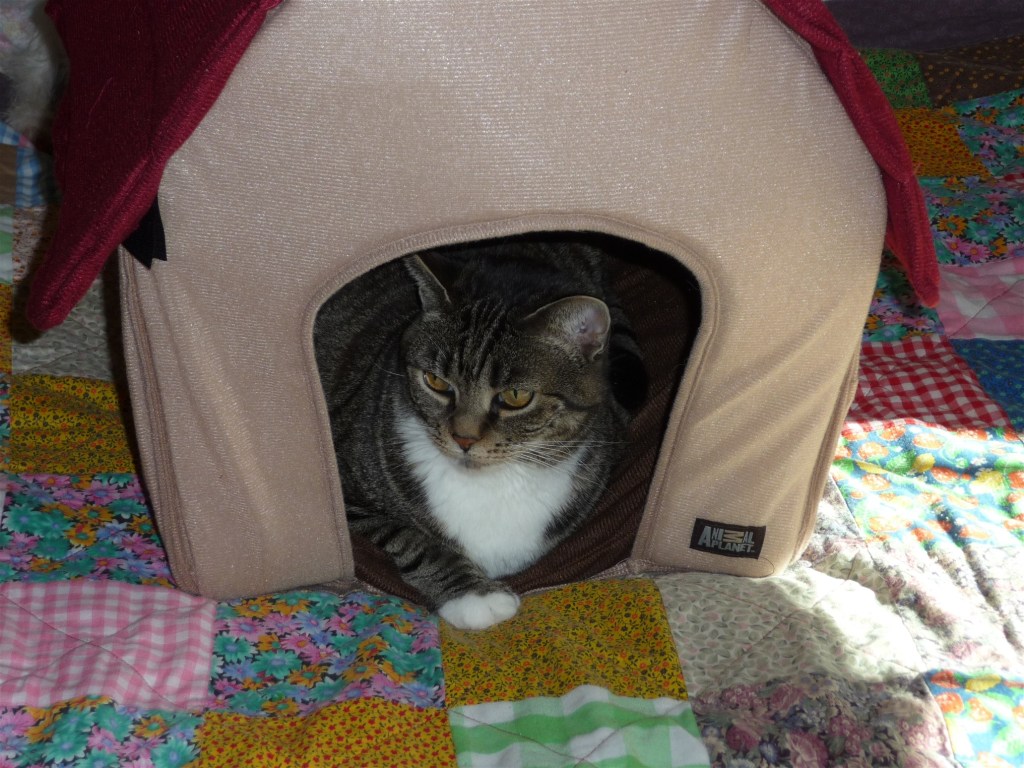
Cats enjoy boxes and other “secret” hiding places. But why? While no one knows for sure, some studies have shown when cats have boxes to hide in, they have lower stress levels, especially cats in rescues or shelters.

Cats generally enjoy going behind, into, under and on top of things. It provides a way to explore, satisfy their curiosity, provide exercise and practice hunting skills. Anyone who has watched cats play have seen them hide behind something and then pounce on anything, (dog, cat or you) that goes by. This can be great fun for the cat. It is especially funny to see kittens do this and after they pounce on their victim, bounce away on their toes, as kittens do. Cats enjoy paper bags, especially if you make scratching noises with your finger nails on the outside of the bag and slowly move your finger along the bag.

Cats may enjoy going in small places such as boxes, to keep warm or bury themselves in something soft such as blankets or clothes in an open hamper. Some cats learn to head for the clothes that have just come out of the dryer and if they can, settle down for a long, warm nap.

A careful cat owner will keep their cat’s safety in mind as they play. This is especially true around holidays, birthdays and other events where there can be empty boxes, wrapping paper, plastic wrap around the house. Children may not see a cat hiding and step on them, especially a young kitten.

Cats can also chew boxes, wrappings, paper, ribbons, strings and other tempting non-cat toys which can result in a trip to the veterinarian. While it is fun to watch a cat or kitten play with these things, they should never have access to anything that can harm them. Even if the owner is there to supervise the cat/kitten, things can happen so fast that you cannot prevent them.

So instead of spending a lot of money on cat toys, once in awhile give your cat a box to play in or a paper or reusable shopping bag to hide in. Your cats will love you for it.

http://phys.org/news/2015-02-cat-stress-access.html

Cats love secret hiding places

Cats enjoy boxes and other “secret” hiding places. But why? While no one knows for sure, some studies have shown when cats have boxes to hide in they have lower stress levels, especially cats in rescues or shelters.

Cats generally enjoy going behind, into, under and on top of things. It provides a way to explore, satisfy their curiosity, provide exercise and practice hunting skills. Anyone who has watched cats play have seen them hide behind something and then pounce on anything, (dog, cat or you) that goes by. This can be great fun for the cat. It is especially funny to see kittens do this and after they pounce on their victim, bounce away on their toes, as kittens do. Cats enjoy paper bags, especially if you make scratching noises with your finger nails on the outside of the bag and slowly move your finger along the bag.

Cats may enjoy going in small places such as boxes, to keep warm or bury themselves in something soft such as blankets or clothes in an open hamper. Some cats learn to head for the clothes that have just come out of the dryer and if they can, settle down for a long, warm nap.

A careful cat owner will keep their cat’s safety in mind as they play. This is especially true around holidays, birthdays and other events where there can be empty boxes, wrapping paper, plastic wrap around the house. Children may not see a cat hiding and step on them, especially a young kitten.

Cats can also chew boxes, wrappings, paper, ribbons, strings and other tempting non-cat toys which can result in a trip to the veterinarian. While it is fun to watch a cat or kitten play with these things, they should never have access to anything that can harm them. Even if the owner is there to supervise the cat/kitten, things can happen so fast that you cannot prevent them.

So instead of spending a lot of money on cat toys, once in awhile give your cat a box to play in or a paper or reusable shopping bag to hide in. Your cats will love you for it.

http://phys.org/news/2015-02-cat-stress-access.html