Cats often get a bad rap

Many people think that cats are asocial. Quite the opposite is true. Cats are very social animals but their way of showing it is quite different from dogs. Because people are used to dogs, they do not recognize the social behavior in cats. Also, many cat owners have just one cat, therefore they do not see cat to cat social interaction.

            From studying feral domestic cat populations, we have learned quite a bit about the cat’s social structure. Female cats, known as queens, will help each other raise their young. They even act as midwives to a queen giving birth. For example, they will help clean the newborn kitten and nurse them if they are lactating. They will groom and guard the kittens as well. Males, or tom’s will also help defend kittens in their colony.

            Cats will sleep together, touching, even if it is hot, which rules out some assumptions that they only sleep close to each other for warmth. Cats will form special friendships with each other, having preferences in the colony. Cats are very family oriented and are closer to relatives than a stranger. Although the colony will accept a strange cat after a period of time. This takes weeks to months, depending on the situation.

            When cats groom each other, it is almost always in areas that are hard to reach, such as the head, face and neck. It is considered bad cat manners to groom below the shoulders.

Another way cats communicate to each other is by rubbing. Anyone who has owned or seen cats would have seen head bumping, body and tail rubbing. Sometimes cats will wrap their tails together, which is a form of rubbing.

            Adult cats will also monitor the play between kittens. If the kittens get too rough, the adult will break it up. The kittens always listen and will stop their play.

            Cats do not hunt in groups. This is because each cat needs the equivalent of three mice a day to survive. Their hunting technique is to sit quietly, slowly stalk and then pounce. This does not lend itself to sharing the food. It is very rare for more than one cat to hunt together but it has happened, for example when trying to catch a squirrel. Cats will spray to mark their territory so that other cats, even those in the colony do not hunt in another cat’s area.   
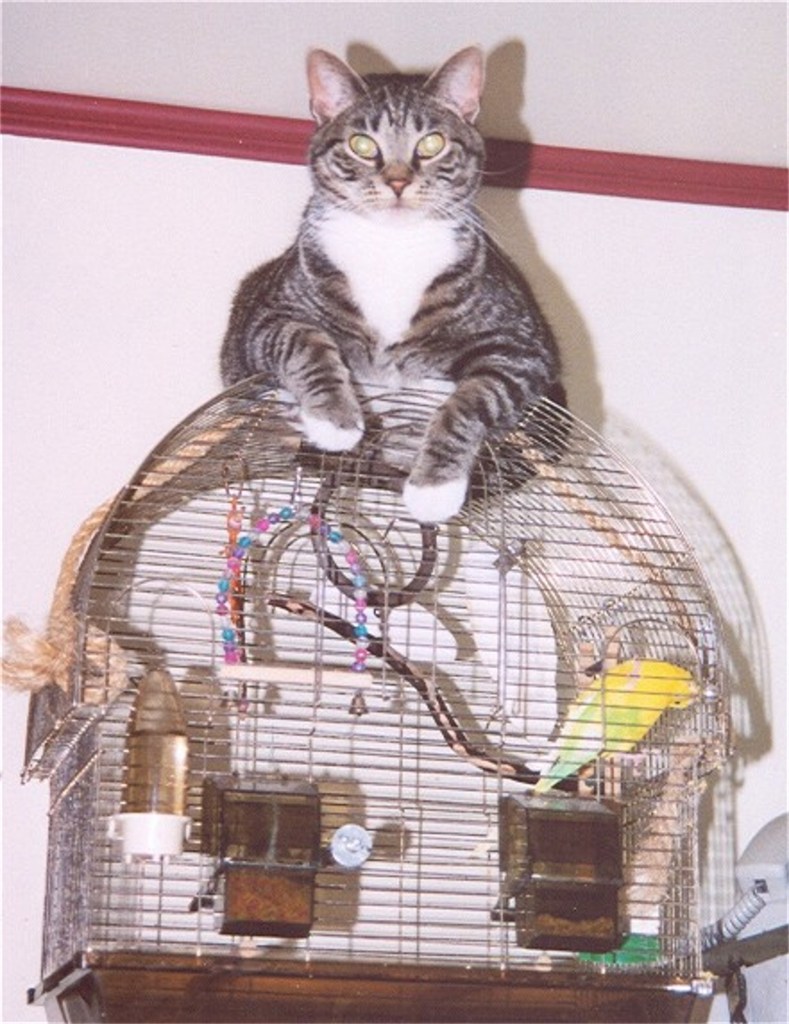
Pluskat and Sunshine (budgie) who are friends

            Kittens need to stay with their litter until they are at least 12 weeks old. They go through developmental stages similar to other animals. They learn how to behave and how to interact with other cats while they are young. If they are taken away from the litter too soon, they do not know how to act like a cat. If the cat owner decides later to get another cat, the resident cat will not know how to accept or interact with the new cat. This is one of the reasons why people have trouble introducing a new cat to the home. It is always better to have two kittens instead of one, and if possible, adopt litter mates. Family is very important to cats.

Mimi

            Like dogs, there are many breeds of cats and there are breed traits. Despite the breed of mix of a cat, each individual will have its own personality. Some cats act more like dogs and some are very aloof. Some cats are bold and some are timid. All cats are different due to breeding, family involvement, early training and experiences. It is important to keep this in mind and not label all cats as having the same personality and temperament. By understanding your cat’s natural social behavior, you can make the quality of life for your cat much better.  

Separation anxiety in first year college students

Researchers at Washington State University conducted a study of first year (freshmen) college students who owned pets and their level of separation anxiety. What they found is not surprising to those of us who are pet owners and lovers.

The students were tested before leaving for college and during their first two weeks on campus. Prior mental issues were accounted for so that they did not influence the results of the study. What the researchers found was that students who treated their pets more like people suffered more. It also seems that dog owners suffered the most rather than cat owners and people with other types of pets.

My soul mate, Scout

The importance of this study shows that programs that allow pets to visit campus to help students that are stressed, are beneficial. What this study made me think of are all of the elderly people who are forced to give up their pets, who were their companions for many years, because they had to move to a care facility. Young people are active and seem to be able to adjust more readily than the elderly. This also brings to mind how important it is to bring certified therapy pets to nursing homes and assisted living facilities. No matter how young or old a person is, losing a pet for any reason is often very traumatic. Your heart can ache for the loss for many years.

Cats prefer free food rather than work for it

According to a study by researchers at the University of California, Davis, School of Veterinary Medicine, even active cats would rather have “free” food rather than work for their meal.

The researchers offered a sample of cats, the option of getting their food from a food puzzle or having access to their food on a tray. All of the cats preferred the easily available food on a tray.

This was true for active cats and cats used to using a food puzzle. The researchers added that the food puzzles used in the study may not have stimulated their natural desire to hunt and ambush their prey.

The researchers added that this does not mean that cat owners should stop using a food puzzle.

The Animals In Our Lives

I had the honor of contributing to this book. Please spread the word.

Stories of Companionship and Awe

by Catherine Lawton (with Cladach Authors and Friends)

The wonderfully varied stories recount experiences with dogs and cats, sheep and horses, backyard birds and woodland deer, and other surprising creatures. The encounters and adventures of people and animals include childhood memories, individual and family experiences, and wilderness adventures. They all celebrate the companionship we have with animals both domestic and wild, in good times and bad, in times of celebration and times of challenge.

As fellow creatures, we give animals attention and care, and they give us so much in return. If we listen and observe, they teach us about God and about ourselves. This inspirational volume will evoke laughter, tears, and the experience of awe.

Animals entertain us, help us, teach us, play with us, mourn with us, even work with us. They help us experience God’s presence in our lives.

Publication date: August 20, 2021

ISBN: 9781945099274, 5.5″ x 8.5″, 15 Black/White Photos

$17.99 Pre-order Now: https://cladach.com/the-animals-in-our-lives/

How high sugar affects memory in animals and people

Although this article is not specifically about animals, I thought it was important enough to include on my blog site.

A research team from the University of Georgia has conducted a study about how sugar affects the brain. I have quoted part of the article below. Based on this research I would caution pet owners, especially those people who have puppies that are slated to be working dogs, to watch the dog’s sugar intake. We do not know how this finding affects other animals. People who have younger children should be especially careful since they tend to share their treats with their pets which could significantly raise the pet’s sugar level.

“New research led by a University of Georgia faculty member in collaboration with a University of Southern California research group has shown in a rodent model that daily consumption of sugar-sweetened beverages during adolescence impairs performance on a learning and memory task during adulthood. The group further showed that changes in the bacteria in the gut may be the key to the sugar-induced memory impairment.”

GPS Tracker for dogs

I was given an article to use for my blog site by Your Dog Advisor and it think it is a great article. Unfortunately, it is too long for my blog. I urge you to go to their link and read the whole article. It is very informative.

Global Positioning System or GPS made for dogs is a way to track your dog’s activity, and/or location. There are many kinds of GPS devices and this article explains, with excellent photos, the types available. Many people in K9 SAR use them to show where their dog has searched in an area.

The canine GPS system is critical if your dog gets lost. The GPS can locate your dog for you. Many times, a dog that is lost will wander or will hide if they are frightened. A small dog can be hidden under debris or brush within a few feet of where you are looking. If they are frightened, they may not come out even for their owner.

In all environments, rural, suburban and urban, it is almost impossible to search every place where a dog could go. It is time consuming and manpower intensive. The GPS tracker will allow you to find your dog quickly.

Here is a list of topics that the article covers. I strongly urge you to click on the link and read their article.

What is a Dog GPS Tracker?

How Does a Dog GPS Tracker Work?

Are There Different Types of Dog GPS Trackers Available?

Which Types of Dogs Should Have a Dog GPS Tracker?

Top 6 Dog GPS Tracker Products We Love

Whistle Go & Go Explore Dog GPS and Health Tracker

Tractive LTE GTPS Dog Tracker

PetFon Pet GPS Tracker

Link AKC Smart Dog Collar

4 Pack Smart Pet Finder GPS Tag

Black and Decker 2-Way Audio GPS Dog Tracker

Does a Dog GPS Tracker Take Place of a Microchip?

Other Tips for Keeping Your Dog Safe

Sue’s Note: A GPS tracker may also work for a cat if it is small enough.

Cats will play in the snow

          December in many parts of the world often means snow. Almost everyone who is an animal lover knows that most dogs love to play in the snow, but do you know that cats can enjoy the snow too? Many people believe that cats do not like any form of liquid, whether it be a bath, the rain, a swimming pool or even riding in a boat, but there are cats who do find these things fun to do.

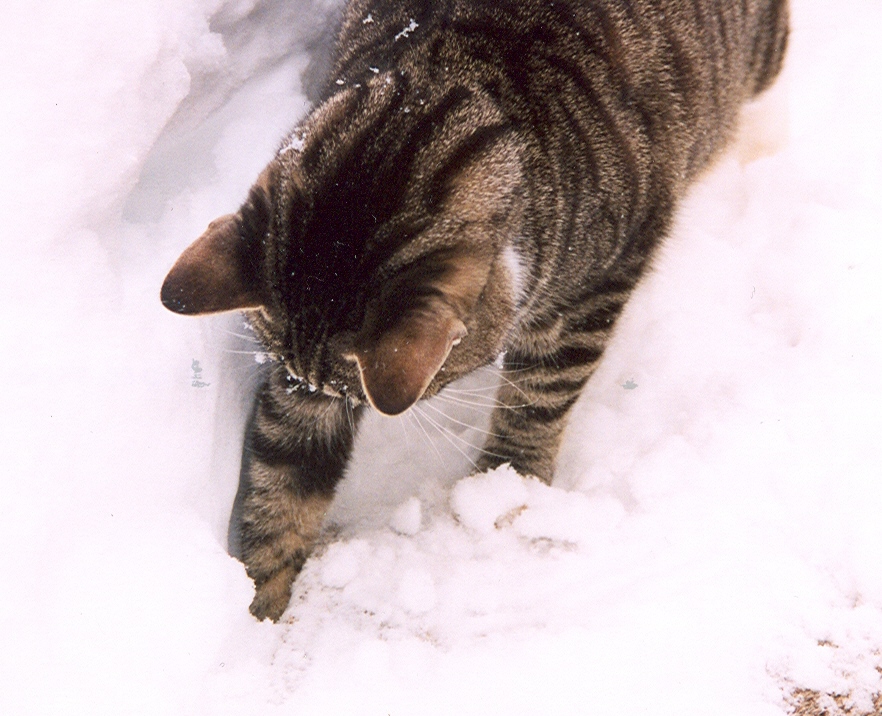
          My cat is one of them. It all started when I was shoveling the deck and she saw a chipmunk run from under the bird feeder and dive into the snow. In a moment of excitement, she leaped off the deck and dove into the snow chasing the chipmunk. I stopped my shoveling to see what would happen. It wasn’t long before her head popped up through the snow, the flakes covered her ears, face and nose. She shook herself and started to come back to the deck. But as she walked, tiny snow balls started to cascade down the sides of her path through the snow. She stopped suddenly and pounced on them with both front feet, like cats do.

Playing in the snow chasing little snowballs

          I could see by her body language that she had discovered a new game and was enjoying it very much. She was oblivious to the fact that some of the snow was melting on her body, making her wet.

          As the winter progressed and we got more snow, she decided that she liked to follow me as I did my outdoor chores and pounce on the little balls of snow that slid into my footprints. She also joined the dogs for their romps through the snow. It is quite a sight to see her walk in the paths that they make, ever alert for sliding snow with her tail above the snow, standing straight up with a slight hook at the tip.

          The lesson I learned from this is that a pet of any kind may enjoy playing in circumstances that you would not expect them to like. In the case of my cat or a small dog, I am careful to keep a close eye on them because they could become disoriented in deep snow, become exhausted and not be able to get back to the house. In very windy conditions they may not hear you call, so it is also important to be able to walk to your pet while they play outside in the winter. I have taught my dogs to come to a sheepherding whistle which carries up to a mile.

          It is also important to be sure that your pet does not become too cold.  Dogs will play outside even though they are cold and wet, to the point of shivering, and not want to come indoors. Cats, however, seem to be more willing to come indoors when they get too cold.

          All pets that go for a walk on paved surfaces may have problems with salt, so it is a good idea to wash their feet when they come indoors. A dog can become cold and wet even if you put a dog coat on them.

          The bottom line is, let your pet have the opportunity to experience safe play, even if it is not the type of play that you think they would like. You never know.                 

Breeding dogs part three: types of breeders

The following is the third part in a series of eight articles about breeding dogs. Although it applies to a dog, it also applies to cats. People do not realize that there are cat mills which are similar to puppy mills. Note that these articles are based on my years of experience, my opinion and that I do not intend to refer to any individual. Please read the entire eight articles to glean a full understanding of breeding.

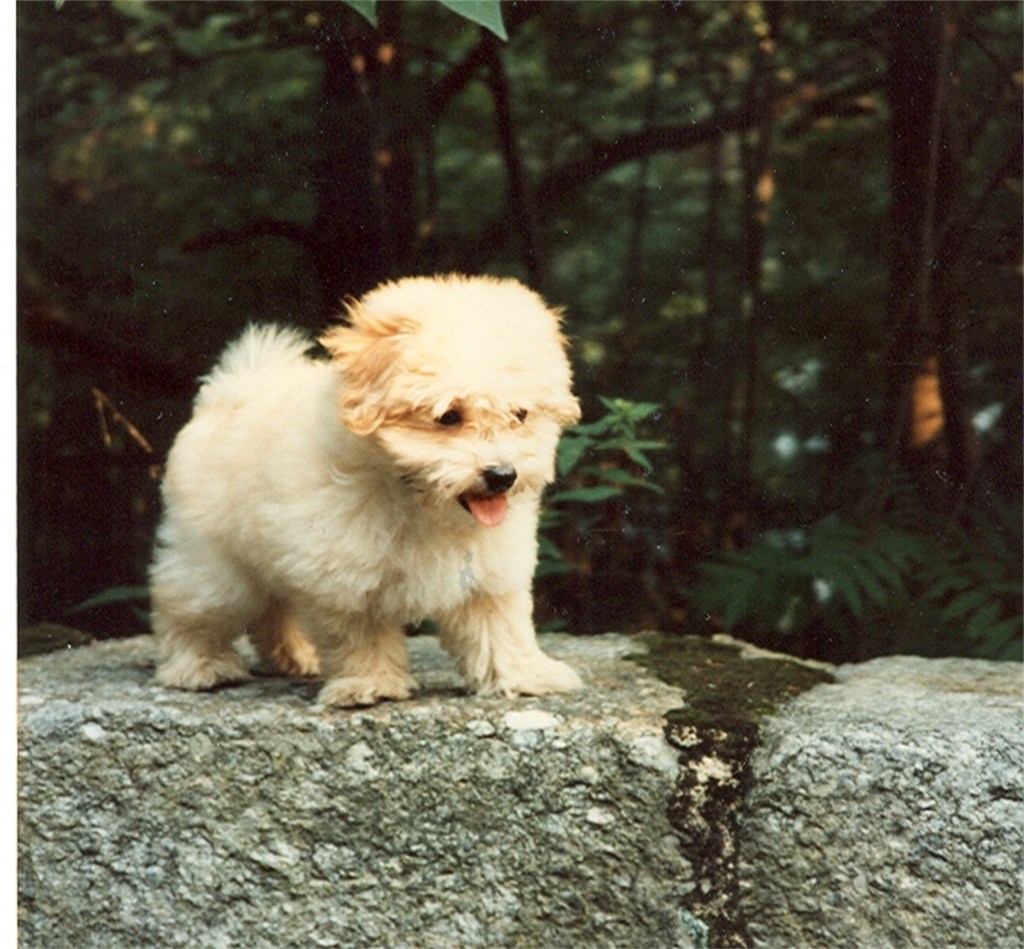
A top quality Havanese puppy

Part Three

There are six types of breeders.

  1. There is the ethical breeder who studies lines and has a goal that they hope to accomplish with a breeding. This goal can be for a litter who has a solid temperament. It could be for conformation showing, for a good working dog and a combination of qualities. It is important to understand that temperament and intelligence are the two qualities that make a dog a good pet or working dog. A dog who meets the conformation standard without a good temperament or intelligence is not a desirable pet or working dog.  

Ethical breeders are typically involved with a breed club or organization that monitors the ethics of the breeder. The ethical breeder does not produce multiple litters at one time and often only has one or two litters a year. They do not breed their dogs before they are tested for inherited issues or are under two years old. The ethical breeder will only breed those dogs who are worthy of breeding having been cleared of inherited issues and has been proven as a good show or working dog. Only exceptional dogs are bred. Ethical breeders work with the puppies from birth to placement so that they are socialized.

Ethical breeders often have waiting lists for puppies because their lines have been proven. They also only line breed or outcross. They rarely if ever inbreed.

The ethical breeder rarely makes a profit from their dogs due to the expenses of raising, testing and proving their dogs. Their litters are consistent in temperament, health and conformation. The ethical breeder will often guarantee the quality of their puppies.

Puppies from an ethical breeder are registered with a recognized registry. In the US this will be either the American Kennel Club or the United Kennel Club. In some cases, there are breed registries that are recognized as well. There are other registries that will register any type of animal and those that cater to the puppy mills. (See Registries Part 2)

  • The new breeder. Everyone has to start sometime. A small in-home breeder who is being mentored by an experienced breeder can be a quality, ethical breeder. Not every breeder has a large kennel. Most ethical breeders have a number of dogs that live in their house with them as pets. A home-raised puppy from an ethical breeder is the ideal place to get your puppy. The quality of the breeding is not measured by the number of dogs a breeder has, but by the care and goals of the breeder.
  • The commercial breeder mass produces puppies from a limited number of dogs. Their puppies are often registered with a national registry but the care and planning of the lines does not exist. Their goal is to make money so they often shortcut the testing and care of their dogs including the puppies. Their puppies are not from proven stock, are not consistent in temperament, health and conformation. These breeders will produce the breeds that are popular and likely to sell. They often produce a number of different breeds.
  • The puppy mill breeder. These people breed solely for profit. The dogs are often kept in cages and rarely given attention. They are not part of the family but viewed as livestock. They do no testing or planning and have no goals except to produce puppies and make money. Often these puppies are not pure and are not registered or if they are, they are registered with a non-recognized organization that supports puppy mills.

These puppies are often not consistent in temperament, conformation and are more prone to health issues.

  • The backyard breeder. This is the person who thinks they can make money from their pet. Due to a lack of understanding about breeding these puppies are one step away from the puppy mill breeder. The parents have no health testing, there is no consistency in the litter since they are randomly bred with no understanding of genetics. Because the backyard breeder does not understand all that is involved in producing and raising a quality dog, they do not take the precautions or socialize the puppies properly.
  • The last type of breeder is a rather recent phenomenon. This is the designer dog breeder. These people take two different breeds and try to create a dog of their own design. There is no consistency in the puppies that result because they do not have a solid goal. One of the excuses these people use is to create an allergy free dog. Because allergies are not a result of dog hair but of dander, this is not possible. All dogs have dander. Unfortunately, since there is no consistent conformation with designer dogs, there is no way other than a DNA test, to prove that the dogs are the mix that the breeder claims. I have had clients come to me with a dog that was supposed to be a Labradoodle and the dog grew up to be a terrier. Unfortunately, there is no way to guarantee the puppies and the buyer cannot know for certain that they are getting what they paid for. Also, it is unfortunate that these breeders charge as much or more for the mixed breed puppies as a buyer would pay for a well-bred puppy from an ethical breeder. These puppies are not registered or if they are, they are not registered with a recognized organization.

What is also important to consider is that a person who has a well-bred dog from an ethical breeder is not likely to cross this quality dog with another breed. Therefore, by default, many designer dogs are created from less desirable stock, often obtained from puppy mill breeders.

Breeding Dogs Part Two – Registries

The following is the second part in a series of eight articles about breeding dogs. Although it applies to a dog, it also applies to cats. People do not realize that there are cat mills which are similar to puppy mills. Note that these articles are based on my years of experience, my opinion and that I do not intend to refer to any individual. Please read the entire eight articles to glean a full understanding of breeding.

Part Two

Understanding registries is important because who a dog is registered with will give you a clue as to its legitimacy. There are a few types of registries.

  1. Nationally recognized registries. These are established organizations that register purebred dogs. In the United States it would be the American Kennel Club and the United Kennel Club. In some cases, there are breed registries that are legitimate. The way to determine if a registry is recognized is if other countries or registries accept a dog registered with the organization.
  • Non-recognized registries are those that anyone can establish. In the United States there are registries that cater to puppy mill breeders so that the AKC cannot shut down puppy mill operations.
  • Breed registries are those that are recognized but are designed to register certain types of working dogs. An example would be some of the working stock dog registries.
  • Anything goes registry are those that will register any type of animal for any reason.

Most people who own a pet dog feel that their dog is worth more if it is registered. They only understand that the dog has “papers.” They do not understand the value or uselessness of the papers. The non-recognized registries have used this lack of understanding to legitimize dogs by giving them “papers” that are not recognized by any national or international recognized registry.  

It is important to note that no registry can guarantee the quality of a dog or puppy. They can only guarantee that as reported to them the records have been accurately kept. If the breeder owns both the sire and dam, they can list any dog as the sire and dam of a litter. For example, I had a client who made an appointment for training and told me that he had a Rottweiler. When I questioned him, he assured me that he had AKC papers. When his breeder found out that he was coming to me for training, he admitted that the dog was a Rottweiler/German Shepherd cross, the result of an accidental breeding. Yet the dog had recognized registration papers because the breeder owned both the male and female. The real ethics depends on the honesty of the breeder.

Ethical breeders will only register their dogs with recognized registries.

Breeding dogs (and cats)

The following is the first part in a series of eight articles about breeding dogs. Although it applies to dogs, it also applies to cats. People do not realize that there are cat mills which are similar to puppy mills. Note that these articles are based on my years of experience, my opinion and that I do not intend to refer to any individual. Please read the entire eight articles to glean a full understanding of breeding.

Dempsey

Part One: The Bitch

First it must be said that only the best bitches and males should be bred. The only reason to breed is to better the breed.

Often in my career I have had clients tell me that they wanted to breed their pet dog. In most cases, they have no idea what is involved. It is much more than simply introducing a male and female.

Here are some of the reasons why they feel they want to breed their dog.

  1. To make a lot of money. Often people will pay a substantial amount of money for a puppy. They feel that if they breed their bitch, they will earn eight to ten times that money.
  • It will be good for the children to watch. Whelping puppies is pretty gory and most children cannot handle what is involved. In some cases, it can traumatize a child and if the child is a girl, make her afraid to have children of her own.

If you still want a child to see this, it is better to find a breeder who will let your child get up in the middle of the night to watch the birthing of a litter.

  • We love our dog so much we want another like him/her.  The chances of reproducing your dog are slim to nothing. Genetics is not an exact science and if breeders could control how a dog turns out there would be many more champions and exceptional dogs.
  • Everyone who meets my dog wants a puppy like him/her.  As soon as the litter is born most people find that all of those friends who said they wanted a puppy have excuses as to why they cannot get one now. Breeders who have dogs that are breeding quality have waiting lists for a reason. A home bred or backyard bred dog has no special qualities to warrant the cost.
  • We really love puppies. Raising a litter of puppies is a lot of work and if done right, is very costly.