In a revealing study conducted by the University of New South Wales, Dr. Kylie Cairns a biologist found that contrary to popular belief, there are few wild dogs and Dingo hybrids in Australia. The study showed that 99% of the 5000+ animals tested, were pure Dingoes or if they were hybrids, were mostly Dingo and not dog. Only 1% were wild dogs or dog dominant hybrids.
Some groups refer to Dingoes as wild dogs and try to kill them. The researchers feel that if Dingoes are called Dingoes, the groups that are in favor of destroying them will change their attitude. Because Dingoes come in a range of colors, it can be difficult for people to identify a Dingo and mistake it for a wild dog.
Dingo
Research has found that by killing Dingoes, the local ecosystem is harmed. The Dingoes keep the herbivores and smaller predators under control and thus keep the environment balanced. When the Dingoes are removed, the Kangaroo population grows which leads to overgrazing and causes damage to the soil.
Only the Victoria National Park in Australia protects Dingoes. Elsewhere they are hunted by dropping aerial bait to kill them. Farmers do complain that their livestock is harmed by Dingoes so a means of protecting farm animals is necessary.
I was given an article to use for my blog site by Your Dog Advisor and it think it is a great article. Unfortunately, it is too long for my blog. I urge you to go to their link and read the whole article. It is very informative.
Global Positioning System or GPS made for dogs is a way to track your dog’s activity, and/or location. There are many kinds of GPS devices and this article explains, with excellent photos, the types available. Many people in K9 SAR use them to show where their dog has searched in an area.
The canine GPS system is critical if your dog gets lost. The GPS can locate your dog for you. Many times, a dog that is lost will wander or will hide if they are frightened. A small dog can be hidden under debris or brush within a few feet of where you are looking. If they are frightened, they may not come out even for their owner.
In all environments, rural, suburban and urban, it is almost impossible to search every place where a dog could go. It is time consuming and manpower intensive. The GPS tracker will allow you to find your dog quickly.
Here is a list of topics that the article covers. I strongly urge you to click on the link and read their article.
What is a Dog GPS Tracker?
How Does a Dog GPS Tracker Work?
Are There Different Types of Dog GPS Trackers Available?
Which Types of Dogs Should Have a Dog GPS Tracker?
Top 6 Dog GPS Tracker Products We Love
Whistle Go & Go Explore Dog GPS and Health Tracker
Tractive LTE GTPS Dog Tracker
PetFon Pet GPS Tracker
Link AKC Smart Dog Collar
4 Pack Smart Pet Finder GPS Tag
Black and Decker 2-Way Audio GPS Dog Tracker
Does a Dog GPS Tracker Take Place of a Microchip?
Other Tips for Keeping Your Dog Safe
Sue’s Note: A GPS tracker may also work for a cat if it is small enough.
Losing a dog can be devastating. A person’s first reaction is usually fear, confusion and panic. However, with a good plan in place, looking for a lost dog can be less stressful and more successful. There are a few simple points to consider when looking for a lost dog. However, prevention is the key ingredient. The most important thing you can do is have your dog microchipped and have a collar on your dog with his name tag that includes a way to contact you. If someone in your area finds your dog, they will not have a microchip reader and will rely on a name tag.
1) If you organize a group of people to look for the dog, use all safety precautions so that the volunteers do not become lost as well. Stay in touch using cell phones or handheld radios. The radios can be purchased for a nominal fee at any store that sells outdoor equipment. Radios will work in areas that cell phones may not, however, they have a limited range so be sure that a chain of people can relay messages over distance. Also, establish radio protocol so that one person does not tie up the frequency preventing communication with others. Communication is essential to let the other volunteers know what is going on, if the search is being suspended, or the dog has been found. Because people feel safer and calmer if they know what is going on, this will allow the volunteers to do a better job.
Be sure that volunteers wear the appropriate clothing, (long pants and long sleeves), hats, and substantial footwear. Each volunteer must carry a snack, water, leash, bath towel, bowl, enough water for themselves and the dog, canned cat food or treats and a flashlight. Flashlights are necessary during the day to check dark places.
The canned cat food should have the strongest aroma, (or a similar treat) to lure the dog. Small cans of cat food work well because they can be carried easily and kept fresh.
A bath towel can be used to carry the dog if he is injured, exhausted or to wipe the dog if he is wet or dirty. If the dog is cold, he can be wrapped in the towel.
Volunteers must always work in pairs for their own safety, and in the event two people are needed when the dog is found. A meeting area and time should be established in case communications break down. No one should leave until all are accounted for.
2) A dog that ran away because he is frightened will bolt in any direction, but usually to the least noisy, darkest area. Given the choice of an open field or woods, the dog will go for the woods. If the dog is lost in the city or suburbs, the dog will look for a dark, quite spot to hide after it has run to exhaustion.
Therefore, try to estimate how far the dog will run (this varies with the dog’s size and condition) and add a mile to that. On a map of the area mark where you last saw the dog as the center of a circle and draw a perimeter around that point, based on the furthest point where the dog could be. The circle will encompass the area to start looking for the dog. If you saw the dog run, you can focus in that direction. Be sure to check small dark areas: under porches, stairs, garages, sheds, etc. If you have several people helping to look, have some start at the perimeter of the circle and some from the center. Be sure to look for the dog, never assume that the dog will come when called.
3) If a dog runs away, they usually run into the wind. That means that the wind will be blowing toward the dog, into the dog’s face. Check with a local airport to see what the wind direction was when the dog ran away. Then start looking into the wind from the point where the dog was last seen.
Dogs who wander away will usually meander along unless they find something to chase or something that interests them. This means that the search area will be smaller. If searching in the woods or a park, look for a game trail and look for fresh dog tracks to see if the dog went that way. If you do find tracks, you will not be able to tell for certain if they are from your dog, so do not give up searching in the rest of the area. If you are searching in an urban or suburban area, listen carefully if neighborhood dogs are barking. Often, they will bark at a stray dog. If you hear a lot of barking in one direction, check that area first.
4) When searching for a dog, travel slowly and make frequent five to ten-minute-long stops. Many people will drive around in a vehicle, calling to the dog. Unless the dog is within a few seconds of your location, he will not be able to find you if you move too quickly. Keep in mind that a dog can hear you calling from quite a distance away. They need time to determine the direction of the sound and then get to it. Wind and other environmental elements can distort the direction of sound (tall buildings, large hills, etc.) making it difficult for the dog to find the source of the sound. By stopping and continuing to call for about five to ten minutes, the dog will have time to find you.
5) When you sight the dog, do not act excited and/or run toward the dog. Sit down or stand still and let the dog approach you, even if it is your dog. Sometimes a dog can become so frightened, hurt, or weary that they may not think straight. Their survival instincts may take over, making them more cautious than they would be at home. Depending upon the direction of the wind, you could be downwind, and the dog may not recognize you right away.
Give the dog time to feel safe. Running to the dog may make him run away from you and lose what little trust in humans that he has left. If you feel it will work, you can, at a distance, slowly move so that you are upwind of the dog, and then open the can of cat food, but still let the dog come to you. When the dog comes to you do not try to grab the dog. Let the dog stay there and relax. Slowly pet the dog until you can attach a leash without frightening the dog. If the dog does not want to be caught, you will most likely not be able to grab the dog fast enough to catch him, even if he is next to you.
6) If the dog does not approach you, do not give up. Stay in that area and/or return to that area. You can leave food etc. but do not try to catch the dog.
7) If you leave food for the dog, do not assume that because the food was eaten that it was eaten by the dog. Other animals may eat the food, so continue to search the area. If you can, spread sand around any food that you leave so that you can check for footprints to determine if a dog ate the food. If sand is not available, loose soil will work as well.
8) If you have to search for the dog over a period of time, keep a log of the weather and the location of water sources. The dog will generally head into the wind and seek water.
9) Never forget to advertise. Use every means possible to let the people in the area know that there is a lost dog. Contact all veterinarian clinics, shelters, pet supply stores, and rescue groups. Also post signs in stores with bulletin boards, on telephone poles, especially where children congregate, by public transportation and any other place that you can think of. Be sure to post on social media. If your dog is not found right away, about every two weeks call everyone you notified, such as the local rescue groups, to let them know that the dog is still missing. This will keep your dog fresh in the minds of the employees.
Always have an up-to-date photo of your dog. If the dog is a breed that looks like others in the breed, a similar picture will do. Remember, the average pet lover will not notice the fine differences between your dog and others of the same breed. So do not panic if you do not have a recent photo. Be sure to expand the area that you advertise to at least five miles from the point where you last saw your dog.
Keep all your bulletins up to date. If the lost signs that you post look old or weathered people will think the dog was found. When you find your dog, it is important to call all the organizations that you originally notified to let them know that the dog was found. Also remove all your postings.
10) Lastly, never give up. Dogs have been found months after they disappear.
When people think of animals being struck by aircraft, birds come to mind. However, researchers have studied how many mammals were hit by aircraft. They found that worldwide, mammals hit by aircraft have increased by 68% world-wide. The range in size was from voles to the giraffe and everything in-between.
In the United States alone, damage to aircraft over a thirty-year period was 103 million dollars. Most of the animal strikes occurred during the landing phase of flight. Typically, the take-off and landing of an aircraft are the riskiest times. The study did not suggest how to alleviate the risk of hitting mammals.
Occasionally I will post some dog training tips to help people successfully train their dogs. I started professionally training dogs in the 1960’s and have learned a lot over the years. I hope these tips will help you. Please feel free to contact me if you have questions or suggestions.
Dogs do not speak English, therefore you must SHOW your dog what you want. Your actions speak louder than your words. All of your body language speaks to your dog. Therefore, your ATTITUDE, FACIAL EXPRESSION, TONE OF VOICE AND MOVEMENT communicate to your dog.
You cannot try and tell your dog that he is not doing the right thing while you are hiding a laugh because you really think your dog’s behavior is cute or funny. Your dog will laugh right along with you. And yes, dogs do laugh.
You cannot ask your dog to obey you if you hesitate in your movements. Your dog will not believe that you are the leader. On the other hand, you cannot bully your dog or physically punish him and expect your dog to respect and trust you. A good working relationship with your dog is built on trust and leadership. This is communicated to your dog by giving commands in a tone of voice that says, “I expect you to do this, no discussion.” Then move in a steady, yet gentle way to convey leadership. Too many people ask their dog to obey, their tone of voice is “sit, will you please sit? Do you feel like sitting?”
Never re-command your dog. If your dog knows what the word means, re-commanding him only teaches your dog that a) he does not have to listen to you; b) he can do it when he wants and c) you are not the leader. For every command there should be an action.
Either you coax the dog into doing what you want or reward him when he does it on his own. If your dog does not know the “sit” command, and you tell your dog, “Sit . . . Sit . . . SIT!”, then make the dog sit on the third sit, your dog will learn not to sit until the third command. He will think that the command is “sit-sit-sit.”
Most people repeat commands to their dog’s because they are being polite (according to human standards) and assume that the dog did not hear the first or second time. I can assure you that if your dog does not respond the first time, and does not acknowledge you, he DOES HEAR you. He is just IGNORING you. Therefore, politeness to a dog translates into “My owner is wimpy, wimpy, wimpy! Why should I listen?”
So, speak clearly and in a direct manner to your dog. For every command expect or initiate an action. Do not repeat commands. Do not hesitate when you move. Show your dog that you are a leader, not a follower.
The two most important things to remember (which is true for people too) are: 1. obedience is not a question of knowing what to do or what not to do, but the ability to exercise self control to do it or not do it. You have to give your dog time and practice to develop self-control. Punishment or harsh training methods should never be used.
2. Your dog knows how to do everything you want him to do. He only has to learn to associate the word or command with the action. For example, before you even obtained your puppy, he knew how to sit, come, and lay down.
By using computers, scientists have discovered the brain activity that precedes vocalization in Seba’s short-tailed bats. This species is important to study since they use a vocal range produced through their larynx to communicate with other bats. What is of interest to scientists is that besides this species of bat, only songbirds and humans use this method.
Since bats use sonar navigation to maneuver and to find food as well as vocalizations to communicate with other bats, their brain activity is an important clue to help understand human vocalizations.
Julio C. Hechavarria at the Institute for Cell Biology and Neuroscience at Goethe University, investigated brain activity preceding vocalization in Seba’s short-tailed bats and were able to identify a group of nerve cells that create a circuitry from the frontal lobe to the corpus striatum in the interior of the brain. When this neural circuit fires off rhythmic signals, the bat emits a vocalization about half a second later. The researchers were able to predict, based on the rhythmic signals, if the bats were about to utter echolocation or communication vocalizations.
According to Dr. Hechavarria, “. . . we know that the corresponding brain networks are impaired in individuals who, for example, stutter as a result of Parkinson’s disease or emit involuntary noises due to Tourette syndrome. We therefore hope that by continuing to study vocal behavior in bats, we can contribute to a better understanding of these human diseases.”
In a study by the Translational Genomics Research Institute (TGen), an affiliate of the City of Hope, and The Ohio State University and published in the journal Clinical Cancer Research, researchers found that dogs and humans have the same gene, HER2, that women get with a certain type of breast cancer.
The good news is that the researchers found that the drug neratinib used for human breast cancer may also help the almost 40,000 dogs in the U.S. that annually develop the most common type of canine lung cancer, known as canine pulmonary adenocarcinoma, or CPAC.
Dr. Hendricks stated, “For humans, we already have drugs that can inhibit many dysregulated proteins. We hope to show that we can provide the same benefit for dogs with canine cancers.”
This is another example where human and canine medicine and studies can help both humans and their pets live a healthier life. Perhaps this will lead to more treatments for other pets such as cats.
I recently read a very interesting story in All Creatures: The Animals Who Share Our Lives, (July/Aug 2019) about an encounter with a humpback whale. What intrigued me was the intelligence and compassion that the whale showed to a research diver.
image from pixabay
Nan Hauser a whale biologist who is the president of the Center for Cetacean Research and Conservation, was snorkeling by the Cook Islands in the Pacific Ocean when this incident took place in 2017.
A humpback whale swam right toward her and started to push her in such a way that she wound up on the whale’s head. Then the whale tried to put her under his pectoral fin. When the whale realized that she could not breathe under his fin, he lifted her up out of the water. While out of the water Ms. Hauser saw a female humpback whale aggressively slapping the water with her fin, which whales do to frighten away a predator.
Ms. Hauser then noticed another very large shape in the water. It turned out that it was a 15-foot tiger shark coming directly for her. The whales saved her life that day. But the story doesn’t end there. A little over a year later Ms. Hauser was out with another research team in a boat. The same male humpback whale swam next to the boat, put his head out of the water and looked at Ms. Hauser. He did not pay attention to anyone else.
This is not an isolated incident since it is not unusual for whales to protect members of other species. What does this tell us about whales? It shows many aspects of an animal’s mind and feelings. If you think of all the implications that acts of kindness such as these imply, it is truly amazing. The whale had to recognize that there was danger to another species. Then it had to gently protect the species at risk. In the case of Ms. Hauser, the whale had to have an understanding that humans cannot breathe underwater even though they may have seen them in scuba gear, breathing underwater. It shows a form of caring, compassion, and the fact that the whale remembered her a year later, shows that the whale specifically remembered Ms. Hauser. There is so much we do not know about animals and so much to learn.
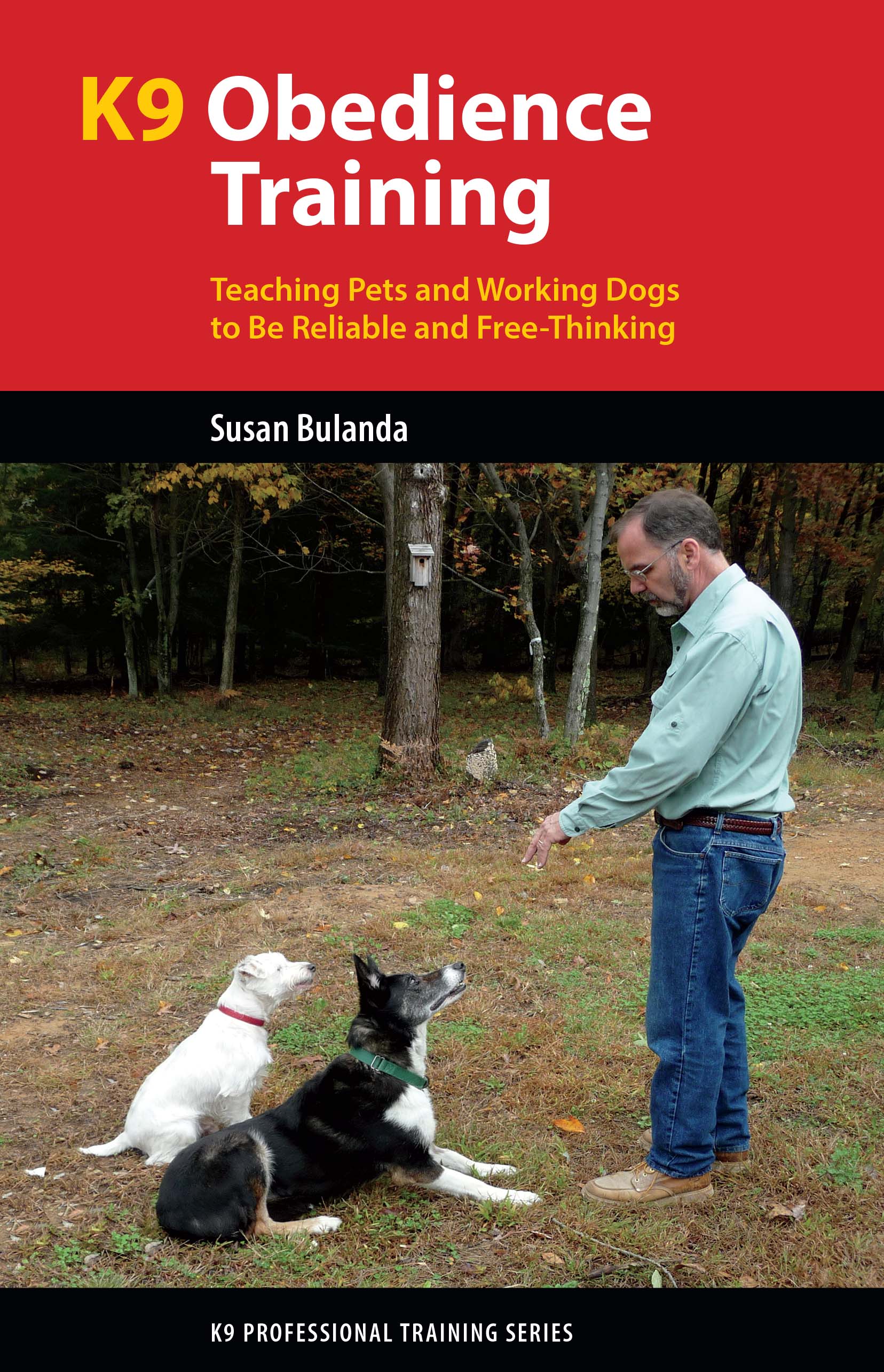
Obedience is the foundation for any reliable, well-trained dog. Without obedience, working dogs are ineffective in operations and pet dogs can be annoying and possibly a danger to themselves or others.
In K9 Obedience Training, veteran search and rescue (SAR) dog handler and trainer Susan Bulanda, M.A., C.A.B.C. (certified animal behavior consultant) shares the secrets of building an effective obedience training program. SAR dogs need “thinking” obedience: they sometimes need to exercise intelligent disobedience in the field. You can use the same training program for any working or pet dog. For trainers who demand the best obedience training for future working dogs, Susan’s techniques lay the groundwork for success.
And pet owners who want to help their dog be easy to be around will find lots of training tips and exercises too, along with straightforward advice on proper handling, grooming and teaching simple tricks.
My new book will be out by the end of June, 2019. You can order it from my web site, www.sbulanda.com You will receive an autographed copy. Please note that the shipping cost is for the US only. If you live outside the US please email me at sbulanda@gmail.com for postal rates. Unfortunately it often cost more to ship the book than the book cost. You can also order it on line as an ebook through Amazon or from the publisher at www.dogtrainingpress.com





 A Blog by Susan Bulanda