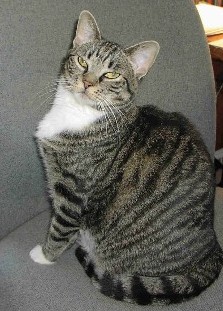
Cats love secret hiding places

Cats enjoy boxes and other “secret” hiding places. But why? While no one knows for sure, some studies have shown when cats have boxes to hide in they have lower stress levels, especially cats in rescues or shelters.

Cats generally enjoy going behind, into, under and on top of things. It provides a way to explore, satisfy their curiosity, provide exercise and practice hunting skills. Anyone who has watched cats play have seen them hide behind something and then pounce on anything, (dog, cat or you) that goes by. This can be great fun for the cat. It is especially funny to see kittens do this and after they pounce on their victim, bounce away on their toes, as kittens do. Cats enjoy paper bags, especially if you make scratching noises with your finger nails on the outside of the bag and slowly move your finger along the bag.

Cats may enjoy going in small places such as boxes, to keep warm or bury themselves in something soft such as blankets or clothes in an open hamper. Some cats learn to head for the clothes that have just come out of the dryer and if they can, settle down for a long, warm nap.

A careful cat owner will keep their cat’s safety in mind as they play. This is especially true around holidays, birthdays and other events where there can be empty boxes, wrapping paper, plastic wrap around the house. Children may not see a cat hiding and step on them, especially a young kitten.

Cats can also chew boxes, wrappings, paper, ribbons, strings and other tempting non-cat toys which can result in a trip to the veterinarian. While it is fun to watch a cat or kitten play with these things, they should never have access to anything that can harm them. Even if the owner is there to supervise the cat/kitten, things can happen so fast that you cannot prevent them.

So instead of spending a lot of money on cat toys, once in awhile give your cat a box to play in or a paper or reusable shopping bag to hide in. Your cats will love you for it.

http://phys.org/news/2015-02-cat-stress-access.html

How cats show affection


People who do not own cats have a hard time understanding the deep affection that cats have for humans and that humans have for cats. In many ways, cats are not much different then dogs. Granted, you cannot do the same things with cats that you can do with dogs, but the relationship is a deep, quiet one. There is something special about the love that cats have for people, it is hard to put into words. The best way to describe it is to imagine sitting quietly with your closest friend, no words needed, but knowing that you are there for each other no matter what. Imagine the feeling of security, peace, and understanding that you and your friend share. This is what cat love is like.

 Some cats are very demonstrative and easily show their affection while other cats are more like the best friend experience described above. This does not mean that they are not bonded or don’t love their owners, they simply show it differently. Just like dogs and people, cats have different personalities. Some are cuddly and others like to share from a distance.

 Many people recognize canine displays of affection, but do not recognize feline displays of affection. While each cat has their own special way of demonstrating their love for their owner, some types of body language and behavior are common with all cats.

 Here is a list of the most common ways cats show affection:

 1. The most recognized sign of affection is when a cat purrs, however, not all purring is a sign of affection. For example a cat who is in pain or stressed will often purr. It is thought to be a way to relieve stress. However almost without a doubt if a cat is near a human and purrs along with a contented face, it is a sign of affection.  Cat purrs can range from soft and subtle to very loud. Kittens can purr from the time they are two days old. There have been a number of studies about how and why cats purr, it is considered the equivalent of a cat smile, a healing mechanism and a form of communication, but by and large, it is still a mystery.

 2. Tails are another indication of affection. Kittens will greet their mother with their tail straight up and the end tipped over just a little.  When the cat gets close to his favorite person, the tail will stay up with the end slightly tipped and the cat will raise their butt, sort of like walking on their hind toes. This is an invitation to scratch them above the tail. Happy cats usually have their tails raised and the tip of the tail in a slight hook.

 3. Cats can show affection by the location they choose to sleep.  This is because a cat sleeps up to 16 hours a day and they are the most vulnerable while sleeping. Therefore if a cat sleeps near, on or next to his person, it is a way the cat tells you that he trusts and feels safe near you. When an owner is not at home, the cat may choose to sleep on their person’s bed, chair or pillow.


4. Much to the dismay of some cat owners, cat gifting is another sign of affection.  I does not matter if the gift is a dead critter, a bug, or a toy, cats only give gifts to the people they love.

 5. Rolling is another sign of affection. If your cat throws himself down in front of you or near you, it is a sign that they love you and often that they want to play. Cats will only do this to engage you to play with them. It does not mean that they want their belly rubbed or scratched. Some cats do not mind belly rubs but most do not care for it.

 6. Scratching is another signal that a cat feels that you are theirs. When cats do this, they leave their scent from scent glands that are located between their pads and toes. They will do this to say that the object of their scratching is theirs. Much the same as family members feel that their family is theirs.

 7. Bumping or bunting is a term that is used when a cat will cheek rub, head butt or wrap themselves or their tail around you. This is a very high complement from a cat.  A cat will do this to other cats, dogs and their favorite human.

 8. Kneading is another sign that the cat is very happy and contented. They often do this while purring.  The behavior goes back to kitten hood when the kitten would knead the mother’s breast to help milk production. Cats only do this with people they hold in high regard.

A very happy Mimi

 9. Playing is an engaging behavior that a cat will only do with someone they feel safe with and love. Often a cat will bring a toy to their person and drop it just out of reach. This way you have to go to them. Playing is also a form of gifting.

 10. Cat eyes are very large in proportion to their heads. This makes them easy to read, cats use their eyes as a form of communication. When a cat puts his face near yours, with wide soft eyes, it is a sign of love. If the cat is across the room and gives you a slow blink, it is sort of the cat’s way of throwing kisses to you.  Often if you blink slowly to your cat, the cat will blink back.

 11. Nose nibbles are one of the most flattering things your cat can do to show affection. Often a cat will do it while you are asleep. It is not a bite and does not hurt, but is a gentle nibble on the tip of your nose.

 The next time you interact with your cat, pay close attention to what your cat is telling you, it may be a pleasant surprise.


Cats often get a bad rap

Many people think that cats are asocial. Quite the opposite is true. Cats are very social animals but their way of showing it is quite different from dogs. Because people are used to dogs, they do not recognize the social behavior in cats. Also, many cat owners have just one cat, therefore they do not see cat to cat social interaction.

            From studying feral domestic cat populations, we have learned quite a bit about the cat’s social structure. Female cats, known as queens, will help each other raise their young. They even act as midwives to a queen giving birth. For example, they will help clean the newborn kitten and nurse them if they are lactating. They will groom and guard the kittens as well. Males, or tom’s will also help defend kittens in their colony.

            Cats will sleep together, touching, even if it is hot, which rules out some assumptions that they only sleep close to each other for warmth. Cats will form special friendships with each other, having preferences in the colony. Cats are very family oriented and are closer to relatives than a stranger. Although the colony will accept a strange cat after a period of time. This takes weeks to months, depending on the situation.

            When cats groom each other, it is almost always in areas that are hard to reach, such as the head, face and neck. It is considered bad cat manners to groom below the shoulders.

Another way cats communicate to each other is by rubbing. Anyone who has owned or seen cats would have seen head bumping, body and tail rubbing. Sometimes cats will wrap their tails together, which is a form of rubbing.

            Adult cats will also monitor the play between kittens. If the kittens get too rough, the adult will break it up. The kittens always listen and will stop their play.

            Cats do not hunt in groups. This is because each cat needs the equivalent of three mice a day to survive. Their hunting technique is to sit quietly, slowly stalk and then pounce. This does not lend itself to sharing the food. It is very rare for more than one cat to hunt together but it has happened, for example when trying to catch a squirrel. Cats will spray to mark their territory so that other cats, even those in the colony do not hunt in another cat’s area.   

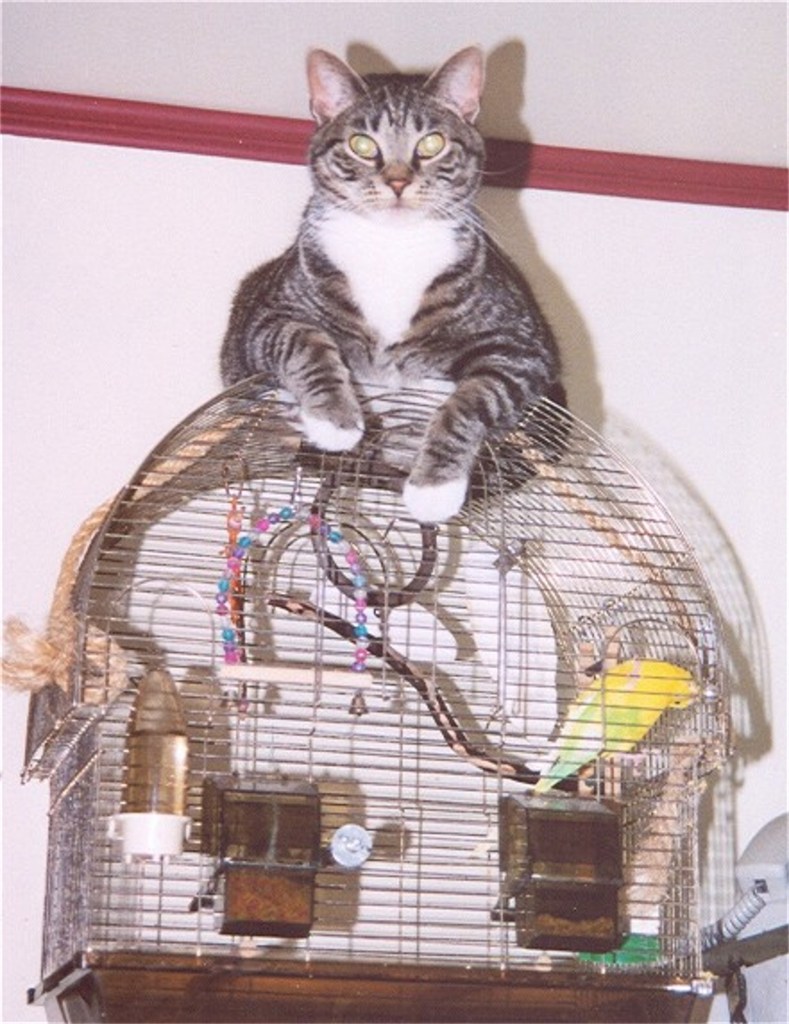
Pluskat and Sunshine (budgie) who are friends

            Kittens need to stay with their litter until they are at least 12 weeks old. They go through developmental stages similar to other animals. They learn how to behave and how to interact with other cats while they are young. If they are taken away from the litter too soon, they do not know how to act like a cat. If the cat owner decides later to get another cat, the resident cat will not know how to accept or interact with the new cat. This is one of the reasons why people have trouble introducing a new cat to the home. It is always better to have two kittens instead of one, and if possible, adopt litter mates. Family is very important to cats.

Mimi

            Like dogs, there are many breeds of cats and there are breed traits. Despite the breed of mix of a cat, each individual will have its own personality. Some cats act more like dogs and some are very aloof. Some cats are bold and some are timid. All cats are different due to breeding, family involvement, early training and experiences. It is important to keep this in mind and not label all cats as having the same personality and temperament. By understanding your cat’s natural social behavior, you can make the quality of life for your cat much better.  

Female cats react differently to unrelated distressed kittens than male cats

Wiebke Konerding the lead researcher at the Hannover Medical School and the University of Veterinary Medicine Hannover, Germany studied the reaction of male vs female cats to distress calls of unrelated kittens.

1pluskat

Interestingly, the more distressed the kittens were, the more the female cats reacted, even if they had not raised kittens themselves. The researchers found that there was no difference between the response of male or female cats to low arousal calls from kittens. But there was a difference to high arousal calls. Only female cats reacted differently.

The study implies that the ability of adult cats to react differently to emotional cues from kittens is ingrained and not due to experience. The kittens used in the experiment were not related to either the male or female cats.

Further research is needed to determine if adult cats react differently to their own kittens then they do to unrelated kittens.

http://www.sciencedaily.com/releases/2016/08/160812073702.htm

Excessive licking in dogs and cats

Dogs and cats will groom themselves by licking their fur. This is normal. They will lick their owners as a sign of affection as well. Licking can be a form of play and to let you know they are hungry. If the owner pays attention to their pet when they lick, it can reinforce the behavior, encouraging the pet to do it more often.

However, some pets will engage in excessive licking. Only the owner can determine if the pet is licking more than normal. Excessive licking is a compulsive behavior and the pet may lick everything in sight. This is not good for the pet and the family. Do not try to “correct” this behavior, it will only make it worse.

The first thing a pet owner must do is schedule a visit with your veterinarian. Excessive licking can be due to allergies, including food allergies. Other causes are boredom, stress, pain and diseases.

Try to recall if anything in the pet’s environment brought about the excessive licking. Changes are especially suspect, did you move, change the pet’s food, bed, alter the environment such as adding or taking away furniture, someone in the family moving in or out, a new pet, neighbor or any other change that the pet is aware of. Even a family member changing jobs, or a family crisis can affect a pet.

The easiest way to correct excessive licking is to give the pet an alternative activity. If the pet is a dog, give the dog a chew toy when he starts to lick. Praise the dog for chewing the toy. If the pet is a cat offer a toy for the cat to play with and interact with the cat. Be sure to give the pet a good rubdown or petting when they stop licking. If the pet tries to lick family members gently say “no” and give them something to chew or an activity.

If the excessive licking was due to a change in the home environment it may take a few weeks for the pet to adjust to the change. If the behavior does not stop or if it increases, it is best to consult with a certified canine or feline behavior consultant. You can find one at www.iaabc.org  With time and patience, excessive licking can often be cured.