Dog sledding is a popular sport in many countries around the world. Competitive dog sledding can be a grueling sport, but recreational dog sledding can be a lot of fun, especially in the winter when many people are confined to indoor activities. Many years ago I had a small team of Siberian Huskies that I did sledding with.
Much to my delight, I read about a study conducted by Fédéric Sotteau who is the founder of the French non-profit group Sourire á la Vie in Canada and Dr. Nicolas André, a pediatric oncologist at the Assistance Publique Hôpitaux de Marseille, France, where they found that dog sledding provided positive results for children who were being treated for cancer.
There were eleven children ages ten – eighteen years old and five chaperones which included doctors and nurses who participated in the expedition.
Many people, including doctors’, think that children who are being treated for cancer are too tired, weak or sick to participate in sports or other physical activities. The children themselves lose faith in their abilities to be active as well.
After going through a program of physical conditioning and training, the children were allowed to participate in the expedition. The reason why the study group picked dog sledding was to provide a unique sport experience that included a change of scenery and bonding with the sled dogs as well as the adventuresome aspect of the event.
The study showed that adapted physical activity is very beneficial to children with cancer, their physical and mental health benefit from the program.
It would be great if more groups sponsored this type of therapy for children with pediatric cancer.
There’s a gentle rebellion happening in quiet corners of cities and suburbs alike. People are building businesses that don’t bulldoze the planet, especially in the pet care space, where ethics and affection collide. You see it in the compostable poop bags, the cruelty-free shampoos, the local, low-waste doggy daycares. If you’re someone who cares about the environment and can’t help but coo at a golden retriever in booties, starting a pet care business rooted in sustainability may feel less like a career and more like a calling. But make no mistake, it still demands spreadsheets, sweat, and strategy. You can’t just wing it with good intentions and a compost bin.
Choose Your Niche
Don’t let the word “pet” fool you; it’s a wide world out there. From high-end grooming vans with solar panels to subscription boxes for gerbils, the possibilities spiral fast. Start by picking one lane and owning it. The most grounded way to do that is to look intoprofitable pet services already out there and ask yourself where your values intersect with demand. Is it organic pet treats? Low-stimulation dog walking for senior pups? Think like a caretaker, but plan like a capitalist. Even good hearts need to keep the lights on.
Sustainable Practices
This is where your ideals become infrastructure. Sustainability in pet care goes beyond tossing recyclables in the blue bin. If you’re opening a pet grooming studio, swap single-use plastics for glass or biodegradable alternatives. For in-home services, plan routes efficiently to reduce emissions or offer virtual check-ins for anxious pet parents. There’s a growing movement encouraging entrepreneurs to embrace sustainability without tanking your bottom line. Even small gestures like repurposing towels or using local suppliers can build credibility. You’re not just cutting waste, you’re creating a business with a conscience.
photo from Freepik
Licensing and Legalities
Paperwork doesn’t purr, but it keeps you out of trouble. You’ll need a business license, possibly animal-specific certifications, and maybe even zoning approvals depending on your location. Insurance is non-negotiable. And don’t forget the money—it costs to register, insure, and outfit a startup, especially one where animals are involved. A breakdown of the costs to start a pet sitting or dog walking business might open your eyes to how quickly expenses can stack up. Budget more than you think and plan for the surprises. They always come.
Build Your Business Know-How
It’s tempting to believe that passion alone will carry you, but the truth is that a little financial fluency goes a long way. If profit margins and marketing metrics make your eyes glaze over, consider going back to school—seriously. A flexiblebusiness management degree program can give you the vocabulary and structure you need to turn a dream into a functioning, ethical company. Most online programs are designed for busy people juggling work, pets, and life. Don’t mistake this as fluff education. It’s a power move for anyone who wants to play the long game.
Marketing and Community Engagement
The best customers are the ones who believe in your mission as much as your services. To reach them, get local. Partner with eco-conscious pet brands, show up at green markets, host adoption events. Most importantly, start telling stories on Instagram, via email newsletters, at meetups. You don’t need a PR firm to build a community around your business, but you do need consistency and heart. Customers notice when your messaging feels real and your mission runs deeper than the About page. Be the kind of business people root for.
Scaling Your Business
Growth should feel intentional, not like you’re getting pulled behind a runaway sled dog. Before hiring staff or expanding into new services, track what’s working and what feels clunky. Does demand justify duplication? Are you delivering at the same quality, or are you stretched too thin to care about the compost bin? Scaling can be sustainable if it follows the same ethos you started with—low impact, high integrity, human-paced. Your future team should share your values and your vision, not just your logo.
Starting a sustainable pet care business isn’t a Sunday side hustle or a cute hobby. It’s a commitment, like any real relationship. One between you, your values, your clients, and yes, the animals that make it all worth it. If you do it right, your work becomes more than just transactions and tail wags. It becomes a daily demonstration that capitalism doesn’t have to be careless. Just careful, thoughtful, and a little bit obsessed with doing things better.
Dive into the captivating world of animal behavior and pet care at Susan Bulanda’s Blog, where passion for pets meets scientific exploration!
Everyone knows that dogs need to be exercised, but often people don’t realize that cats need exercise too. When they are young, cats will play and amuse themselves, but as they get older, they tend to play less. It is beneficial for older cat to exercise, and playing with your cat is one way to do this. Cats often prefer toys that move or fly such as toys on a sting. Many cats love to pounce on a plain string that is pulled along the ground. Fortunately there are several toys designed to both play with and exercise your cat. By playing with your cat you also foster a positive bond.
chasing mini snowballs
You may have to experiment with simple toys to see what your cat likes. I have owned cats that loved to play with a wadded tissue tied with a string. A wadded tissue is easy for the cat to pick up and carry and cost next to nothing. Some cats love the craft puff balls, or ones that make a crackling sound.
Cats that are deaf or blind can also play with toys. If the cat is blind a toy that works best is one that makes some sound, even if it is the sound of it going across the floor.
Cats can benefit from having the ability to go outside for exercise, venting energy and soaking up some sun. This is especially beneficial for the multi-cat household, since letting cats exercise can help them get along. However, the main problem in letting cats go outdoors is keeping them safe and at home. Purr…fect Fence offers a solution to this problem by offering an easy to install poly mesh system. They also offer a converter kit to make existing 5 – 6-foot fences cat proof.
Many people are surprised that you can train a cat to do tricks and obey basic commands. The best way to train a cat is to use the clicker training method. Cats enjoy interaction with their owners. Clicker training also helps cats that have been adopted and may have been feral for a period of time. Many zoo animals have been easier to handle after they are clicker trained.
Cats are very social and enjoy the company people and other animals. However, some cats are more social than others, they have as many different personalities as dogs.
Cat fence information: www.purrfectfence.com, email info@purrfectfence.com or call 888-280-4066
Getting Started: Clicker Training for Cats by Karen Pryor
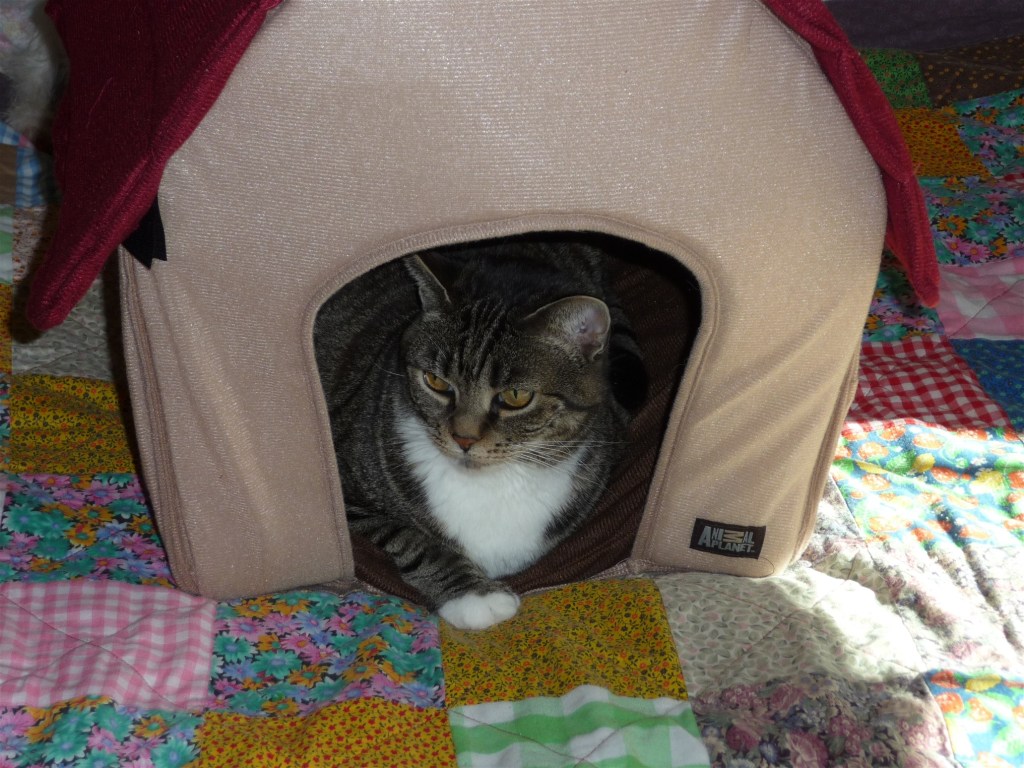
Cats enjoy boxes and other “secret” hiding places. But why? While no one knows for sure, some studies have shown when cats have boxes to hide in, they have lower stress levels, especially cats in rescues or shelters.
Cats generally enjoy going behind, into, under and on top of things. It provides a way to explore, satisfy their curiosity, provide exercise and practice hunting skills. Anyone who has watched cats play have seen them hide behind something and then pounce on anything, (dog, cat or you) that goes by. This can be great fun for the cat. It is especially funny to see kittens do this and after they pounce on their victim, bounce away on their toes, as kittens do. Cats enjoy paper bags, especially if you make scratching noises with your finger nails on the outside of the bag and slowly move your finger along the bag.
Cats may enjoy going in small places such as boxes, to keep warm or bury themselves in something soft such as blankets or clothes in an open hamper. Some cats learn to head for the clothes that have just come out of the dryer and if they can, settle down for a long, warm nap.
A careful cat owner will keep their cat’s safety in mind as they play. This is especially true around holidays, birthdays and other events where there can be empty boxes, wrapping paper, plastic wrap around the house. Children may not see a cat hiding and step on them, especially a young kitten.
Cats can also chew boxes, wrappings, paper, ribbons, strings and other tempting non-cat toys which can result in a trip to the veterinarian. While it is fun to watch a cat or kitten play with these things, they should never have access to anything that can harm them. Even if the owner is there to supervise the cat/kitten, things can happen so fast that you cannot prevent them.
So instead of spending a lot of money on cat toys, once in awhile give your cat a box to play in or a paper or reusable shopping bag to hide in. Your cats will love you for it.
Cats enjoy boxes and other “secret” hiding places. But why? While no one knows for sure, some studies have shown when cats have boxes to hide in they have lower stress levels, especially cats in rescues or shelters.
Cats generally enjoy going behind, into, under and on top of things. It provides a way to explore, satisfy their curiosity, provide exercise and practice hunting skills. Anyone who has watched cats play have seen them hide behind something and then pounce on anything, (dog, cat or you) that goes by. This can be great fun for the cat. It is especially funny to see kittens do this and after they pounce on their victim, bounce away on their toes, as kittens do. Cats enjoy paper bags, especially if you make scratching noises with your finger nails on the outside of the bag and slowly move your finger along the bag.
Cats may enjoy going in small places such as boxes, to keep warm or bury themselves in something soft such as blankets or clothes in an open hamper. Some cats learn to head for the clothes that have just come out of the dryer and if they can, settle down for a long, warm nap.
A careful cat owner will keep their cat’s safety in mind as they play. This is especially true around holidays, birthdays and other events where there can be empty boxes, wrapping paper, plastic wrap around the house. Children may not see a cat hiding and step on them, especially a young kitten.
Cats can also chew boxes, wrappings, paper, ribbons, strings and other tempting non-cat toys which can result in a trip to the veterinarian. While it is fun to watch a cat or kitten play with these things, they should never have access to anything that can harm them. Even if the owner is there to supervise the cat/kitten, things can happen so fast that you cannot prevent them.
So instead of spending a lot of money on cat toys, once in awhile give your cat a box to play in or a paper or reusable shopping bag to hide in. Your cats will love you for it.
If cat food stayed the same, it would not be a problem feeding a finicky cat, but unfortunately brands change, specific varieties may be discontinued, or you may have to change your cat’s food for health reasons. If your cat is a finicky eater, this can be a huge challenge. There are a few things that may work to help.
The best thing to do is prevent the cat from becoming finicky. This is easily accomplished while the cat is a kitten. Do not feed your kitten only one brand and flavor of food. Offer the kitten many different brands of food and flavors as well as textures.
Most cat owners do not consider the texture of the food, how the food feels in the cat’s mouth is important. Cats are aware of the appearance, smell, taste and feel of the food. With so many aspects to consider, it makes substituting one brand of food for another more difficult.
If you must change the cat’s food, offer the new food in a separate dish next to the cat’s normal food at feeding time. Another method that can work is to mix a small amount of the new food with the food that the cat likes. Gradually add more of the new food until the cat will eat the new food exclusively.
There are a few other feeding tips that can help a cat. I like to feed my cat both dry and wet food. Feeding dry food will not harm the cat as some people believe, nor will it cause dehydration. If your cat is on a self-feed system, the dry food will stay fresh longer. It often works well to leave a dish of dry food out and twice a day offer wet food.
Each meal does not have to be the same amount of food. For example, the cat may get a smaller amount of dry food in the morning with a larger portion of wet food, and then in the evening, more dry food and less wet food, or more of both at one feeding and a less amount of both at the next feeding.
Cats may enjoy food puzzles because they satisfy their hunting instinct. Food puzzles also encourage the cat to exercise as they work the food out of the puzzle. If food puzzles are new to the cat, offer them on a quiet day at mealtime. Put their normal amount of food in the puzzle and offer the puzzle as close to their normal eating area as you can. Be sure to thoroughly wash the food puzzle with hot water and soap after the cat is finished with it. Because of a cat’s very good sense of smell, be sure to thoroughly rinse the puzzle so that the cat cannot smell the soap.
If the cat will not use a food puzzle, dry food can be hidden in and on a cat tree if the cat uses one. For example, my cat is blind so a food puzzle will not work with her. I have a three-tiered cat tree that has a “den” in the middle of it. I scatter her treats on the cat tree in different places. She loves to jump on it and using her sense of smell, find the treats. If you do not have a cat tree, you can hide treats around a room. Let the cat see you place one treat and show the cat where it is. You can tell the cat to find the treat as you do this. As the cat gets the idea hide the treat in a place near where you started and tell the cat to find the treat, gradually expand the area. Most cats will get the idea quickly and enjoy the game. This too satisfies their hunting instinct.
The bottom line is do not give up trying different foods and puzzles to keep your cat healthy and happy.
People who do not own cats have a hard time understanding the deep affection that cats have for humans and that humans have for cats. In many ways, cats are not much different then dogs. Granted, you cannot do the same things with cats that you can do with dogs, but the relationship is a deep, quiet one. There is something special about the love that cats have for people, it is hard to put into words. The best way to describe it is to imagine sitting quietly with your closest friend, no words needed, but knowing that you are there for each other no matter what. Imagine the feeling of security, peace, and understanding that you and your friend share. This is what cat love is like.
Some cats are very demonstrative and easily show their affection while other cats are more like the best friend experience described above. This does not mean that they are not bonded or don’t love their owners, they simply show it differently. Just like dogs and people, cats have different personalities. Some are cuddly and others like to share from a distance.
Many people recognize canine displays of affection, but do not recognize feline displays of affection. While each cat has their own special way of demonstrating their love for their owner, some types of body language and behavior are common with all cats.
Here is a list of the most common ways cats show affection:
1. The most recognized sign of affection is when a cat purrs, however, not all purring is a sign of affection. For example a cat who is in pain or stressed will often purr. It is thought to be a way to relieve stress. However almost without a doubt if a cat is near a human and purrs along with a contented face, it is a sign of affection. Cat purrs can range from soft and subtle to very loud. Kittens can purr from the time they are two days old. There have been a number of studies about how and why cats purr, it is considered the equivalent of a cat smile, a healing mechanism and a form of communication, but by and large, it is still a mystery.
2. Tails are another indication of affection. Kittens will greet their mother with their tail straight up and the end tipped over just a little. When the cat gets close to his favorite person, the tail will stay up with the end slightly tipped and the cat will raise their butt, sort of like walking on their hind toes. This is an invitation to scratch them above the tail. Happy cats usually have their tails raised and the tip of the tail in a slight hook.
3. Cats can show affection by the location they choose to sleep. This is because a cat sleeps up to 16 hours a day and they are the most vulnerable while sleeping. Therefore if a cat sleeps near, on or next to his person, it is a way the cat tells you that he trusts and feels safe near you. When an owner is not at home, the cat may choose to sleep on their person’s bed, chair or pillow.
4. Much to the dismay of some cat owners, cat gifting is another sign of affection. I does not matter if the gift is a dead critter, a bug, or a toy, cats only give gifts to the people they love.
5. Rolling is another sign of affection. If your cat throws himself down in front of you or near you, it is a sign that they love you and often that they want to play. Cats will only do this to engage you to play with them. It does not mean that they want their belly rubbed or scratched. Some cats do not mind belly rubs but most do not care for it.
6. Scratching is another signal that a cat feels that you are theirs. When cats do this, they leave their scent from scent glands that are located between their pads and toes. They will do this to say that the object of their scratching is theirs. Much the same as family members feel that their family is theirs.
7. Bumping or bunting is a term that is used when a cat will cheek rub, head butt or wrap themselves or their tail around you. This is a very high complement from a cat. A cat will do this to other cats, dogs and their favorite human.
8. Kneading is another sign that the cat is very happy and contented. They often do this while purring. The behavior goes back to kitten hood when the kitten would knead the mother’s breast to help milk production. Cats only do this with people they hold in high regard.
A very happy Mimi
9. Playing is an engaging behavior that a cat will only do with someone they feel safe with and love. Often a cat will bring a toy to their person and drop it just out of reach. This way you have to go to them. Playing is also a form of gifting.
10. Cat eyes are very large in proportion to their heads. This makes them easy to read, cats use their eyes as a form of communication. When a cat puts his face near yours, with wide soft eyes, it is a sign of love. If the cat is across the room and gives you a slow blink, it is sort of the cat’s way of throwing kisses to you. Often if you blink slowly to your cat, the cat will blink back.
11. Nose nibbles are one of the most flattering things your cat can do to show affection. Often a cat will do it while you are asleep. It is not a bite and does not hurt, but is a gentle nibble on the tip of your nose.
The next time you interact with your cat, pay close attention to what your cat is telling you, it may be a pleasant surprise.
Pet ownership is more than just a source of joy—it’s a gateway to better health and a more fulfilling life. From reducing stress levels to promoting physical activity, the bond between humans and their pets profoundly impacts overall well-being. This article explores how pets contribute to a healthier, happier lifestyle, showcasing their unique role in enriching our lives.
The Mutual Benefits of Pet Interaction
Spending time with pets like dogs and cats can be a delightful way to unwind and reduce stress. Engaging in regular playtime and maintaining a consistent routine with your furry friend can help lower cortisol levels, a key stress hormone. This benefits your health and positively impacts your pet’s well-being, as your stress can affect them, too. Consider working from home occasionally or arranging for a pet sitter if your pet shows signs of stress. These steps can create a more harmonious environment, enhancing your and your pet’s health and happiness.
Boosting Your Immune System with Pet Companionship
Owning a pet can be a delightful way to boost your immune system. Sharing your home with a pet, especially a dog, exposes you to various microbes that can strengthen your body’s defenses. Research indicates that children raised with pets often develop a more diverse gut microbiome, which is associated with a lower risk of asthma and allergies. This aligns with the hygiene hypothesis, suggesting that early exposure to microbes can help the immune system manage allergens more effectively.
The Mental Health Benefits of Pet Care Routines
Establishing a routine through feeding, grooming, and exercising your pet provides structure and instills a sense of purpose and accomplishment. This routine can be particularly beneficial for those facing mental health challenges, as it encourages regular physical activity and fosters a stable environment. The bond you form with your pet through non-verbal communication can uplift your mood and alleviate anxiety. Studies suggest that over 60% of dog owners achieve recommended exercise levels, highlighting the physical benefits of pet ownership.
How Therapy Animals Help with Mental Health
Therapy animals have increasingly become a vital component of mental health care, offering comfort and support to individuals facing challenges such as PTSD and autism. Their calming presence can significantly enhance social skills, reduce anxiety, and promote emotional stability across diverse groups. For example, equine-assisted therapy involves interactions with horses and is particularly effective in building trust and facilitating emotional healing. Additionally, service dogs are trained to address specific needs, such as providing mobility support or detecting health issues like low blood sugar, enhancing independence and quality of life.
The Health Benefits of Pet Ownership
Delving into the science of the human-animal bond reveals its significant impact on health and well-being. Engaging with pets can lower blood pressure and ease anxiety, mainly due to releasing hormones like oxytocin and dopamine, which foster happiness and relaxation. The companionship of a pet can alleviate loneliness and depression, enhancing your overall quality of life. Understanding these dynamics lets you appreciate how pets contribute to a healthier, more fulfilling life.
freepik
Pets are more than just companions; they are catalysts for improved health and happiness. Their presence can transform daily routines, offering emotional support and fostering a sense of purpose. As we continue to explore the profound connections between humans and animals, it becomes clear that pets play an integral role in enhancing our lives. Embrace the unique benefits they bring, and let these bonds enrich your journey toward well-being.
Discover the fascinating world of canine intelligence and groundbreaking research at Susan Bulanda’s Blog, (website) sbulanda.com where passion for pets meets scientific exploration!
UCLA psychologists have discovered a circuit in the brain of mice that makes them crave food and seek it out, even when they are not hungry. What is interesting about this discovery is that when the group of cells is stimulated, the mice seek fatty and pleasurable foods such as chocolate instead of healthier foods such as carrots.
The area of the brain where the cells are located is called the periaqueductal gray which is in the brainstem. When these cells are stimulated, the mice are so driven to eat that they will endure foot shocks to get to the food. The opposite occurs when the researchers inject a virus that produces a protein that reduces the cells activity even hungry mice foraged less.
“Like mice, humans also possess vgat PAG cells in the brainstem. It could be that if this circuit is overactive in a person, they might feel more rewarded by eating or crave food when not hungry. Conversely, if this circuit is not active enough, they could have less pleasure associated with eating, potentially contributing to anorexia. If found in humans, the food-seeking circuit could become the treatment target for some kinds of eating disorders.”
Sue’s Note: If mice have this cluster of cells, it stands to reason that other animals have it as well. Could this be why some of our pets overeat and some have low appetites?
Journal Reference:
Fernando M. C. V. Reis, Sandra Maesta-Pereira, Matthias Ollivier, Peter J. Schuette, Ekayana Sethi, Blake A. Miranda, Emily Iniguez, Meghmik Chakerian, Eric Vaughn, Megha Sehgal, Darren C. T. Nguyen, Faith T. H. Yuan, Anita Torossian, Juliane M. Ikebara, Alexandre H. Kihara, Alcino J. Silva, Jonathan C. Kao, Baljit S. Khakh, Avishek Adhikari. Control of feeding by a bottom-up midbrain-subthalamic pathway. Nature Communications, 2024; 15 (1) DOI: 10.1038/s41467-024-46430-5
Cite This Page:
University of California – Los Angeles. “Craving snacks after a meal? It might be food-seeking neurons, not an overactive appetite.” ScienceDaily. ScienceDaily, 20 March 2024. <www.sciencedaily.com/releases/2024/03/240320122517.htm>.
A new study investigated whether dogs understand the words on a soundboard or if they were responding to cues from their owners. The study was conducted by researchers at the University of California San Diego as well as other institutions and have proven that dogs who are trained with soundboard buttons can comprehend specific words and will perform contextually appropriate responses. The study was led by Federico Rossano who is an associate professor in the Department of Cognitive Science at UC San Diego and is head of the comparative Cognition Lab. This study was the first empirical study from the world’s largest longitudinal or panel study of button-trained pets.
The way the study was conducted removed bias, owner cues, and showed that the dogs truly did understand the words on the sound board. One of the more important findings is that it shows the complexities of dog cognition and communication.
Sue’s Note: Since I first started training dogs and working as a behaviorist, we have come a long way in understanding how intelligent dogs (and other animals) are. One of the key lessons that we as pet owners must keep in mind, is that dogs are much smarter than previously thought and understand much more than most people give them credit for. This is important to keep in mind when training any animal. What you do and how you do it is critical in building your relationship with your dog or other pet and having them understand what you are teaching them or want them to do. This is why it is very important to use the same word for a specific command. For example, do not use the word DOWN to tell your dog to get off you or furniture and then say the same word to tell your dog to lie down.
Journal Reference:
Amalia P. M. Bastos, Ashley Evenson, Patrick M. Wood, Zachary N. Houghton, Lucas Naranjo, Gabriella E. Smith, Alexandria Cairo-Evans, Lisa Korpos, Jack Terwilliger, Sarita Raghunath, Cassandra Paul, Hairou Hou, Federico Rossano. How do soundboard-trained dogs respond to human button presses? An investigation into word comprehension. PLOS ONE, 2024; 19 (8): e0307189 DOI: 10.1371/journal.pone.0307189
Cite This Page:
University of California – San Diego. “Dogs understand words from soundboard buttons.” ScienceDaily. ScienceDaily, 28 August 2024. <www.sciencedaily.com/releases/2024/08/240828154926.htm>.




 A Blog by Susan Bulanda