K9 Obedience Training: Teaching Pets and Working Dogs to be Reliable and Free-Thinking by Susan Bulanda

I am very excited to announce that my latest book is now available. If you would like an autographed copy please go to my website and order one, http://www.sbulanda.com.

If you live outside of the USA the postage may cost more than the book, but if you still want a copy please email me at: sbulanda@gmail.com and I will check how much the postage will cost. The book is also available as an Ebook. Below is a summary of what is in the book. As always, if after you read the book you can email me with any questions that you may have.
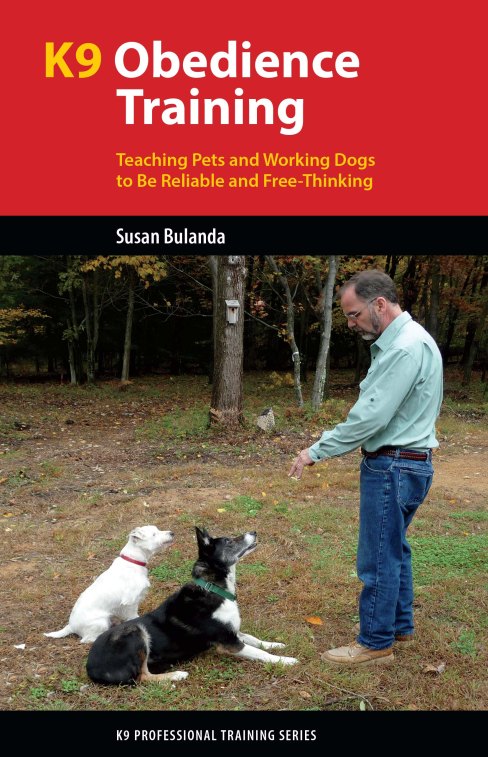
K9 OBEDIENCE TRAINING COVER PRINT

Obedience is the foundation for any reliable, well-trained dog. Without obedience, working dogs are ineffective in operations and pet dogs can be annoying and possibly a danger to themselves or others.

In K9 Obedience Training, you will learn the techniques that I have developed during my career as a dog trainer and then certified animal behavior consultant. The methods outlined in my book will let your dog be free-thinking as well as obedient. I also cover the latest research about how a dog thinks, what they understand and what they are capable of solving.

What is free-thinking? This is when a dog can apply what he has been taught to situations that he has not encountered before. His training allows him to solve problems and even perform obedient disobedience. An example of obedient disobedience is when a person directs a dog to do something, but the dog knows that it is not safe to do it. For example, if you toss a ball and it drops over a ledge that is unsafe, the dog will not retrieve it even though you have told him to “fetch.” This allows the dog to make decisions. It does not undo the training that the dog has had.

In my book I cover many topics that are part of obedience but not part of the basic obedience exercises. This includes teaching your dog to allow you to groom him, handle his body parts for things such as nail clipping, brushing the coat and teeth.

The book also covers basic manners such as not jumping, bolting in and out of doors and other safety exercises.

What is also very important is the discussion about who should train the dog and the rules that you must follow to successfully train the dog. Everything is explained in detail so that you can understand the purposes behind the rules.

I also cover food and how it affects your dog’s behavior. There is so much more in this book including some fun tricks to teach your dog. And for fun, at the end of the book is a photo gallery of some of the animals that have shared my life.

Here is a list of major topics. Many of these have sub-topics as well.

Part I Training Your Dog to Think Freely

  1. What is a Free-Thinking Dog?
  2. A Positive Training Philosophy

Part II Pre-Training Basics for The Free-Thinking Dog Trainer

  1. Talking to Your Dog
  2. Questions to Ask Before You Start Training
  3. House Training and Crate Training
  4. Handling Your Dog’s Body for Grooming and Hygiene

Part III

  1. The Equipment
  2. Setting Up for Success
  3. Basic Obedience Training
  4. Advanced Obedience for Safe Work, Sport and Play
  5. Exercises for Common Behavioral Challenges
  6. Tricks

Asthma and Pets

In a new study conducted by the Nationwide Children’s Hospital, if parents and children follow the NAEPP (EPR-3) guidelines for asthma control in children, pets and secondhand smoke does not increase their symptoms. This is important to those people who love pets because it means that a family does not have to get rid of a pet if a family member develops asthma.

scan0023

This is also important because if a child suffers from asthma, a pet can be a big comfort to them if the asthma interferes with other activities.

However, it is important to work with your health care provider and follow the NAEPP (EPR-3) guidelines. The study shows that asthma treatment is more important than exposure to elements in the environment.

Hemorrhagic gastroenteritis (HGE) in dogs revisited

Because so many people have clicked on my HGE article, I thought it might be a good idea to write another article about it.

As I stated in my earlier article, my Parsons Russell Terrier had it twice. Once when he was young which is when it usually manifests itself in dogs, and another time when he was about 8 years old.

What is critical to understand about this illness, is that it can kill a dog in 24 hours and must be treated by a veterinarian. While it is typically found in small dogs such as Toy Poodles and Miniature Schnauzers, it can attack any dog.

The Signs:

  1. Sudden vomiting
  2. Bloody diarrhea
  3. Low blood volume
  4. Severe concentrated blood
  5. Hypovolemic Shock
  6. Very lethargic

If your dog gets HGE, you will see three critical signs, sudden vomiting, bloody diarrhea and your dog will be very lethargic. Very small dogs cannot survive long with these symptoms.

The exact cause is unknown. However, it is suspected that an abnormal reaction to bacteria or a reaction to toxins from the bacteria is one cause of HGE. Another possibility is an extreme reaction to food. This is one reason why it is very important to only feed your dog the highest quality of food. I strongly suggest checking one of the many sites that analyze pet food. Most pet food is not safe or good for your dog. Nothing that you buy at a discount store or supermarket is the high quality that you want.

Another cause is Colostridium perfringens which is another type of bacteria. This has been found in quite a few dogs who have gotten HGE.

The articles that I have researched mention that HGE appears to be similar to canine parvovirus (CPV), making it critical that you take your dog to a veterinarian at the first signs of vomiting and diarrhea. If your dog is up to date on his shots it is not likely to be CPV. There are other illnesses that have similar signs as well which is why an immediate veterinary visit is necessary.

When my dog got it again, he started the symptoms while we were asleep. When my husband woke up early, Riley was very sick. Not knowing when the symptoms started, I immediately took him to the emergency veterinary clinic. When my regular veterinary clinic opened, we transferred Riley to them to spend the rest of the day. By evening he was recovered.

Your veterinarian will start intravenous fluids immediately and will treat the other symptoms which can last up to two days. If you take your dog to the veterinarian right away your dog will most likely survive. Only about 10% of dogs with HGE do not survive. As I experienced with my dog, and statistics show that up to 15% of dogs that get it may get it again.

In my practice as a behavior consultant, I have seen where people whose dog has gotten sick, wait a day or so to see if the dog gets better before they take their dog to the veterinarian. If your dog has HGE, this is a death sentence. Take your dog to the veterinarian at the first signs of any illness.

I hope this article has helped you understand this very dangerous illness. Riley is going on 13 and is very healthy.

DSCN1778 Rolly 2

Riley as a puppy with Mom in the background


K9 Obedience Training: Teaching Pets and Working Dogs to be Reliable and Free Thinking – by Susan Bulanda

Obedience is the foundation for any reliable, well-trained dog. Without obedience, working dogs are ineffective in operations and pet dogs can be annoying and possibly a danger to themselves or others.

K9 OBEDIENCE TRAINING COVER PRINT

In K9 Obedience Training, veteran search and rescue (SAR) dog handler and trainer Susan Bulanda, M.A., C.A.B.C. (certified animal behavior consultant) shares the secrets of building an effective obedience training program. SAR dogs need “thinking” obedience: they sometimes need to exercise intelligent disobedience in the field. You can use the same training program for any working or pet dog. For trainers who demand the best obedience training for future working dogs, Susan’s techniques lay the groundwork for success.

And pet owners who want to help their dog be easy to be around will find lots of training tips and exercises too, along with straightforward advice on proper handling, grooming and teaching simple tricks.

My new book will be out by the end of June, 2019. You can order it from my web site, www.sbulanda.com  You will receive an autographed copy. Please note that the shipping cost is for the US only. If you live outside the US please email me at sbulanda@gmail.com for postal rates.  Unfortunately it often cost more to ship the book than the book cost. You can also order it on line as an ebook through Amazon or from the publisher at www.dogtrainingpress.com 

A new strain of distemper is a risk for dogs

“The new strain of canine distemper virus was identified by UNH pathologists in collaboration with colleagues at Cornell University, University of Georgia, Northeast Wildlife Disease Cooperative, N.H. Fish and Game, and Vermont Fish and Game. Over a one-year period, pathologists diagnosed canine distemper virus infection in eight largely carnivorous mammals in southeastern New Hampshire and north central Vermont. The animals included three fishers, two gray foxes, one skunk, one raccoon, and one mink.”

jib

While this new strain may not be a risk for the rest of the country, it would be diligent to alert your veterinarian to the new distemper strain. According to the report a raccoon in Rhode Island was found to have it in 2004. This indicates that it is not new and has potentially spread. There is always the chance in time, it will spread across the country.


Virtual dog helps prevent dog bites

Dogs Trust and the University of Liverpool researchers have created a virtual reality dog that people can approach and interact with that displays signs of aggression.

scan0012

The purpose of the project is to educate people, including children, how to recognize signs of aggression in a dog in a safe environment. As the user approaches the dog its behavior changes to include lip licking, lowering of the head and body, front paw lifting, growling and showing of teeth. The team plans to improve the virtual dog to show a variety of behaviors and situations.

This is an excellent project and I hope that it will succeed and be used worldwide to help educate people and teach them how to recognize and understand canine body language. This could also work with all types of animals and would be a safe fantastic way for people to learn about animal behavior.

Sleepovers for shelter dogs

A team of researchers from the Canine Science Collaboratory have determined that if volunteers take shelter dogs home for a few days, it reduces their stress level. The benefits of this mini-vacation last for a while after they are brought back to the shelter.

img039

The researchers found that the sleepovers provided a break for the dogs from the stress of the shelter. The team found that dogs in a shelter cannot get the sleep that they need because of how busy and noisy it is in a typical shelter.

The team is also looking into other programs that allow dogs to leave shelters, such as field trips and long-term foster care. With a grant from Maddie’s Fund, they are enrolling 100 animal shelters across the country in a study to understand how foster care impacts the dogs in shelters.

Identifying shelter dogs

Arizona State University’s Canine Science Collaboratory researchers Lisa Gunter and Clive Wynne collected DNA from over 900 shelter dogs that were at the Arizona Animal Welfare League and Society for the Prevention of Cruelty to Animals (AAWL) in Phoenix, AZ, as well as the San Diego Humane Society and Society for the Prevention of Cruelty to Animals (SDHS) in San Diego, CA.

beagle pups

They found that although only 5% were purebreds, there were 125 distinct breeds that made up the mixed breed dogs. They also found that unless the dog was a purebred, shelter employees could only determine the mix  about 10% of the time.

Interestingly the three most common breeds were the American Staffordshire Terrier, Chihuahua and Poodle but they represented less than half the dogs in the shelters.

The researchers feel that since the bully breeds stay in shelters up to three weeks longer before being adopted, that the emphasis should be on the individual dog’s behavior to match them with their new families rather than the breed. They stress that a behavior assessment program would be very beneficial for shelter dogs.

I personally agree that each dog should be judged on its own merit rather than its breed. Labeling all individuals of a specific breed is profiling at its worst.


Non-invasive test for liver disease in dogs

Veterinarians at the University’s Royal (Dick) School of Veterinary Studies have worked with medical doctors to develop a blood test that can detect early liver disease in dogs. They based their studies on the molecule miR-122 which is found in humans who have liver disease.

DSCN1485

Their studies showed that dogs have the same molecule as humans and the team has developed a blood test that can be used on dogs.

Professor Richard Mellanby, who is the Head of Companion Animal Sciences at The Hospital for Small Animals at the University of Edinburgh has stated that the blood test provides a safe, non-invasive way to detect liver damage in dogs. Research in dogs has helped human illnesses many times, it is exciting that human tests can now help dogs.

What is important is that the blood test is safer to use than biopsies which can cause complications and can be expensive. I hope they continue the research to develop a blood test for cats and other pets.

The Very First Dog: Book Three in the Sam and Gunny K9 Adventure Series by Joe Jennings

The Very First Dog: Book Three in the Sam and Gunny K9 Adventure Series by Joe Jennings, ISBN: 9781791950033, $11.50, Self- published.

joes book

This book is a novel and an easy read. It is suitable for young adults. The story blends Native American lore, archaeology and fiction into a very easy read story about a young boy and a search dog who have dreams or “memories” of the past. The story takes you back 15,000 years ago with a dream or vision quest by a young boy. He is called to find the wolves that his people have not seen in many years. A modern boy, Clay, has the dreams and tells them to his family as well as a paleontologist and an Arapaho medicine man who help him understand what he was dreaming. The key to the dreams is Gunny, the search dog.

The book is well written and flows nicely between the dreams and modern day. The interaction of the family is very realistic and relaxed. The main point of the book is to give the reader an idea about the theory of how wolves and humans co-existed and eventually became dogs. What I liked about this book is that Mr. Jennings does not try to claim that the events in his book are fact, but only a theory.

This is a great book to sit down with on a sunny day on the beach or in an easy chair on a rainy day. While it is an adventure, it isn’t a nail biting one.

Mr. Jennings is an excellent writer and having read his two other books, Ghosts of Iwo Jima and Ghosts of the Buffalo Wheel, I can honestly say I was not disappointed. You will enjoy this book.