An extensive research project led by palaeogeneticist Laurent Frantz from the Ludwig-Maximilian-Universität Müchen determined that dogs from Siberia resulted from cross-breeding with dogs from Eurasian populations over 2000 years ago. His findings along with artifacts found at ancient sites, shows extensive trading. Dogs were an important trade item between the Siberian people and people from the Eurasian steppe and Europe.
For example, he goes on to say that although a large percent of the Samoyed genome can be traced to original Artic bloodlines, it also shows more Western influence than the husky. This finding helps to explain why the Samoyed can herd reindeer yet the husky does not. According to his findings the Samoyed as a breed has had little changes since the Middle Ages.
It is also interesting to note that according to Frantz, although there was an exchange and inbreeding of Siberian dogs, there was no indication that the people intermarried. The human genomes stayed very stable over the same period.
A study in the Veterinary Record, has reported a few cases of dogs and cats contracting the SARS-CoV-2 variant in England. In these cases, the pets caught the variant from their owners who had shown symptoms several weeks before the pets became ill. Heart problems were manifested in the pets who contracted the variant.
While this is not widespread and actually rare, it is a good idea for pet owners to be aware of the possibility since COVID-19 is so widespread. At this point the research does not indicate that people can catch the variant from pets.
We all know that some dogs seem to be more stressed than other dogs. Part of the reason is the genetics of the dog. Certain breeds tend to be more noise sensitive than others. But all dogs can be stressed by certain types of noise. Researchers at the University of California found that dogs are often stressed by common household noise. Particularly noises that are high frequency or very loud. Examples are smoke detectors, microwave ovens, and vacuum cleaners.
Many loud and high pitches noises actually hurt a dog’s ears. Most owners recognize obvious signs of fear or stress, such as trembling, hiding, howling, barking and running away. However, owners often miss a dog’s more subtle signs and therefore do not help their dog when stressed. Some of the subtle signs are panting, licking their lips, turning their head away, a rigid body, ears turned back or flattened against the head, and lowering their head below their shoulders.
By watching your dog or cat carefully you can learn to recognize their relaxed body language. This will help you recognize when your pet is not relaxed.
Babs, totally relaxed
Whenever a stressful noise occurs, a concerned owner will remove the dog from the area. It is important to watch the dog’s body language to see how far away the dog needs to be to avoid being stressed.
Cats are also stressed by noises therefore cat owners should also be aware if noise bothers their cat.
Researchers at Washington State University conducted a study of first year (freshmen) college students who owned pets and their level of separation anxiety. What they found is not surprising to those of us who are pet owners and lovers.
The students were tested before leaving for college and during their first two weeks on campus. Prior mental issues were accounted for so that they did not influence the results of the study. What the researchers found was that students who treated their pets more like people suffered more. It also seems that dog owners suffered the most rather than cat owners and people with other types of pets.
My soul mate, Scout
The importance of this study shows that programs that allow pets to visit campus to help students that are stressed, are beneficial. What this study made me think of are all of the elderly people who are forced to give up their pets, who were their companions for many years, because they had to move to a care facility. Young people are active and seem to be able to adjust more readily than the elderly. This also brings to mind how important it is to bring certified therapy pets to nursing homes and assisted living facilities. No matter how young or old a person is, losing a pet for any reason is often very traumatic. Your heart can ache for the loss for many years.
The Cavalier King Charles Spaniel has been a breed for over 1000 years. However, during that time there were “bottlenecks” in the breeding of these dogs where only a small number of dogs were bred.
Researchers studied eight different breeds and found that the Cav had the greatest number of disease-causing genes than any of the other breeds studied. They are especially prone to heart disease.
picabay photo
Note: The study only sampled a limited number of dogs of each breed studied. While this is a good indicator, I would have liked to see a larger number of dogs tested from a wider geographical area. However, breeders who sincerely love their breed, what ever it is, can improve the breed by selective breeding for the right reasons. Too many people breed indiscriminately and do not test their dogs for genetic defects. As a canine behavior consultant, I have seen the results of this for my entire career.
A new study has found that there are five distinct coat colors in dogs and wolves. Previously scientists believed that there were only four. The mystery of coat colors has been solved. (However, we never know what discoveries the future holds.)
This discovery is the result of the work done by an international team of researchers including scientists from the Institute of Genetics of the University of Bern. The team found that a genetic variant which is responsible for a very light-colored coat in dogs and wolves originated in a now extinct relative of the modern wolf.
According to the research a small piece of DNA from this extinct ancestor is still found in yellow dogs and white artic wolves.
Note: This information may help breeders better determine the potential coat color of future litters. I hope that it eventually helps eliminate the deafness and other ills that are connected to certain colorations in dogs, namely the merle, harlequin, piebald and for some breeds the all-white factors, that cause genetic problems.)
What goes into being a great dog owner? Obviously, it means giving your pet the best possible care. It means building a long-term relationship of trust and affection. But there’s another component of being a great dog owner, too, that has to do with how you and your dog relate to your neighbors. If you want those around you to love your pet as much as you do, it’s important that you keep in mind certain basic principles of good neighborly behavior for dog owners. After all, failure to do so can jeopardize your relationships in your community, which can have a harmful effect on your dog’s well-being, too.
image pixabay
Keep the noise down.
Just because your dog’s barking doesn’t bother you, that doesn’t mean that it’s acceptable. For one thing, your dog may be barking because they are anxious, bored, or feel threatened. It’s important to pinpoint the reason behind the barking so you can help your dog get past whatever is bothering them. Secondly, you don’t want your family to be a nuisance. Hearing constant barking can be frustrating for your neighbors, and significantly reduce their quality of life. Seek the help of a trainer if your dog is barking excessively for no clear reason.
Clean up after your dog.
Hopefully, you know that letting your dog defecate on someone else’s property is a major faux pas. In fact, in many states, it constitutes a trespass and is technically illegal. Make sure you keep your dog from running onto someone else’s property. Should they happen to do so, however, and relieve themselves there, be sure to clean up after them and apologize to your neighbor. You don’t want to let feces accumulate on your property, either, as the stink can be unpleasant to those around you. It can also attract flies and other unappealing insects, and in significant quantities pose a health risk, as dog poop can carry dangerous parasites and bacteria.
Don’t let your dog roam past property lines.
If you live in a rural area, this rule may be easy to follow – even then, it’s important to train your dognot to leave your property. In the suburbs or in urban areas, letting your dog run about willy-nilly could lead to an accident. They could get struck by a car or get into a fight with another dog. They could become the victim of dognapping or animal cruelty. If your dog is more reactive or nervous, they could end up doing physical harm to someone else. If you want to let your dog run freely in your yard, have sturdy and attractive fences installed. Do a little research to see what kind of fence will work best for you and your dog – then, when searching for afencing company near me, compare prices and read reviews on the specific type of fence you are looking for.
Communicate with your neighbors about your dog.
As a dog owner, you will find that plenty of people want to chat with you, especially those who have dogs themselves. But even if your neighbors are reserved, it’s important for you to let them knowabout your dog’s temperament, especially if there are any behavioral issues you are working out. If your dogtends to be aggressive or reactive, let your neighbor know. Or, if your dog is friendly and enjoys being petted, your neighbor may (or may not) appreciate the opportunity to make a new local friend. Be sure, too, to let your neighbors know they should feel free to communicate with you if any issues arise with your dog.
When you adopted your dog, you may have signed on to accepting a certain level of noise, mess, and disruption, but your neighbors did not. You owe it both to the others in your community, and to your dog, to train them well so that they can be a happy, pleasant member of your community, and be appreciated – not resented – by others around you. It might be helpful for you as a dog owner to understand more about canine behavior, so reach out to a certified animal behavior consultant like Susan Bulanda for more tips and pointers.
Scientists are constantly trying to understand the mind of the dog vs. the wolf. A recent study at <a href="http://<!– wp:paragraph –> <p>www.sciencedaily.com/releases/2021/07/210712122206.htm</p> Duke University showed that dogs understand people almost from birth whereas wolf puppies that were raised by people within days of their birth do not.
The wolf puppies were fed, slept in bed with and thoroughly interacted with people to try and socialize them. The dog puppies were left with their mother and littermates. The wolf and dog puppies were tested between 5 and 18 weeks old.
The researchers hid a piece of food in one of two bowls and then pointed to the right one. The dog puppies knew instantly, often on the first try, to follow the clue given by the tester. The wolf puppies never were able to follow the tester’s indication, often pointing to the correct bowl.
When the food was put in a container so that the puppy could not access it, the dog puppies looked to the human tester for help but the wolf puppies did not.
According to the researchers, the ability to understand human gestures is a complex cognitive ability that is rare in the animal kingdom. So, the fact that dogs can do it is special.
Author’s Note: Researchers try to understand the process about how dogs became dogs. There are a number of theories and as more material becomes available the theories change. One theory is that dogs are not descended from wolves, even though they are closely related but a species in and of themselves. There is evidence to support this theory the same as other theories.
According to retired anthropologist Pat Shipman from Penn State University, dingoes and their closely related New Guinea singing dogs, are not dogs. They are not wolves either, but fall into their own class.
Domestic dogs arrived in Australia in 1788 with the first ships of convicts. The dingoes were already there for at least 4000 or more years prior to that. Genetically and behaviorally, they are more like wolves with their inability to digest starches and their inability to bond with humans. Dogs on the other hand have no difficulty digesting starches and do bond with people.
Dingoes can survive in the Australian outback where domestic dogs that are feral have a difficult time or cannot survive.
What makes it difficult to separate the lines between wolves, dogs and dingoes is that genetically they can hybridize and have fertile offspring unlike horses and donkeys who typically produce infertile mules.
Shipman feels that a dingo is a wolf on its way to becoming a dog but never made it.
Puppies and adult dogs will often swallow a foreign object that can potentially harm them. If they ingest an object that is sharp, and they seem normal and are not gagging, or choking, immediately give them Metamucil or another psyllium fiber product and then call your veterinarian. I keep unflavored psyllium fiber on hand so that if necessary, I can add broth to it so the dog will eat/drink it. If you don’t have psyllium fiber on hand the old-time remedy was to give the dog bread and milk or bread and water. The purpose of doing this is to form bulk or a coating around the object to prevent it from injuring the dog until a veterinarian can evaluate the situation and treat the dog. It is a first aid measure, not a cure.
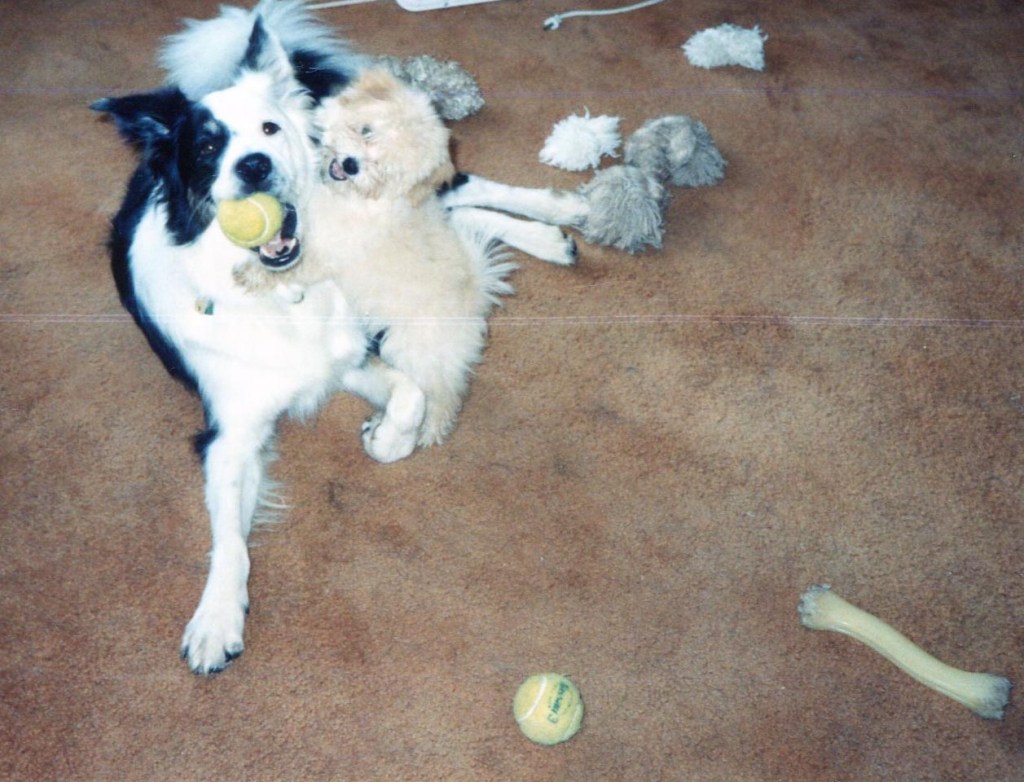
Woody and Lily playing with toys under supervision
Dogs should not be given any product that can be chewed into small undigestible pieces. Such items would be bones, both real and fake, plastic toys, balls, sticks, some of the teeth cleaning chews/products, rawhide, pig ears, and cow hooves. If you are in doubt as to whether or not a product is safe for your dog to eat, put it in a bowl of water. If it does not break down and dissolve in five to ten minutes it is most likely not safe for your dog to ingest.
Many people like to play tug-of-war with their dog and use rope toys. These are OK for this type of play, but a dog should not be allowed to chew and swallow any type of rope. The strands can block the intestines, they are not digestible. Also be careful of stuffed toys and any product made of cloth. These also can block the dog’s intestines and are not digestible. Many stuffed toys are stuffed with batting that is made of synthetic material, again, not digestible.
If your dog likes to play with stuffed toys, watch him carefully to see if he rips the toy apart to pull out the stuffing or if he is the type of dog that will not destroy the stuffed toy. The key with any type of toy is to know your dog. With care and observation, a dog can play safely with toys.






 A Blog by Susan Bulanda