Many children are taught that if a dog’s tail is wagging that it is safe to approach the dog and pet him. This is one reason why children are sometimes bitten. First, a child should be taught to never approach any animal without first asking permission to do so. If the child is alone and there is no one around to ask, they should avoid all animals.
I recall being at a dog show with my young Doberman and a young girl ran up to my dog and gave him a big hug. Fortunately my dog was safe and liked all people. I did tell the child that she should always ask first since all dogs are not safe. She looked at me, thought a minute and said, “I have a way with dogs” and left. She was at the age where she should have known better, but obviously someone had told her this and she thought that she was safe from all harm. How sad. At the same show with the same dog, an adult couple approached and started to pet my dog, giving him kisses and hugs. Being a red Doberman and young, he was rather slender. They looked up with love in their eyes and asked if he was a Vizsla. I said, “No, he’s a Doberman.” They collectively gave a gasp of horror, quickly backed away saying “I’m afraid of Dobermans!” Fortunately my dog ignored their behavior.
But the fact is that many adults think that if a dog is wagging his tail, that he is safe to approach. Some behavior consultants feel that the tail is not an indicator of a dog’s mental state at all and not a reliable means of determining how a dog feels. To a point this is true. The tail should always be included with other body language. This includes the dog’s posture, facial expressions, vocalizations and spatial proximity to the object of his interest.
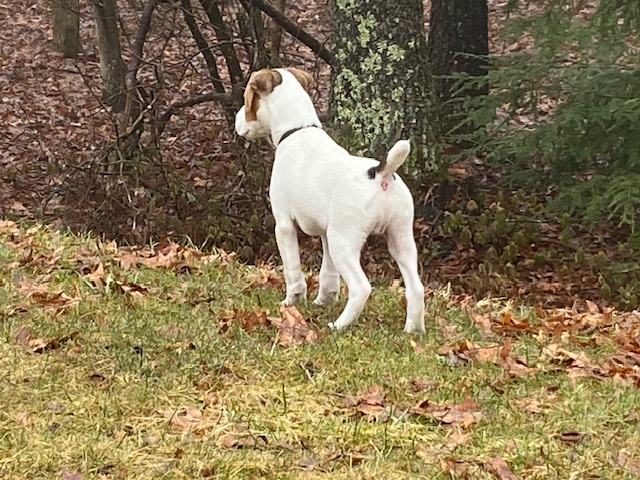
What makes it difficult to determine the meaning of a dog’s tail are physical factors such as a dog who has no tail or a small stubby tail like a Doberman. Dogs whose tails are naturally carried in a certain position, such as the high tail of a Beagle, or breeds that normally carry their tails low such as a Greyhound as well as those dogs who have very curly tails such as a Husky.
However, there are some general rules that a person can use to determine if the tail is a warning rather than an invitation.
1) A slow wag that is lower than the back of the dog is often a dog that is insecure. An insecure dog may fear-bite.
2) A tail tucked between the dog’s legs or even curled between the dog’s legs and tucked all the way to the dogs stomach. This means the dog is very fearful.
3) A slow high wag is often a dog that is assertive and willing to fight. If the dog is barking he could be aggressive.
4) A tail that is very high, erect, and stiff is also a sign of high alert or aggression.
With a little bit a caution and common sense, a person can avoid being bitten or being confronted by a dog that would rather be left alone.
 A Blog by Susan Bulanda