Thoughtful Ways to Include Your Pet in Your Wedding Story

by guest blogger, Cindy Aldridge

cindy@ourdogfriends.org

For many couples, a wedding isn’t complete without the pet who’s been there through everyday life. From quiet mornings to major milestones, furry companions are part of the story being celebrated. Including them in wedding festivities can feel meaningful rather than gimmicky when it’s done with intention. With a little planning, pets can add heart without adding stress.

Key Ideas

  • Choose roles that fit your pet’s temperament, not trends.
  • Plan logistics so comfort and safety come first.
  • Build in a graceful exit plan if your pet needs a break.
  • Carry the pet theme through details, from décor to keepsakes.

Why Pets Belong in the Story

From first apartments to long walks after work, pets witness the relationship’s quiet milestones. Inviting them into the celebration isn’t a gimmick; it’s a nod to shared life. The trick is choosing moments where they add warmth without stealing focus or feeling overwhelmed.

Roles That Feel Natural, Not Forced

Some pets love the spotlight; others prefer a cameo. A calm dog might walk down the aisle with a handler, while a shy cat could appear in portraits taken earlier in the day. Even a brief appearance—like greeting guests during cocktail hour—can feel meaningful when it aligns with your pet’s personality.

Preparing Your Pet for the Big Day

The goal is familiarity, not perfection. Walk your dog around the venue in advance. Practice short leash walks with distractions. Introduce any outfit well before the wedding so it feels routine, not restrictive. Assign a trusted friend or professional handler whose only job is your pet’s care.

Before the celebration arrives, walk through these practical steps to set everyone up for success:

  • Schedule a vet check to confirm vaccinations and health.
  • Pack a small kit with water, treats, waste bags, and a favorite toy.
  • Choose a quiet rest space away from music and crowds.
  • Confirm venue rules and any required documentation.
  • Plan transportation to and from the venue that suits your pet.

Styling Without Stress

Comfort always wins. Lightweight collars with florals, a simple bow tie, or a flower crown designed for pets can elevate photos without irritation. Skip anything that limits movement or hearing. If in doubt, dress up the leash instead of the pet.

Turning Wedding Memories Into Lasting Keepsakes

Including pets doesn’t have to stop when the music fades. Thank-you cards featuring your furry companion extend the celebration and add a personal note guests genuinely remember. Using an online app that lets couples design and order printed custom cards with polished templates and intuitive editing tools makes the process simple and flexible. You can personalize colors, photos, and messaging, then easily print online cards that feel thoughtful without adding post-wedding stress.
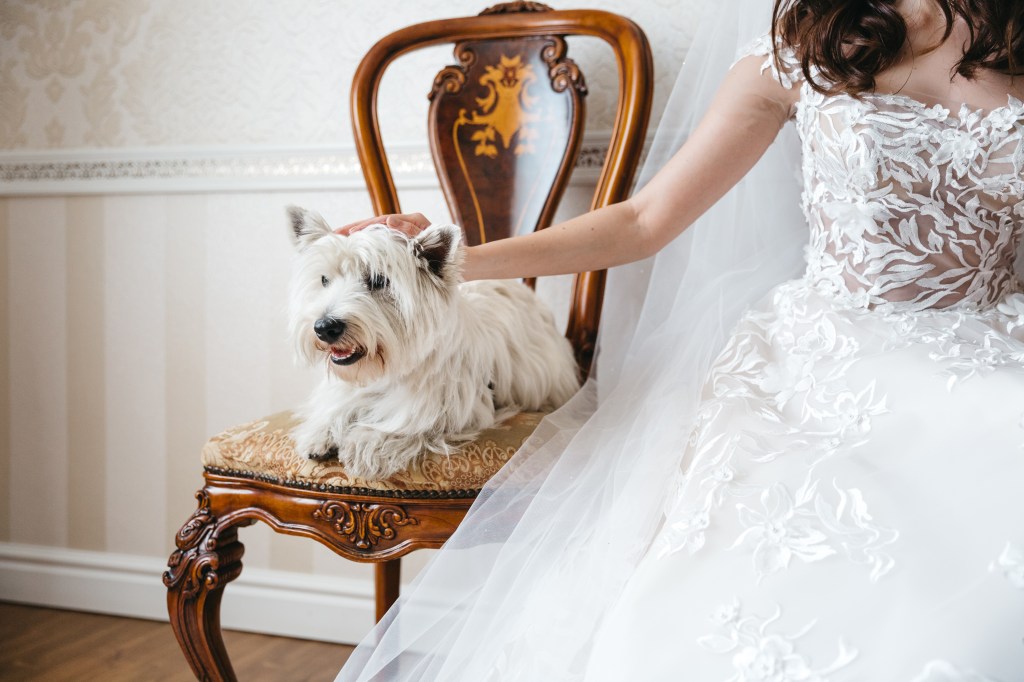
Bride with a beautiful dog on the wedding day

What Works Best by Wedding Moment

Different parts of the day call for different levels of pet participation. This overview helps you decide where your companion fits most comfortably.

Wedding MomentBest Pet InvolvementNotes
Getting readyPortraits and quiet bonding timeLow stress, great photos
CeremonyAisle walk or front-row seatingKeep it brief
Cocktail hourGuest greetings with a handlerMonitor energy levels
ReceptionQuick appearance or early send-offNoise can be overwhelming

Practical Questions Couples Ask

These common questions help clarify what’s realistic and worthwhile.

Is it okay if our pet doesn’t stay for the whole wedding?
Absolutely, and it’s often ideal. Many couples plan a meaningful appearance followed by a calm exit. This keeps the experience positive for the pet and stress-free for you.

Should we hire a professional pet handler?
If your budget allows, it can be a game-changer. A handler manages walks, breaks, and cues so friends can enjoy the day. It also gives you peace of mind during key moments.

What if our venue has restrictions?
Always confirm rules early. Some venues allow pets only outdoors or for photos. If restrictions are tight, consider off-site portraits or symbolic nods like signage or stationery.

How do we keep guests comfortable if they’re not animal lovers?
Clear boundaries help. Assign handlers, avoid roaming pets, and ensure no one is surprised. Thoughtful planning keeps the focus on celebration, not logistics.

Are outfits really necessary for pets?
Not at all. Many couples skip clothing and still achieve beautiful photos. A clean, brushed pet with a stylish leash can look just as polished.

What’s the simplest way to include a pet if logistics feel overwhelming?
Photos and paper details are the easiest path. A short portrait session or pet-themed thank-you card captures inclusion without day-of stress.

Bringing It All Together

Including a furry companion can deepen the emotional texture of your wedding when it’s done thoughtfully. Focus on comfort, choose moments that suit your pet’s nature, and let simplicity guide your choices. Whether they walk the aisle or smile from a photo on your thank-you cards, their presence can quietly remind everyone what family really means.
Genetic and Environmental Drivers of Disease

Lead animal scientist Antonia Mataragka of the Agricultural University of Athens has conducted a study that explores the increase in chronic diseases in the animal kingdom. These same diseases are found in both animals and humans.

For example, obesity is widespread in dogs and cats. Being overweight leads to a greater number of cats who develop diabetes. About 20% of pigs develop osteoarthritis, beluga whales have an increase of gastrointestinal cancers and farmed Atlantic salmon suffer from cardiomyopathy. It doesn’t end there, up to 25% of wildlife living in polluted estuaries are developing liver tumors. Even

Marine turtles and fish are developing more tumors.

Mataragka hopes that her research will encourage more coordinated monitoring of both animals, people and ecosystems to identify early warning signs by recognizing shared causes of chronic illnesses and reduce disease risks for both animals and people.

Antonia Mataragka. Beyond Infections: The Growing Crisis of Chronic Disease in AnimalsRisk Analysis, 2025; DOI: 10.1111/risa.70130

Society for Risk Analysis. “Animals are developing the same chronic diseases as humans.” ScienceDaily. ScienceDaily, 17 November 2025. <www.sciencedaily.com/releases/2025/11/251116105735.htm>.

Dogs can tell how toys work without training

What this means is that dogs can group objects by how they are used, not by how they look. The importance of this discovery shows that dogs understand words and in a more flexible manner than previously thought.

A team of animal behavior researchers worked with dog owners and had them play with their dogs with objects in two categories, pull and fetch. The owners used these words with specific toys that did not look similar.

“Next, the dogs were tested to see if they had learned to connect the functional labels to the correct group of toys before playing with more novel toys in the two distinct categories. However, this time, their owners didn’t use the “pull” and “fetch” labels for the dogs.

The team found that the dogs were able to extend the functional labels they’d learned previously to the new toys based on their experience playing with them. In the final test, the dogs showed that they could successfully apply the verbal labels to the toys by either pulling or fetching accordingly, even when their owners hadn’t named them.”

This impacts the way we train our dogs and the importance of the words that we use, especially associating the words with actions. If dogs are capable of understanding words to this level, it is reasonable to assume that other animals and birds can do the same thing.

Journal Reference:

  1. Claudia Fugazza, Andrea Sommese, Ádám Miklósi. Dogs extend verbal labels for functional classification of objectsCurrent Biology, 2025; DOI: 10.1016/j.cub.2025.08.013

Cite This Page:

Cell Press. “Dogs can tell how toys work without any training.” ScienceDaily. ScienceDaily, 23 September 2025. <www.sciencedaily.com/releases/2025/09/250923021212.htm>.

Entertain your cat while you’re at work

Some cat owners worry that while they are away at work that their cat will sleep all day and become sedentary. There are a few tricks that you can do to entertain your cat during the day or when you are away.

Adopting another cat if you only have one, may be the solution. This works very well if the cat is still a kitten or younger. Two young cats will play and entertain themselves quite nicely. As they get older, they will provide company for each other. If you have an older cat, be sure to introduce the cats by keeping the new cat in a room alone. You will know when it is time to let the two cats get together when the resident cat sits by the door where the new cat is being kept. Do not force the cats to interact, let them do it on their own.  

Cats love to explore boxes and paper bags. You can design a maze of boxes by cutting holes in the sides and attaching them together. You can also leave open paper bags (shopping size) around the house.

Making a window available for a cat, either with a chair, wide window sill or a cat perch designed for a window is also a way for a cat to enjoy being alone. If you hang a bird feeder outside the window the cat will enjoy watching the birds for hours. Make sure that the available window is by a sunny side of the room because cats love to sit in the sun.

If there are no dogs in the house, you can hide cat treats for the cat to find. Do not let the cat see you hide the treats the cat may get wise to the treat hiding game. If your cat gets wise to the game, lock the cat in one room while you hide the treats. Your cat will have a lot of fun hunting for the treats.

Be sure to include lots of toys for your cat to play with. Adding new and different toys will keep the cat interested. You can remove a few toys each week and add different ones, rotating the toys will make the old ones seem new to the cat.

Some cats enjoy soothing music, such as classical music or easy listening music. If your cat likes music play it while you are gone.

With a little thought and planning you can keep your cat happy and entertained while you are away. Your cat will appreciate it and help prevent separation anxiety.

Pet Toys

Note: This article is my opinion, based on my experiences with many dogs, cats and birds.

Pet owners spend a considerable amount of money on toys for their pets. Toys are important for pets; they give pets something to do and, in some cases, build the bond between the pet and owner. While I will refer mostly to dogs, this article applies to all pets.

It is important to realize that there is no regulatory body for pet toys. What that means is that manufacturers can use whatever material they choose to make pet toys. Unfortunately, many of the products that are available are not safe, either because of a chewing or a toxic substance risk.

When picking a toy for your pet, you should consider the type of animal it is and what it likes to do. Dogs like to fetch, toss and chew and shred toys. This satisfies their natural hunting instinct. Cats like to chase, pounce, carry and sometimes tear up toys.

Birds generally like to tear apart, peck and toss toys. Although many birds play with toys in various ways. I had a budgie who liked to “herd” plastic balls into a tight group.

When considering a toy for a pet, keep in mind that if there is a risk associated with the toy, the risk increases if the pet is small. This is because it takes less material to block their intestines and less toxins to make them sick or kill them. This is why a pet owner should carefully evaluate what toy they give their pet.

I feel that toys for dogs pose the most risks because dogs tend to chew and eat pieces of their toys more than other pets. Know how your dog likes to play with a toy before you pick one out for him. Some dogs will totally destroy a stuffed toy or a plastic one. Other dogs like to carry a toy around and will not destroy it. Many dogs are obsessed with getting the squeaker out of a toy that has one. My terrier is a squeaker killer. He will work on a toy almost endlessly until he gets the squeaker out. Then for the most part, he loses interest in the toy.

Puppies almost always chew a toy until it is destroyed and they are more likely to eat the pieces of the toy. For this reason, plastic toys are a higher risk for puppies. Regardless if your dog is a puppy or an adult, plastic toys in general are the highest risk.

Because dogs like to chew and destroy toys, they are less likely to play with the chew-proof variety of toy. Some of the hard nylon toys are coated with a scent and when the coating wears off, the dog loses interest in the toy. Stuffed toys pose a problem because the stuffing, which can be ingested and not digested. The stuffing in most dog and cat toys are fiber fill which is a form of plastic and can block intestines.

If a dog owner is going to give their dog one of the many products on the market designed to clean the dog’s teeth while they chew the toy, be sure to check the ingredients. Most dental chews for dogs are only 96% digestible. What is the other 4%? Some of these products have plastic in them to make them last longer.

Those chew products that are designed to be eaten, should break down in five to ten minutes when placed in water, if not, it is a high risk for your dog. These types of products can block a dog’s intestines. Because of a dog’s short digestive tract, these products do not have enough time to break down if they can break down at all.

This is also true of any rawhide product. I personally do not approve of any animal product such as cow hooves, pig’s ears and rawhide. These products are often treated with formaldehyde as a preservative and cured in arsenic. Many people think that rawhide comes from a butcher, but in reality, rawhide comes from a tannery. Also, keep in mind that any wild domestic canine does not eat bones, skin or hooves.

This is evident when you see a dead deer along the roadside. After everything, animal, bird and insect are finished feeding on the carcass, the things left are hide, hooves and bones. The main risks for letting a dog eat rawhide are contamination, choking hazard, and intestinal blockage. A number of pet related organization discourage giving dogs rawhide.

(https://m.facebook.com/PlanetPawsMedia/photos/a.114414471966777/883417478399802/?type=3&p=30)

Rope toys are acceptable if your dog does not chew them and swallow the threads. The safest rope toy is one made of cotton instead of nylon. Cotton has a better chance of breaking down if it is ingested whereas the nylon will not.

It is never a good idea to give a dog old shoes or slippers because of the chemicals used to make them. It is especially difficult for a puppy to understand that old shoes and slippers are OK to play with, but new shoes and slippers are not. If you insist on giving your dog rawhide remember that rawhide comes from a tannery and dogs have a very sophisticated sense of smell. Therefore, a dog of any age can smell the similarity between rawhide and other leather products, which include furniture, gloves, jackets and briefcases.

Bones are not a good choice for dogs either. Again, it is not natural for dogs to eat bones. Many of the “natural” bones have bacteria on them that can harm both dogs and people who handle them. Some of the stuffed bones that are treated can be safer for a dog who likes bones. The danger associated with bones are splinters from the bone and bacteria.

The bottom line is to know your dog. If a toy becomes small enough to swallow it should be taken away from the dog. By knowing your dog’s play habits you will be able to decide what toy is safe for them to play with. The best toy is one that allows you to interact with your dog, playing fetch games, chase games or whatever your dog likes. If you understand your dog’s breed, it will guide you to selecting the right toy for your dog. All dogs and cats can benefit from puzzle toys and treat dispensing toys. The main thing is to keep your pet safe and happy.

Susan Bulanda’s books

The Business of Dog Training: How to Succeed as a Successful Dog Trainer – will guide you through every aspect of running dog training business from what kind of trainer you want to be to how to deal with clients. This is a must have book for those people who want to become dog trainers as well as those who already have a business.     2024 First Place Dog Writers Association of America – Maxwell Award

Miitary Dogs of WWII – covers all the countries involved in WWII. It names famous dogs as well as mascots. It covers the dogs that served as SAR dogs in England, helping to find buried people in bombed buildings. It explains training methods as well as the missions that the dogs went on and how they saved lives. There are about 100 photos included in the book.      2023 First Place Dog Writers Association of America- Maxwell Award

K9 Obedience Training: Teaching Pets and Working Dogs to be Reliable and Free-Thinking.  This explains how to teach a dog the basic obedience that is the foundation for all other training. The methods used in this book allow the dog the freedom to think for themselves rather than perform robotically where creativity is discouraged. Free-Thinking is necessary for all working dogs. Obedient disobedience is also covered. The book explains what not to do and why. Some fun tricks are included.

K9 Search and Rescue Troubleshooting: Practical Solutions to Common Search-Dog Training Problems – explains the typical SAR dog training problems and offers solutions for the SAR dog handler. The solutions apply to all disciplines in canine search and rescue. It explains how the puppy stages of development can have lasting effects on the behavior and training of a dog. Often people adopt an older dog to train and do not understand why the dog behaves the way it does, this book gives insight to those issues. Although K9 Search and Rescue Troubleshooting: Practical Solutions to Common Search-Dog Training Problems is written for the SAR dog handler, the information contained in it applies to many training issues that are not related to SAR.      2020, Certificate of Excellence, Dog Writers Association of America.      2018, First Place, National League of American Pen Woman.

Soldiers in Fur and Feathers: The Animals That Served in WWI – Allied Forces: A unique, collection of accounts about many different animals that served in WWI. There are many rare photos. What is especially interesting about this book is that it includes many of the mascots that the soldiers kept. Some went into the trenches with the men. For example, there is an account about how a cat saved the life of a soldier, how a pair of geese slated to be Christmas dinner wound up being kept as mascots, and one soldier had a huge Golden Eagle as a pet. WWI was a transitional war from animal power to mechanization, therefore many species of animals served, such as oxen, horses, mules, camels, pigeons, and dogs in many capacities. 2012: Second Place Winner, National League of American Pen Women, Finalist for the Alliance of Purebred Dog Writers Arthur Award,      Certificate of Excellence for the Cat Writers Association of America.

Faithful Friends: Holocaust Survivors Stories of the Pets Who Gave Them Comfort, Suffered Alongside Them and Waited for Their Return: The only book written about the animals of the Holocaust victims, recording a part of history that has been overlooked. Some of the stories are sad and some joyous, but all are a part of history. Learn about Nicholas the French Bulldog owned by a woman who was part of the French resistance, and how he came to tour with the German army. Also, the dogs who somehow survived the war and were reunited with their owners and many other stories about dogs and cats.      2012: Dog Writers Association of America, Maxwell Award,     Certificate of Excellence Cat Writers Association, 2012; National League of American Pen Woman 2nd place  

God’s Creatures: A Biblical View of Animals explains the role that animals play in the Bible and how God uses them. It explores the nature of animals and miracles that involve them. It answers questions such as, do animals go to heaven, do they know and obey God, can they be evil?

Boston Terriers, a book all about this wonderful breed of dog. Learn about their care, training and personality. The book has fun sidebars that give personal accounts of Boston terriers.        2002 – First Place Maxwell Award for the Dog Writers Association of America (only available on Amazon)

Ready: The Training of the Search and Rescue Dog: Adopted worldwide as the training book for SAR dogs. This book has been in print since 1994 and is in its second edition. It gives the SAR dog handler a training plan for all disciplines of canine search and rescue.       First place for the National League of American Pen Woman, 1996. Also nominated best book of the year, 1994 Dog Writers Association.

Scenting on the Wind: Scent Work for Hunting Dogs: helps the hunting enthusiast understand how weather, wind and terrain features affect scent. It is a great aid for people who compete in field trials or who do any kind of scent work with dogs. Only available from the author’s website http://www.sbulanda.com

Real Estate Today, Seller Beware! – explains how to save thousands of dollars when selling your house. Available on Amazon

Do it yourself anti-cancer diet for pets

While this article is old, it does have important information for pet owners to consider. According to the article adding the Budwig diet to your pets daily diet can go a long way to prevent cancer in dogs and cats.

Some of the breeds that are more susceptible to cancer are:

Bengals (cats)
Boxers
Great Danes
Labradors and many of the Retriever breeds
Persians (cats)
Rottweilers
Saint Bernards
Scottish Terriers
Siamese (cats)

According to the article the following are some of the contributors to cancer:

Over-vaccination
Overuse of topical chemicals and flea and tick medications
Lawn treatment
Fluoridated water
Obesity
Certain pet food ingredients

Some of these pet food ingredients include:

Ethoxyquin
By-products
Dyes
Molds/fungi
Simple carbohydrates like corn, wheat, and soy

The diet was discovered by Dr. Johanna Budwig a German Biochemist. Dr. Budwig found that two ingredients helped prevent cancer.

Budwig Recipe:

2 tablespoons flaxseed oil, fresh, refrigerated

1/4 cup cottage cheese, organic

Mix together so that the cottage cheese is no longer oily. If it is still oily, add more cottage cheese.

Feed this mixture to your pet two or three times a day every day on an empty stomach. Wait one hour to feed a regular meal.

Every day. Feed 1-2 teaspoons for cats, up to ½ cup twice a day for large breed dogs.

Make fresh at each meal. Flax seeds can be used but should be ground fresh then mixed into cottage cheese.

A DIY anti-cancer recipe for your pet – Truth about Pet Food

Children often have a closer relationship with pets than siblings

When Matt Cassels, at the University of Cambridge, studied the data set from the Toddlers Up Project led by Professor Claire Hughes at the Centre for Family Research, he made some interesting discoveries. He found that children often have a closer relationship with their pet than their siblings.

This gives us new information about the depth of the human animal bond, even in children. The Toddlers Up Project has collected information over a ten-year period about the social and emotional development of children. The research included data from the children, their parents, teacher and siblings.

Cassels found that children who suffered from adversity in their lives were more likely to have a stronger relationship with their pets than their peers. The types of adversities ranged from divorce, illness, instability, and disadvantaged backgrounds.

What is interesting is that these children would turn to their pets, confiding in them instead of peers even though they knew the pets did not understand what they were saying.

The study showed that children with stronger relationships with their pets had a higher level of prosocial behavior, such as helping, sharing, and co-operating than their peers.

I personally have seen the positive impact of pets on children and would love to see more research about the role pets play for young children who do not have siblings.

Children have bonded to dogs and other animals throughout history. One famous actor got his nickname because of his Airedale, Duke, was his constant companion. That actor of course, was John Wayne.

For more information about Matt Cassels study go to:

http://www.sciencedaily.com/releases/2015/05/150513135011.htm?utm_source=feedburner&utm_medium=email&utm_campaign=Feed%3A+sciencedaily%2Fplants_animals%2Fdogs+%28Dogs+News+–+ScienceDaily%29

Early spay or neuter in dogs

There is an on-going debate over spaying or neutering dogs before they reach maturity. In the United States, most veterinarians, shelters and rescue groups encourage dog owners to spay or neuter their dogs before or by six months of age, before a first heat for females. The AKC Health Foundation has been researching the pro’s and con’s of early spay/neuter in Golden Retrievers.

They have compared dogs that were spay/neutered before one year of age and after one year of age. What they have found so far is that the timing of spay/neutering had a significant effect on the health of the dogs. They found that early neutering of male dogs more than doubled the risk of Hip Dysplasia but did not have the same affect on female dogs.

Early spay/neuter increased the risk of cruciat ligament tear (CCL) and lymphosarcoma (LSA) in both sexes. Late spaying in females increased the risk of hemangiosarcoma (HAS) and mast cell tumor (MCT). Intact female dogs had no mast cell tumors.

As a result of this study, the AKC CHF is extending its research to include German Shepherd Dogs, Labrador Retrievers, Dachshunds, Rottweiler’s, Chihuahua’s, Standard and Miniature Poodles. 

The question remains, what should a dog owner do? No one wants to increase the risk of health issues in their pet.

First and foremost is talk to your veterinarian and ask them if he/she is aware of the most recent studies concerning the effects of early spay/neuter. After researching the facts, the dog owner must evaluate their ability to handle a dog that is not spayed or neutered. How the dog will behave depends in part on how well it is trained and its breed as well as its individual personality.

Some considerations are:

Should I wait until my dog reaches sexual maturity and then have the dog spayed/neutered?

If I have a female dog can I keep the dog safe from being bred until it reaches or passes sexual maturity?

Can I deal with the discharge that comes with the “heat” cycle?

Do I have a prevention plan with my veterinarian to take care of an unwanted, accidental breeding with my female dog?

Do I have a plan to deal with an unwanted litter of puppies?

Can I keep my dog, male or female under control to prevent them from wandering/escaping during a heat cycle?  Females will wander to spread their scent to try to lure a male and a male will run away to find a female when he picks up her scent.

Can I control my male dog to keep him from marking?

If my male dog has a tendency to be aggressive, can I handle the aggression (toward humans and other animals) that sometimes manifests itself in un-neutered male dogs?

These are just a few of the important decisions a dog owner should consider when deciding if they should have their dog spayed or neutered before sexual maturity or at all.

Sue’s Note: For many years people who own working dogs, such as Border Collies that are used for herding have said that if a dog is spayed/neutered before maturity that they do not work as well. Some people feel that the dog does not fully mature mentally if they are spayed before a first heat for females.

Dog sports help children with cancer

Dog sledding is a popular sport in many countries around the world. Competitive dog sledding can be a grueling sport, but recreational dog sledding can be a lot of fun, especially in the winter when many people are confined to indoor activities. Many years ago I had a small team of Siberian Huskies that I did sledding with.

         Much to my delight, I read about a study conducted by Fédéric Sotteau who is the founder of the French non-profit group Sourire á la Vie in Canada and Dr. Nicolas André, a pediatric oncologist at the Assistance Publique Hôpitaux de Marseille, France, where they found that dog sledding provided positive results for children who were being treated for cancer.

         There were eleven children ages ten – eighteen years old and five chaperones which included doctors and nurses who participated in the expedition.

         Many people, including doctors’, think that children who are being treated for cancer are too tired, weak or sick to participate in sports or other physical activities. The children themselves lose faith in their abilities to be active as well.

         After going through a program of physical conditioning and training, the children were allowed to participate in the expedition. The reason why the study group picked dog sledding was to provide a unique sport experience that included a change of scenery and bonding with the sled dogs as well as the adventuresome aspect of the event.

         The study showed that adapted physical activity is very beneficial to children with cancer, their physical and mental health benefit from the program.

         It would be great if more groups sponsored this type of therapy for children with pediatric cancer.

ecancer. (2015, July 28). Dog sledding offers a healthy dose of adventure for children with cancer. ScienceDaily. Retrieved May 22, 2025 from http://www.sciencedaily.com/releases/2015/07/150728092057.htm