A New Study Shows that People “Baby Talk” To Their Dogs


Dr. Nicolas Mathevon from Hunter College (CUNY) conducted an international study showing that people talk to their dogs, both puppies and adult dogs, the same way they talk to human babies. They use higher tones and speak slower. Interestingly people tend to talk this way to elderly people and people who do not speak their native language.

dscn1417

What the team noted is that puppies do respond to this type of speech whereas adult dogs do not. It seems as though people talk this way when they think the animal or person they are talking to does not understand or has difficulty understanding what is being said.

It would be interesting to research this further to see if people talk this way to other animals such as birds and cats. It could be fun for my readers to watch people and see if you notice that they do this or even if you do it yourself.

Read the full article at: www.sciencedaily.com/releases/2017/01/170111151828.htm

Are Chickens Really “Dumb Clucks?” New research says No.

Recent tests have shown that chickens have individual personalities, can function in a group, can reason by deduction and understand their place in the flock.  Not only that, but chickens have a sense of numbers and self-awareness.

It turns out that chicken communication is also much more complex than previously thought, including visual and auditory forms of communication. They are able to make decisions based on what they determine is best for themselves.

The study also showed that chickens experience both negative and positive emotions. Mother hens display maternal feelings for their chicks and influence how the chick behaves.

How interesting chickens are. Many people keep chickens for pets so this study should be of special interest to them. Chickens have been used for years to hone clicker skills for dog trainers and potential dog trainers.

img066

img065

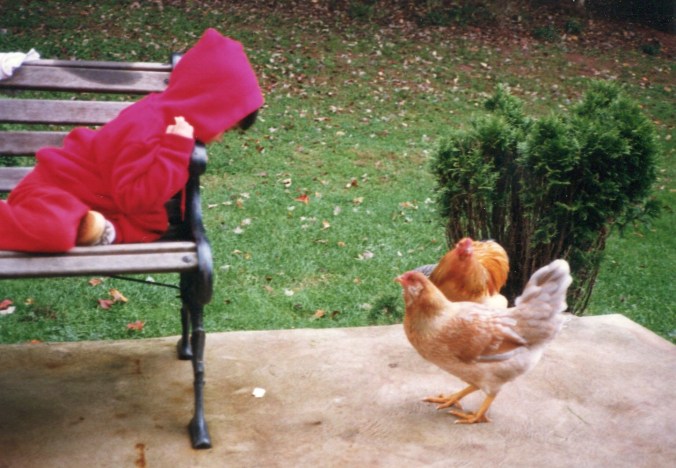
My son Tom and my araucana chickens (many years ago)

www.sciencedaily.com/releases/2017/01/170103091955.htm

Lady Bugs Can Pose a Threat to Pets

There is a “new” threat that dog owners have to watch out for, Lady Bugs! There have been cases where dogs were foaming at the mouth, drooling, lethargic and refused to eat. Upon examination the dog’s owner and/or veterinarian found Lady Bugs in the dog’s mouth.

Apparently Lady Bugs give off a toxin that causes a chemical burn in the dog’s mouth. There are certain times of the year that Lady Bugs seem to invade homes and some dogs try to eat them.

As a general rule, if there is an infestation of bugs in a home, a pet owner, both dog and cats, should watch carefully to make sure that their pet is not eating the bugs. My own dog became sick after eating a large number of Stink bugs. Fortunately, he only vomited and as a result of the experience never ate a Stink bug again.

download-10

http://thebark.com/content/dogs-mouths-damaged-ladybugs?utm_source=Bark+Newsletter&utm_campaign=16b764efae-BarkNews_11162016&utm_medium=email&utm_term=0_e8c8dbbec1-16b764efae-78310125&mc_cid=16b764efae&mc_eid=7a6c42f027

After the Rain by Rita Gerlach

41kwi-2fmyl

After the Rain by Rita Gerlach, ISBN: 13: 978-1517606886 & 10: 1517606888, Self-Published, 569 pgs, $19.33.

This a wonderful Historical Christian Romance novel by Rita Gerlach that takes place in Chevy Chase, MD and Virginia during the Edwardian Age. Ms. Gerlach has captured the essence of life during this time in a captivating way. She shows the reader what life was like for the privileged and the poorest unwanted children. It is a captivating, page turning story with twists that will surprise the reader. One of the things that makes this novel seem real, is the way Ms. Gerlach portrays the personality of each character and weaves it together through the relationships between the people in the story. This book is suitable for all ages.

Phillip’s War

Phillip’s War by Rachel Muller, 374 pgs., ISBN: 9781536961546, $15.99

51mjg9dmkjl-_sx322_bo1204203200_

This is the third and final book in the Love & War series by Ms. Muller. The other two books are Letters from Grace and Maggie’s Mission.  All three books complement each other telling the story about three friends during WWII. The emotions and flavor of this time period are captured by Ms. Muller with accurate details about life during WWII. Phillips War shows the reader how shell shock (PTSD) affected soldiers and their families.

While each book is unique, they weave a complete story together. Often when you finish a book you are left wondering what finally happened but Phillip’s War tells the rest of the story in a special section at the end of the book.

All three books are Christian based without being preachy and are suitable for all age groups. It is a good book for young adults to learn what life was like during the war years. Although the situations in all books are unique to WWII, the way the characters handle their problems applies to modern times as well.

Do Dogs Prefer Food or Praise as a Reward?

In an attempt to further understand the human-animal bond, researchers investigated whether or not dogs prefer praise or food from their owners. Surprisingly most of the dogs preferred praise or praise and food equally. Two of the dogs were chow-hounds and preferred food.

While 13 subjects are not a fair sampling, especially when one considers the personality differences in breeds and even within the same breed, the study does shed some possibilities for consideration.

Most trainers, behavior consultants and handlers of working or sport dogs can tell you about individual dogs who are not food motivated. The people who try to work with these dogs have to find another way to motivate them. Fortunately, most dogs will work for both praise and food, making it easier to motivate them in training situations.

Food is still a great way to train a dog, especially when coupled with clicker training. But for those dogs who are not food motivated, a pat on the head or verbal praise is just as good. When using food, it is always best to wean the dog off of the food once he has learned the exercise and save the special treat for new exercises.

Studies such as this one are great because they open minds and possibilities for future studies. The research team in this case want to explore how dogs process and understand human language.

www.sciencedaily.com/releases/2016/08/160816120656.htm

dscn1701

Bab’s — Praise Motivated

smiling-riley

Riley — Food Motivated and laughing about it!

K9 Investigation Errors: A Manual for Avoiding Mistakes

K9 Investigation Errors: A Manual for Avoiding Mistakes, by Resi Gerritsen and Ruud Haak, Brush Education, Inc.; 256 pgs.; ISBN: 978-1-55059-672-4, $44.95

510zjcqcgl-_sx320_bo1204203200_

How can you make a good book better? Resi Gerritsen and Ruud Haak who wrote K9 Fraud, have accomplished that with their updated book, K9 Investigation Errors. They cover many important points in handling dogs that are common mistakes. For example, they explain how dogs can read human gestures, even the slightest ones (the Clever Hans Effect) which can cause a false response from a dog. They review some famous cases in the United States and show how the handler or poor training misled authorities, sometimes resulting in the arrest of the wrong person.

What I especially liked was their comments that dog handlers who claim fantastic results with their dogs (typically false) influence authorities who believe them and then think that properly trained dogs who cannot perform to that level are not as good, when in fact the properly trained and handled dogs are correct.

Another interesting point that they bring out in their book is what they call failure scents. This is when a dog associates a scent with failure and by association can lead to the dog’s poor performance. This is the same as people will often associate a benign event, song, scent or even food with a bad experience and react to the memory that it triggers.

There is so much information in this book that I strongly recommend handlers of all disciplines read this book and evaluate how they can improve their dogs and their handling skills.

The book is a high quality book, as is typical of Brush Education Publications, with quality binding, pages and soft cover. It is well edited with no typo’s or other common mistakes that authors tend to make when writing. It is always a pleasure to review a Brush Education book.

The chapters are:

Scent-Identification Lineups

The Dutch Training Method for Scent Identification

Dogs’ Responsiveness to Human Gestures

Tracking Dogs in Crime Investigations

Scent Research and Tracking Experiments

Errors in Mantrailing

Human Odor and Dogs’ Scent Perception

Scent Problems and Training Problems

Preventing Investigation Errors

Birds nest near friends that they made during the winter- new study shows

Birds in general are much smarter than previously thought. They form friendships, work together and protect each other.

Most people have seen flocks of geese grazing in a field or by the water. If you look closely you will see one or two geese standing with their heads held high scanning the area for danger. They are the geese on guard.

Crows will have meetings to learn who had the best success in finding food that day. The next day some of the members of the flock will follow the successful crows.

Certain types of birds, such as Chickadees, Titmouse, and others will let birds in the area know that they have found a well-stocked bird feeder, especially in the winter. The other birds learn to listen for the announcement.

New research shows that some birds will establish their spring nesting sites near the birds they made friends with during the winter. They seem to share boundaries with the birds that they are closest too. What is interesting is that the birds will form friendships. This indicates that the birds have social interactions with each other, perhaps more than we humans suspected.

Even birds that typically live a solitary life, such as Robins, will join together and flock to migrate. Sometimes a person is able to predict the weather by the behavior of the wild birds. The birds seem to  know when a storm is coming, sometimes a day before.

How fascinating it is to learn about wild animals. Birds are easy to watch if you put up a few bird feeders. It is wonderful that scientists are learning how smart animals really are.

www.sciencedaily.com/releases/2016/09/160914143538.htm

https://www.linkedin.com/pulse/backyard-food-scouts-titmice-chickadees-sherry-thornburg

dscn1753copy-of-hawkdscn0971


The Amazing World of Plants – Some Trees Know When a Roe Deer Has Eaten a Shoot or Bud


Although plant neurobiology is not a new field new material is always a fascinating topic. In this case, Carolin Seele (Leipzig University) and Stefan Meldau (Max-Planck-Institute for Chemical Ecology) have discovered that young beech trees (Fagus sylvatica) and maple trees (Acer pseudoplatanus), can protect themselves from roe deer that love to eat their new shoots and buds.

This amazing discovery found that the trees can determine whether the shoot and/or bud was eaten by roe deer or damaged by other circumstances. The trees are able to detect roe deer saliva which triggers an increase in its production of salicylic acid. This hormone then signals an increase in the production of specific tannins which the deer do not like to eat. Not only that, but the growth hormone is also increased to compensate for the lost bud or shoot. If the damage is by other means, such as a storm, the trees only produce a growth hormone.

Many years ago people found that if they talked to their plants they would grow better. Maybe there was something to this. There are so many wonderful things yet to be discovered about plants. What a fun topic!

www.sciencedaily.com/releases/2016/09/160912132733.htm

dscn1824

Canine Parvovirus Mutated from Domestic Cats

Those of us who have been involved with dogs for many years may recall the terrible outbreak of Canine Parvovirus in the 1970’s. Many puppies and dogs died as a result. In some cases, whole litters died.

What most people do not realize is that according to a study conducted by Colin Parrish, the John M. Olin Professor of Virology and director of the Baker Institute for Animal Health at Cornell University and Susan Daniel, associate professor in Cornell’s Robert Frederick Smith School of Chemical and Biomolecular Engineering, is that the virus most likely was transferred from the feline panueukopenia or a similar virus from domesticated cats.

According to their study the virus can jump from one species to another because of a mutation in its protein shell. As a result, the virus has since infected a variety of wild carnivores including the raccoon.

This is why it is very important to vaccinate pet dogs and cats. This not only protects them from the virus, but can help prevent the virus from spreading to wildlife.

FMI: www.sciencedaily.com/releases/2016/04/160414122007.htm

scan0022