Has the Grey Wolf and Striped Hyena Joined Forces in Israel for Survival?

A study conducted by Vladimire Dinets, UT Assistant Professor of Psychology at the University of Tennessee, Knoxville, and Benjamin Eligulashvili, an Israel-based zoologist, seems to imply that these two enemies may have joined together for survival in the harsh Israeli desert.

Striped Hyenas were observed in the middle of grey wolf packs as they traveled together through a maze of canyons in the southern part of the Negev desert.

Why would they do this? The theory is that the hyenas have a better sense of smell and the ability to locate carrion miles away. They can also dig and crack bones better than wolves. The wolves are more agile and can bring down large game. Together they both have a greater chance of survival.

What is not known is if this is a common occurrence that has not been observed before, or an unusual event.

What is nice about their unity, as Dinets commented, it is an example for humans about overcoming differences and learning to get along.

It is always refreshing to learn more about the behavior of wild animals and studies like this make you wonder how much more there is to learn.

https://www.sciencedaily.com/releases/2016/03/160317151307.htm?utm_source=feedburner&utm_medium=email&utm_campaign=Feed%3A+sciencedaily%2Fplants_animals%2Fdogs+%28Dogs+News+–+ScienceDaily%29


Canine Hereditary Disorders Affect More Dogs Than Previously Thought

Good breeders typically do all of the genetic testing on the parents of a litter before they breed. Research has indicated that this is much more important than ever before.

Genoscoper Ltd. (a Finnish company specializing in animal genetics and gene testing) has published the most conclusive study ever on canine hereditary disorders. The study was done with researchers from the University of Helsinki and the University of Pennsylvania and published on PLOS ONE, 8/15/16.

They tested 7000 dogs in about 230 different breeds for a predisposition for about 100 genetic disorders. They found that 1 in 6 dogs carried at least one disease. Additionally, 1 in 6 breeds that never tested positive for one of the diseases had a predisposition for it.

This information will help dog owners understand and identify early signs of inherited disorders which may enable pet owners and veterinarians to better able  identify health issues earlier and perhaps prevent suffering for the dog.

This important study will lead to further research about inherited diseases in dogs that will help the overall health and well-being of both dogs and other pets.

www.sciencedalily.com/releases/2016/08/160822100703.htm

dempsey.jpg

New Hope For Cat FHV-1 Eye Infections

Cats frequently suffer from Herpes Virus 1 (FHV-1) an eye infection that causes them to blink, squint have teary eyes and eyes that look sore. If not treated a cat can become blind. The current medication to treat this eye infection must be applied frequently and may not always work.

Dr. Gerlinde Van de Walle has led a study at the Baker Institute for Animal Health at Cornell’s College of Veterinary Medicine that may lead to a new drug that will cure the infection and only needs to be applied once a day. The drug will soon head to clinical trials.

baby


Transporting Your Nervous Cat to the Veterinarian

The following article is written by and provided courtesy of:

Dr. Daniel Mudrick; B.Sc, D.V.M, Clarkson Village Animal Hospital, 1659 Lakeshore Road West, Mississauga, ON, L5J 1J4

905-855-2100

petcare@clarksonvillagevet.com

www.clarksonvillagevet.com


cat.png

Transporting Your Nervous Cat to the Vet

As tough as cats can be, a simple car ride to the vet can be very stressful for them. Cats often become nervous or anxious with travel, and then behave in a passive or sometimes aggressive way.

Our goal is to prevent problems for you and your pet. Our simple recommendations will make travel and vet visits much easier for your cat.

Cat Calming Recommendations

Leave your cat carrier out for at least a few days prior to travelling.

Leave the carrier in an easily accessible area of the house where your cat will see it. You should leave the door of the carrier open so your cat may go in and out as she/he pleases. You can place food or treats in the carrier to help build a positive association with it.

Use Feliway 15 minutes prior to putting your cat in the carrier.

15 minutes before you will put your cat in the carrier, you should wipe down the inside with Feliway wipes or Feliway spray. Feliway is a pheromone treatment that helps elicit a calming response in cats.

Learn more at www.feliway.com.

Don’t put your cat in the front seat of the car.

It’s best not to put your cat carrier in the front seat of the car as it can be dangerous if the passenger airbag is deployed. You can secure the carrier in the back seat using one of the rear passenger seatbelts. Try to keep the carrier level, instead of sloping back.

Calming Supplements and Medications 

Some cats will be anxious despite the above measures. If that’s the case, we may recommend the use of a calming supplement or medication to ease your cat through the trip and vet visit.

If we have discussed with you the use of Zylkene (a calming milk protein based supplement) or Gabapentin (a gentle calming medication) to help your cat cope with the anxiety of going for a car ride, please read the following recommendations:

Hunger is your friend!

It is ideal if your cat is hungry before travel time. Feed your cat a small dinner and breakfast the night and morning before your visit. One hour before you are going to put your cat in the carrier, feed a small amount of her/his favorite food with the medication mixed in. Once you get back home, you can feed the remainder of the meal.

If your cat is not willing to eat, you should reschedule for another day.

If you need, please come in to the clinic and pick up an appetite stimulate that you can use to help ensure your cat will eat (and therefore eat the medication) at the appropriate time prior to your next appointment. The appetite stimulant is in the form of a paste that you can apply to the inside of your cat’s ear – no pilling required!

We use Feliway pheromone diffusers at the hospital and we handle cats very gently to minimize nervous behaviour.

Each cat is an individual and we want to make your cat’s car rides, and life, as comfortable as can be. Cats don’t understand what is happening; they are just afraid, and we want to help alleviate those fears.

Our goal is “Stress-Free Visits”.

For more information, visit CATalyst Council’s Cat Friendly Practice to watch a thorough video on this subject.

Please call us if you have any questions at all about helping to take the stress away from your cat.

That Day by the Creek: A Novel About the Sand Creek Massacre of 1864

Although this book is not about animals, I enjoyed it so much that I wanted to share it with all of you.

That Day by the Creek: A Novel About the Sand Creed Massacre of 1864, by John Buzzard, ISBN: 978-0-9891014-7-9; $14.49; 221 pgs, Cladach Publishing, www.cladach.com

History lovers will enjoy this book. While the main characters are fictional, other characters in this historical novel are real. The author does an excellent job of telling the true story of the events that led up to the massacre as well as the massacre itself. He shows us how the Indians, the settlers and the army felt. Buzzard has thoroughly researched the incident and includes the actual letters written by Robert Bent, Captain Silas Soule; Lieutenant Joseph Cramer; and Major Edward Wynkoop’s report in the appendix.

51pbOJ8jsQL._SX322_BO1,204,203,200_.jpg

Although this is a sad event in history, it is true and must not be forgotten. That Day by the Creek will help the reader understand how people felt, why they did what they did and the consequences of their actions. The book is an easy read, entertaining and educational making it an ideal book for teens, young adults and adults to read.


K9 Professional Tracking: A Complete Manual for Theory and Training

K9 Professional Tracking: A Complete Manual for Theory and Training by Resi Gerritsen & Rudd Haak

Detselig Enterprises, Ltd.; Calgary, Alberta, Canada; 154 pgs; $32.95; ISBN:1-55059-223-8.

This is another great book by Gerritsen and Haak. It is well researched and offers many interesting points and tips about training the tracking dog. It covers many of the myths about odor and explains how a dog detects odor and what they detect. What is especially helpful is the way the authors explain why and how dogs fail to follow scent. They stress that handler error plays a large part, as well as faulty training.

The training methods are detailed with a thorough explanation about what works and what does not. Although this book focuses more on competition, it will help the SAR dog handler as well. There was one point that I did not agree with for SAR work, but I understand why they brought it up for competition. They mention in the chapter on Cross Tracks, that if the track is interrupted, for example the person gets on a bicycle and rides away, that the dog should be stopped because the track ended. In reality the scent from the person riding the bicycle may fall to the ground and a dog can still follow it.

51RzV5LmrjL._SX382_BO1,204,203,200_

K9 Professional Tracking

All in all, this is an excellent book that will help both the sport tracker and the SAR dog handler. The chapters are:

Preface; Introduction; Scent and Perception; The Dog’s Nose; The Odors of the Track; By the Sweat of One’s Feet; Equipment and Conditions; Common Training Methods; Asking for Trouble; History of Tracking Research; Scientific Aspects; Conditions for Success; Preliminary Exercises; Clean-scent Tracking; Weather Conditions; Cross-tracks; The Limits of Tracking; Epilogue: A Lack of Character; Bibliography; About the Authors.


Soldiers in Fur and Feathers: The Animals That Served in WWI Allied Forces

Soldiers in Fur and Feathers

“There goes Little Jim!” the soldiers would call outfrom the trenches as an unusual messenger dog flew across the fields. Little Jim was a small black Pomeranian mix who was so fast that soldiers described him as a black streak.

In December of 1915 the soldiers of A Battery, 52nd Brigade, RFA, purchased a goose and gander to be fattened for Christmas dinner. However, some of the soldiers decided that they were too cute to eat. So a trial was held to determine their fate. It was decided that they should be mascots for the duration of the war. They traveled in the mess cart with their heads hanging out for the rest of the war. What a comical sight they made.

Pitoutchi the cat is credited for saving his masters life inthe trenches. How could a cat save a man’s life from the Germans?

One of England’s largest seaplanes went down in bad weather. The only hope for survival depended on a pigeon, one pigeon out of three that survived the crash. Did he make it?

The variety of animals and birds were involved in WWI is amazing. Any type of animal or bird could be a mascot. Some mascots went to battle and some stayed behind to cheer the wounded or relieve stress for the newly arrived soldiers.

Read these accounts and many others in the book Soldiers in Fur and Feathers: The Animals that Served in WWI- Allied Forces. An autographed copy of the book is available at www.sbulanda.com you can also purchase it on Amazon or at www.alpinepub.com

K9 Fraud! Fraudulent Handling of Police Search Dogs

K9 Fraud

K9 Fraud

K9 Fraud! Fraudulent Handling of Police Search Dogs, by Resi Gerritsen & Ruud Haak; Publisher, Detselig Enterprises LTD Alberta, Canada; ISBN: 978-55059-393-8, $27.95, 216 pgs.

This is a very interesting book and one of the most unusual books that I have reviewed. While book is primarily about police dogs and scent specific work, it is very applicable for SAR units. Each chapter has a number of real cases which are reviewed. The lessons in this book can be applied to all SAR disciplines.

The authors refer to studies and tests that have been conducted over the past hundred plus years to verify how and why dogs work. For example they address the studies done to determine if dogs follow human scent or the disturbance on the ground.

Each chapter reviews actual cases and why there was fraud or not. Although the book points out flaws in handling and training, it is not done in an accusatory manner. The authors explain the common mistakes that dog handlers make which lead to fraud.

The case studies covered in this book are from around the world including some better known USA cases and are lessons for the SAR dog handler. They are also interesting to read for everyone else.

What is most important about this book are the lessons that the SAR dog handler can learn about how to properly handle cases that will hold up in court as well as how to properly train and handle their dogs. I highly recommend this book. An added benefit of this book is as a guide for lawyers and other people who are involved in legal cases that use canine evidence.

The chapters are:
Chapter 1: Fraud with Scent Identification Line-ups
Chapter 2: Dog’s Responsiveness to Human Gestures
Chapter 3: Fraud with Tracking Dogs
Chapter 4: Scent Research and Tracking Experiments
Chapter 5: Fraud with Mantrailing
Chapter 6: Human Odor and Dog’s Scent Perception
Chapter 7: Scent Problems and Training Problems
Chapter 8: Avoiding and Preventing Fraud
Section 1: Scent Identification Line-ups
Section 2: Management Attention: Intentional Fraud
Section 3: Civilians in Criminal Investigations
Section 4: Contamination of Scents
Section 5: Improper Training
Section 6: Insurance Fraud

Christmas Eve Kitten

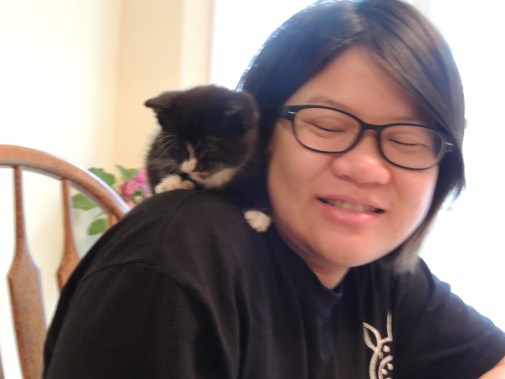
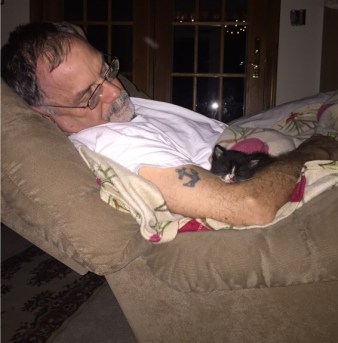
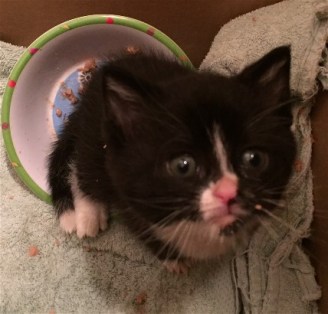
December 24, 2015 was a chilly, foggy night. Larry, Tom, Jory and I were driving home from church when we turned the corner a block from our house. Tom was driving and saw a tiny kitten scoot across the road following an older cat.

“Did you see that?” he asked. None of us saw the black kitten. Tom stopped the car and lowered the window. We could hear the pitiful cry of the kitten. We got out of the car and walked around the wooded area where the cries were coming from. There was the kitten in a pile of brush. Nearby was a dead cat. Another older cat (about six months old) stood near, watching but would not approach us.

I gently picked up the kitten whose little body fit in the palm of my hand and held her against my chest. She was trembling from the cold. By the time we reached our home the kitten had stopped shaking. Inside in good light, I could see that she was about 3 weeks old. Her eyes still had that kitten just opened blue-gray color. Fortunately I had some small cans of wet cat food left over from my cat. I put the food in a dish and put it in the box with the kitten. She did not know how to eat or what it was. Gently, I took some of the food and put it on the end of my finger and touched it to the kitten’s mouth. She licked the food off of her face and after two tries, literally dove into the dish of food with her two front feet and face. She ate almost the whole thing.

Later I eye dropper fed her some milk and water which she readily took. Of course Tom and Jory kept asking me if I was going to keep the kitten. I told them I could not because of the dogs. Although my Parson’s Russell Terrier, Riley, was raised with a cat, our new Border Collie puppy Babs, was not. I did not think I could keep the kitten safe from the dogs. I fully expected Babs to want to play with the kitten and could injure or kill her with rough play.

The next day, as hard as it was, we took the kitten to our local humane shelter (Humane Society of Carroll County, Inc. Westminster, MD) which does a great job finding homes for them. They even have programs to socialize their cats. We were lucky that someone was at the shelter to take the kitten for us.

Update: January 8, 2015

I stopped by the shelter to see how the Christmas kitten was doing. Much to my delight, they had a mother cat who is nursing the kitten, along with another little older kitten. Although she was in the quarantine area and I could not see her, I knew that taking her to the shelter was the best thing for her. They confirmed that she was barely three weeks old. She is so cute that I know she will get a forever home.DSCN1504 image3 image8

K-9 SAR Novel – ‘The Canine Handler Payback’ by M.C. Hillegas

The Canine Handler PaybackCCF12172015

By M.C. Hillegas, ISBN: 9781942430360; 273 pgs. $14.99; Publisher: Year of the Book.

This was an interesting and a surprising novel about Sarah, a volunteer canine SAR handler. The book is written from the three main character’s points of view which provided an interesting perspective for the story.

While this story is fiction, it did give the reader an inside look at what K9 SAR is like, the stresses and the problems that we all face. Ms. Hillegas is a real-life K9 handler which gave the story it’s realism. I found the story interesting because I am familiar with Codorus State Park, the setting for the searches.

The story weaves the life of Sarah, a woman who lived most of her youth being abused in the foster child care program, her efforts to leave her past behind and make a new life for herself. The searches are connected to each other and turn out to involve Sarah’s past. They are both homicides which require police investigation and surprisingly are also connected to a cold case.

The ending was a real twist and leaves the reader waiting for the continuation of the story which will be Ms. Hillegas’s next book.

Although this is a self-published book, the quality of the soft cover and pages are good. The font is clear and easy to read and for a first novel, Ms. Hillegas did very well.