Check out this neat site. Look for my contribution.
https://thecatsite.com/ams/14-cat-experts-reveal-how-to-get-a-cat-to-like-me.33883/
Check out this neat site. Look for my contribution.
https://thecatsite.com/ams/14-cat-experts-reveal-how-to-get-a-cat-to-like-me.33883/
A recent comparison of the number of cortical neurons in the brains of various carnivores found two things: First, the size of the brain does not necessarily coordinate with the level of intelligence as was previously thought and, Second, dogs have over twice the neurons than cats.

For example, raccoons have as many neurons as a primate but in the brain about the size of a cat while bears have the same number of neurons as a cat but in a much larger brain.
The research was conducted by Associate Professor of Psychology and Biological Sciences Suzana Herculano-Houzel, who developed the method for accurately measuring the number of neurons in brains.
Herculano-Houzel is convinced that the number of neurons an animal has determines their ability to predict what is about to happen in their environment based on their experience. What that may mean is that dogs are biologically capable of doing more complex and flexible things with their lives than cats.
The study also found that there was no difference between wild and domestic animals or predators or prey. It was always thought that predators were smarter than prey.
My comments: This is an interesting study that adds more fuel to the debate about who is smarter, dogs or cats. One thing to keep in mind is that intelligence varies from individual to individual (human or animal) and having greater intelligence does not necessarily mean it is used to its fullest capability. In the case of animals, there is no accurate way to measure their true intelligence or their willingness to do what humans want, also known as being biddable.

Some people feel that they must declaw a cat in order to save their furniture, rugs and curtains. However, they fail to realize that declawing a cat is not the same a trimming their nails. It involves removing the end bone and claw on each of the cat’s toes. This is a painful procedure and the cat will need care and pain medications to recover. Many veterinarians will not declaw a cat.

Declawing a cat will also take away the cat’s main defense mechanism. While you may feel that your cat will be an indoor cat, during the cat’s lifetime, he may accidently get outside and will be almost defenseless.
Scratching is a normal behavior for a cat. They mark their territory and sharpen their nails by scratching. It seems that they also enjoy the activity.
Rather than declaw a cat, you can teach a cat to use a scratching post. Provide a scratching post in the places the cat likes to scratch. If the cat starts to scratch furniture, simply say no and move the cat to a scratching post. They are capable of learning where to scratch. Clicker training can help a cat learn to use a scratching post.
There are different types of scratching posts for cats. Experiment with them to see which one appeals to your cat. Some of the types of scratching posts are ones made from rug, natural wood and cardboard like substance.
It is easier to train a young cat than an older cat, but the main thing is to not give up. With the right scratching post and encouragement, your cat will learn.
If you do consider declawing, consult with your veterinarian first to see what is involved in the procedure as well as the care that the cat will need after. It is always easier to declaw a young cat. Declawing an older cat or one that has medical issues can be riskier and cause health problems.
Cats communicate in many ways. They use vocalizations, body language and spatial position to communicate.
For example, a cat will gently paw you to get your attention. While batting things around is a form of play, a hard swat without their claws out can be a warning. A swat with the claws out is a much more aggressive act, either in defense or as an attack. Of course there is the kneading action with their paws that cats do when they are happy.

(my cat who was taught not to bother the bird, note the bird is not afraid of the cat)
When a cat vocalizes a short meow is like a greeting, or a friendly “how are you doing?” A meow that is a bit louder and perhaps longer typically is a request for something, such as dinner or to get to a place that is inaccessible. A longer meow is a more demanding request, typically if you ignored the cat’s earlier request. A high pitch meow is a protest, such as if the cat does not like to be groomed or have its nails clipped. Then there is a long, almost sad meow that sounds as if the cat is confused.
If an old cat does this and seems to be lost or confused, it is time for an examination by your veterinarian. The cat may be suffering from or starting to get dementia. A hiss is usually a warning to move away from the cat. Purring is usually a sign of contentment but a cat that is in pain or stress will purr.
Facial expressions are important, including the ear set, eyes as well as the mouth. Flattened ears show that the cat is angry or frightened. Large dark eyes also can mean anger or fear. An opened mouth with a hiss is anger or fear and it can be difficult for a cat owner to tell the difference between anger and fear.
A cat’s tail is just as expressive as vocalizations. A happy cat will have its tail up and often with a small hook at the end. A swishing tail is a sign of annoyance and sometimes anger. Of course there are many positions in between the upright tail and the swishing tail. Some cats will appear to be contented but the tips of their tail flicks up and down or back and forth, it can mean that the cat is irritated. When some cats are very happy their tail will stand upright and shake with the hair at the base of the tail puffed out.
As most people know, when a cat is angry or frightened they will arch their back and raise the hair on their back and tail. The tail will usually be erect or curved down and sometimes tucked between their legs.
To help our cats understand us, we need to be consistent in our body language and tone of voice. You can train a cat if you are careful not to give the cat mixed signals. A treat with a happy face and voice will show a cat that you are pleased with their behavior. A firm no and a serious face will let them know that you do not approve of their actions.
Cats sometimes do not recognize our space. Therefore, if a cat gets on you, near you or goes where you do not want them to go, such as on the table at dinner time, you can give the cat a stern “no” and point to the floor while you gently push them away. It may take a few times but the cat will learn.
For behavior that you want, you can smile, tell the cat that it is good and give the cat a treat. The cat will learn that this is acceptable behavior. Of course, you can clicker train a cat. https://clickertraining.com/cat-training
With a little thought, planning, and careful observation, it is not as difficult to communicate with a cat or understand what they are trying to tell us as a person may think. Your cat will love you more for the effort and you will understand your cat better.
A group of cats in a shelter in Northwest Indiana have tested positive for the canine influenza H3N2 virus. This was confirmed by Sandra Newbury the clinical assistant professor and also the director of the Shelter Medicine Program at the University of Wisconsin School of Veterinary Medicine in collaboration with Kathy Toohey-Kurth, virology section head at the Wisconsin Veterinary Diagnostic Laboratory.

Although cases have been reported in South Korea, only a single case showed up in the United States in 2015. The cats that are infected shared a shelter with dogs that were also infected.
Tests have shown that the virus can reproduce in cats and spread from cat to cat, as well as from dog to cat. This means that dogs and cats must be housed separate from each other in shelters.
Cats exhibit upper respiratory symptoms such as runny nose, congestion and general malaise, as well as lip smacking and excessive salivation. Fortunately, the symptoms do not last long and so far, have not caused death in cats.
Dogs that have the virus often develop a persistent cough, runny nose and fever, although some dogs show no symptoms and some can get very sick. Canine flu has caused death in dogs but most recover if taken to a veterinarian and given the proper care.
Although there is a flu shot for dogs, there is no shot for cats. So far the canine virus has not infected a large number of cats. However, if a potential cat owner goes to a shelter and adopts a cat or visits a shelter and already owns a cat, they should be cautious when handling cats by using hand sanitizer before and after handling each individual cat or dog.
If your dog or cat shows flu symptoms, a trip to the veterinarian is in order. However, be sure to tell the receptionist when making an appointment that you suspect that your dog or cat has the canine influenza virus so that they make take proper precautions.
Proper treatment, care and handling of pets who may have the canine influenza virus, will go a long way to preventing it from spreading. Be sure not to make contact with other pets until your veterinarian says the virus is no longer contagious.
Is there a difference between cat and dog owners? Some studies say that there is, and when you think of each pet, it makes sense. Dogs are more active and social and cats quieter and less playful than a dog. Its reasonable that different human personalities would be attracted to the different personalities between dogs and cats.

An article by Lorenzo Jensen III says that there are 17 differences between dog and cat owners. Another article by Cosette Jarrett says that there are 10 differences. Stanely Coren also tackled this question in his own study.

Here is a comparison of what they found.
1) Dog lovers listen – they follow the rules more closely (Cosette Jarrett) CJ
Dog people are more obedient ( Lorenzo Jensen III) LJ
2) Cat lovers are smart – generally cat people scored higher in IQ tests (CJ)
Cat people are smarter – (LJ)
3) Dog lovers are more lively – friendlier and more energetic (CJ)
4) Cat lovers keep an open mind – (CJ)
Cat lovers are more open minded – (LJ)
5) Dog lovers love people – (CJ)
Dog lovers are more outgoing (LJ)
6) Cat lovers seek affection (CJ)
Cat people seen affection (LJ)
7) Dog lovers look for companionship (CJ)
Dog Lovers seek companionship (LJ)
8) Cat lovers are sensitive (CJ)
Cat lovers are more sensitive (LJ)
9) There are more dog lovers than cat lovers (CJ)
More dog people than cat people (LJ)
10) Cat lovers would rather be alone, single and in an apartment (CJ)
Cat lovers tend to live alone (LJ)
11) Dog lovers are dominant – (CJ)
12) Cat people tend to be more prone to anxiety and have neurotic disorders (LJ)
13) Dog people tend to live in rural areas (LJ)
14) Dog people are more conservative (LJ)
15) Dog Lovers are more masculine (LJ)
16) Dog people tolerate cats (LJ)
17) Cat people hate dogs (LJ)
18) Dog people love a different Beatle – Dog people love Paul McCartney; Cat people love George Harrison (LJ)
19) Dog and cat people have a different sense of humor (LJ)
20) Cat people are more independent
What about people who love both dogs and cats? According to Stanley Coren, people who owned both tended to fall into the dog people category. Perhaps there needs to be further studies on the differences between dog and cat lovers/owners. But always keep in mind that these studies do not apply to everyone. There are always exceptions to the rule, however it is fun to read these studies.
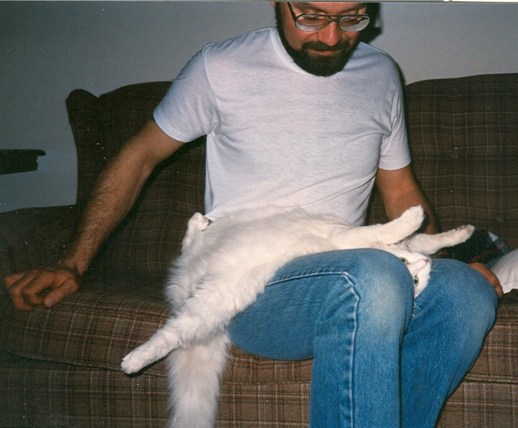
“My cat rolls over but if I try to rub her belly, she will scratch and bite, why does she do this?” is a question I am often asked by cat owners. People who are familiar with dogs and have experienced the dog that rolls over to have his belly scratched, assume that cats want the same thing.

When a cat, rolls over it is a defensive position that they use when they cannot out run an attacker. This allows them to use the claws on all four feet for defense.
However, some cats do roll over and lay on their back because they enjoy it. They will do this when they feel comfortable enough in their environment to expose their vital organs.

If you have a kitten, you can get the kitten used to being handled and petted by gently handling all their body parts in a caressing manner. This will allow a veterinarian and you to examine the cat for lumps, bumps and injuries without too much stress to the cat.

If you gently pet a kitten sometimes the kitten will allow you to rub its belly. If the kitten seems to enjoy this, you can do it as a sign of affection. Often a kitten will playfully hit your hand with its front and hind feet. As long as it is playful and no teeth and claws scratch or bite, this can be a fun time for the kitten and owner. But if the cat offers its belly but does not like to be touched there, it is best to accept the friendly gesture as a compliment and do not try to rub their belly.
Many people have rodents as pets and they can make wonderful pets for people who do not have room for a larger pet or cannot have a dog, cat or bird. However, although it is rare, rat bite fever can be transmitted by pet rodents, either through a bite or scratch. Rats, gerbils, mice, guinea pigs and ferrets are capable of transmitting rat bite fever. Rat bite fever is an old disease that has been recorded for over 2300 years.
Rat bite fever is caused by Streptobacillus moniliformis which is the most common cause. The symptoms include fever, pain in joints, nausea, rash and vomiting and can be fatal if not treated.

Children, pet store workers, veterinary technicians, veterinarians and laboratory technicians are in the higher risk group since they handle rodents on a regular basis. People who frequently handle rodents can wear protective gloves to prevent being bitten. Parents should monitor children who have rodents as pets and if they are bitten or scratched, notify your pediatrician.
Socializing a pet rodent is a precautionary measure that will reduce the chance of being bitten. Rodents can be trained using clicker training methods which will also help to reduce the chances of being bitten by teaching the rodent to come to you.
Always be careful not to frighten or startle a rodent. Avoid trying to handle a rodent that is sleeping. A tap on the cage or talking to the rodent before handling it can calm the rodent and allow the pet to be aware that it is going to be handled. Using common sense will help prevent being bitten and avoid rat bite fever.
Keep in mind that rat bite fever can also be transmitted by wild rodents. If there are wild rodents in your area and they are trapped, use caution in removing them or handling predators that might have caught and killed a rodent.
If your cat is ten years old or older, there is a 33% chance that your cat will get chronic kidney disease, (CKD). Cats that have CKD often have a number of signs and complications which include, lack of appetite, nausea, vomiting, anemia, hypertension and urinary tract infections (UTI).

Because standard tests can be iffy, diagnosing CKD may not be easy for a veterinarian. To help veterinarians, cats and their owners, the International Society of Feline Medicine (ISFM), the veterinary division of International Cat Care, formed an international panel of veterinarians from the UK, France, Australia and North America to analyze CKD.
They found that dietary management is one of the best therapies, but often it is difficult to get a cat to eat the prescription diets. They also found that routine blood pressure monitoring and the use of antihypertension medications helped reduce damage to other organs such as the eyes and heart, thus prolonging the quality of the cat’s life. While there is no cure as yet, it is heartening that veterinarians continue to search for ways to help our pets live longer, quality lives.