Pepper made headlines last year when his owner, John Lednicky, Ph.D., a University of Florida College of Public Health and Health Professions virologist, discovered the jeilongvirus in a cotton mouse that Pepper caught. Now Pepper brought home an everglades short-tail shrew that had an unidentified strain of orthoreovirus.
The discovery is important because this type of virus is known to infect humans, white-tailed deer, bats and other mammals. Unfortunately the effects of this virus are not fully understood, there have been cases of the virus associated with encephalitis, meningitis and gastroenteritis in children.
Dr. Lednicky and his collogues stress that more research involving serology and immunology studies are needed to fully understand the threat this virus may hold for both humans, wildlife and pets.
Pepper is happy and healthy and has not shown any illness or side effects as a result of his hunting expertise.
Journal Reference:
Emily DeRuyter, Robert A. Williams, Kuttichantran Subramaniam, John A. Lednicky. Coding complete sequences of the 10 genomic segments of a mammalian orthoreovirus type 3 isolated from a Blarina peninsulae shrew. Microbiology Resource Announcements, 2025; 14 (7) DOI: 10.1128/mra.00219-25
Cite This Page:
University of Florida. “Florida cat sniffs out another new virus—and scientists are listening.” ScienceDaily. ScienceDaily, 12 July 2025. <www.sciencedaily.com/releases/2025/07/250711224330.htm>.
For many couples, a wedding isn’t complete without the pet who’s been there through everyday life. From quiet mornings to major milestones, furry companions are part of the story being celebrated. Including them in wedding festivities can feel meaningful rather than gimmicky when it’s done with intention. With a little planning, pets can add heart without adding stress.
Key Ideas
Choose roles that fit your pet’s temperament, not trends.
Plan logistics so comfort and safety come first.
Build in a graceful exit plan if your pet needs a break.
Carry the pet theme through details, from décor to keepsakes.
Why Pets Belong in the Story
From first apartments to long walks after work, pets witness the relationship’s quiet milestones. Inviting them into the celebration isn’t a gimmick; it’s a nod to shared life. The trick is choosing moments where they add warmth without stealing focus or feeling overwhelmed.
Roles That Feel Natural, Not Forced
Some pets love the spotlight; others prefer a cameo. A calm dog might walk down the aisle with a handler, while a shy cat could appear in portraits taken earlier in the day. Even a brief appearance—like greeting guests during cocktail hour—can feel meaningful when it aligns with your pet’s personality.
Preparing Your Pet for the Big Day
The goal is familiarity, not perfection. Walk your dog around the venue in advance. Practice short leash walks with distractions. Introduce any outfit well before the wedding so it feels routine, not restrictive. Assign a trusted friend or professional handler whose only job is your pet’s care.
Before the celebration arrives, walk through these practical steps to set everyone up for success:
Schedule a vet check to confirm vaccinations and health.
Pack a small kit with water, treats, waste bags, and a favorite toy.
Choose a quiet rest space away from music and crowds.
Confirm venue rules and any required documentation.
Plan transportation to and from the venue that suits your pet.
Styling Without Stress
Comfort always wins. Lightweight collars with florals, a simple bow tie, or a flower crown designed for pets can elevate photos without irritation. Skip anything that limits movement or hearing. If in doubt, dress up the leash instead of the pet.
Turning Wedding Memories Into Lasting Keepsakes
Including pets doesn’t have to stop when the music fades. Thank-you cards featuring your furry companion extend the celebration and add a personal note guests genuinely remember. Using an online app that lets couples design and order printed custom cards with polished templates and intuitive editing tools makes the process simple and flexible. You can personalize colors, photos, and messaging, then easily print online cards that feel thoughtful without adding post-wedding stress.
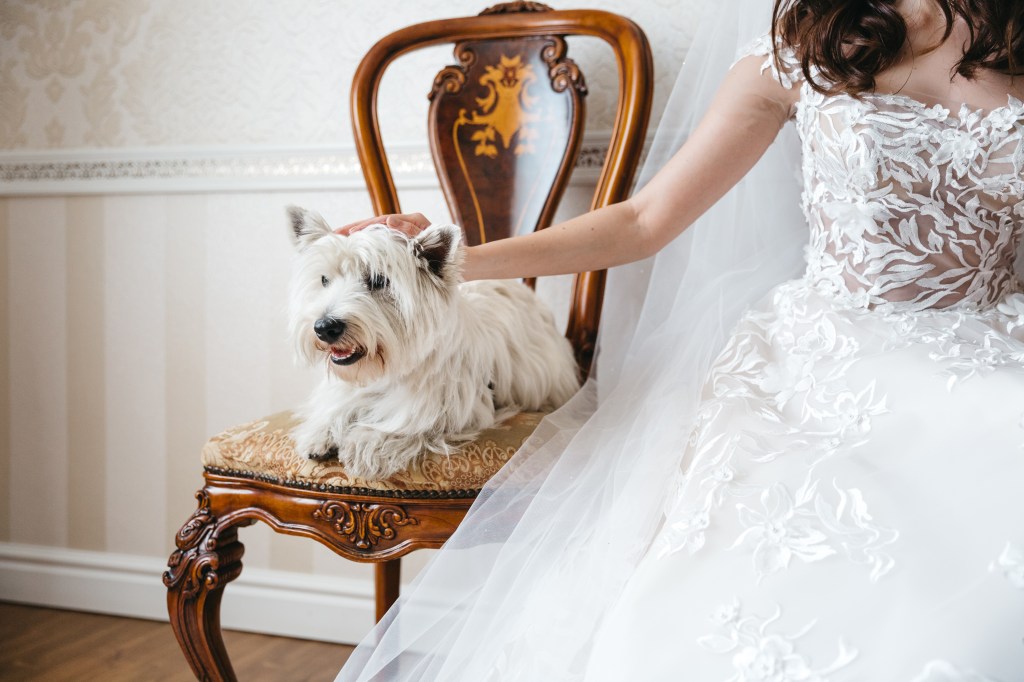
Bride with a beautiful dog on the wedding day
What Works Best by Wedding Moment
Different parts of the day call for different levels of pet participation. This overview helps you decide where your companion fits most comfortably.
These common questions help clarify what’s realistic and worthwhile.
Is it okay if our pet doesn’t stay for the whole wedding? Absolutely, and it’s often ideal. Many couples plan a meaningful appearance followed by a calm exit. This keeps the experience positive for the pet and stress-free for you.
Should we hire a professional pet handler? If your budget allows, it can be a game-changer. A handler manages walks, breaks, and cues so friends can enjoy the day. It also gives you peace of mind during key moments.
What if our venue has restrictions? Always confirm rules early. Some venues allow pets only outdoors or for photos. If restrictions are tight, consider off-site portraits or symbolic nods like signage or stationery.
How do we keep guests comfortable if they’re not animal lovers? Clear boundaries help. Assign handlers, avoid roaming pets, and ensure no one is surprised. Thoughtful planning keeps the focus on celebration, not logistics.
Are outfits really necessary for pets? Not at all. Many couples skip clothing and still achieve beautiful photos. A clean, brushed pet with a stylish leash can look just as polished.
What’s the simplest way to include a pet if logistics feel overwhelming? Photos and paper details are the easiest path. A short portrait session or pet-themed thank-you card captures inclusion without day-of stress.
Bringing It All Together
Including a furry companion can deepen the emotional texture of your wedding when it’s done thoughtfully. Focus on comfort, choose moments that suit your pet’s nature, and let simplicity guide your choices. Whether they walk the aisle or smile from a photo on your thank-you cards, their presence can quietly remind everyone what family really means.
Just like any other animal, cats have a wide range of personalities from very shy and demure to the warrior cat who likes to attack and chase everything in sight. It is very difficult to evaluate a cat or kitten’s true personality before selecting one to take home. This is especially true for cats and kittens that are being adopted from a rescue or shelter because they will not have the opportunity to exhibit their true personality in that environment.
What can a cat owner do if their cat is the warrior cat who likes to get into and chase everything, even your feet when you walk? The first thing to do if it has not already been done is to spay or neuter your cat. This can help calm your cat down.
Next, be sure that your cat is on a high quality diet. It is has been my experience that nothing you buy at the super market is a high quality brand of food.
The next thing you must do is make sure that your cat has quality interaction time with you playing with toys. Do not allow the cat to play with any part of your body or on your body. If your cat does try to do this, gently put them off of your body and say no. If your cat bites or claws you say “ouch” in a high pitched voice and remove the cat. Make sure that you ignore the cat for a few minutes after that. Only interact with your cat if the cat plays gently, this way you will reinforce the behavior you want in your cat.
If your cat does something you do not like, distract the cat from doing it by offering a favorite toy. When the cat focuses his attention on the toy instead of the bad behavior, praise the cat in a soothing voice.
Some cats like to have play sessions in the middle of the night and will wake their owners to join in the fun. If you do not want this to become a daily habit, do not get up. It is best to pretend to be asleep and ignore the cat. It may take a few nights but the cat will eventually give up trying to engage you in play.
What can help is to have a tiring (for the cat) play session before you go to bed, but pick a time that is convenient for you because it may become a daily habit for the cat and cats do not like changes in their routine.
A very busy cat might enjoy having another cat (or dog) as a companion. I always felt that adopting two kittens or cats at the same time works out the best rather than try to introduce a new adult cat later. Often cats are kept together in the rescue or shelter and have already bonded enough to live successfully together. Having a familiar companion can help the adopted cats’ make the transition to a new home easier. If you do adopt two cats, be sure to have at least two litter boxes for them. However, it is important that the litter boxes not be kept in the same location or the cat will view the two boxes as one.
With a little planning, you can help your cat be everything you want him to be. Contrary to popular myth, cats can be trained and are happier when they understand the house rules.
There’s a gentle rebellion happening in quiet corners of cities and suburbs alike. People are building businesses that don’t bulldoze the planet, especially in the pet care space, where ethics and affection collide. You see it in the compostable poop bags, the cruelty-free shampoos, the local, low-waste doggy daycares. If you’re someone who cares about the environment and can’t help but coo at a golden retriever in booties, starting a pet care business rooted in sustainability may feel less like a career and more like a calling. But make no mistake, it still demands spreadsheets, sweat, and strategy. You can’t just wing it with good intentions and a compost bin.
Choose Your Niche
Don’t let the word “pet” fool you; it’s a wide world out there. From high-end grooming vans with solar panels to subscription boxes for gerbils, the possibilities spiral fast. Start by picking one lane and owning it. The most grounded way to do that is to look intoprofitable pet services already out there and ask yourself where your values intersect with demand. Is it organic pet treats? Low-stimulation dog walking for senior pups? Think like a caretaker, but plan like a capitalist. Even good hearts need to keep the lights on.
Sustainable Practices
This is where your ideals become infrastructure. Sustainability in pet care goes beyond tossing recyclables in the blue bin. If you’re opening a pet grooming studio, swap single-use plastics for glass or biodegradable alternatives. For in-home services, plan routes efficiently to reduce emissions or offer virtual check-ins for anxious pet parents. There’s a growing movement encouraging entrepreneurs to embrace sustainability without tanking your bottom line. Even small gestures like repurposing towels or using local suppliers can build credibility. You’re not just cutting waste, you’re creating a business with a conscience.
photo from Freepik
Licensing and Legalities
Paperwork doesn’t purr, but it keeps you out of trouble. You’ll need a business license, possibly animal-specific certifications, and maybe even zoning approvals depending on your location. Insurance is non-negotiable. And don’t forget the money—it costs to register, insure, and outfit a startup, especially one where animals are involved. A breakdown of the costs to start a pet sitting or dog walking business might open your eyes to how quickly expenses can stack up. Budget more than you think and plan for the surprises. They always come.
Build Your Business Know-How
It’s tempting to believe that passion alone will carry you, but the truth is that a little financial fluency goes a long way. If profit margins and marketing metrics make your eyes glaze over, consider going back to school—seriously. A flexiblebusiness management degree program can give you the vocabulary and structure you need to turn a dream into a functioning, ethical company. Most online programs are designed for busy people juggling work, pets, and life. Don’t mistake this as fluff education. It’s a power move for anyone who wants to play the long game.
Marketing and Community Engagement
The best customers are the ones who believe in your mission as much as your services. To reach them, get local. Partner with eco-conscious pet brands, show up at green markets, host adoption events. Most importantly, start telling stories on Instagram, via email newsletters, at meetups. You don’t need a PR firm to build a community around your business, but you do need consistency and heart. Customers notice when your messaging feels real and your mission runs deeper than the About page. Be the kind of business people root for.
Scaling Your Business
Growth should feel intentional, not like you’re getting pulled behind a runaway sled dog. Before hiring staff or expanding into new services, track what’s working and what feels clunky. Does demand justify duplication? Are you delivering at the same quality, or are you stretched too thin to care about the compost bin? Scaling can be sustainable if it follows the same ethos you started with—low impact, high integrity, human-paced. Your future team should share your values and your vision, not just your logo.
Starting a sustainable pet care business isn’t a Sunday side hustle or a cute hobby. It’s a commitment, like any real relationship. One between you, your values, your clients, and yes, the animals that make it all worth it. If you do it right, your work becomes more than just transactions and tail wags. It becomes a daily demonstration that capitalism doesn’t have to be careless. Just careful, thoughtful, and a little bit obsessed with doing things better.
Dive into the captivating world of animal behavior and pet care at Susan Bulanda’s Blog, where passion for pets meets scientific exploration!
With the use of sophisticated tools, scientists have been able to determine the life of plants. They have found that plants can perceive and respond to a changing environment.
They use their roots, leaves and flowers to take in information such as the amount of light, water, nutrients, that are available as well as the presence of predators and pathogens. Some trees will give off a chemical when attacked by a disease or an insect that signals the other trees around it to release a protective hormone.
How does something without a “brain” accomplish this? Researchers have found that plant memory involves sensory perception, intracellular signaling pathways, and molecular events that allows them to store and retrieve information. Plant metabolism is the driving force of plant memory.
To further understand plant memory and communication researchers focused on the spruce trees in the Costa Bocche forest in Italy. They attached sensors to the trees to record their reaction to a solar eclipse. Their studies showed how the trees were aware of the eclipse and responded to it. They also found that the older trees support the younger ones.
Other studies have shown that a parent tree will help its offspring survive by feeding it most of the nutrients that it gathers from its roots. That the trees recognize its relatives.
Plants can also sense and react to color and sound. Years ago people were encouraged to talk to their plants. Some nurseries sell a red mulch to put under tomato plants that increases the yield of the plants.
The next time you take a walk in a garden or the forest, feel free to talk to the plants around you. What surprises may be in store.
A team from the University of Pennsylvania announced that they have cured X-linked retinitis pigmentosa, a blinding retinal disease in dogs when caught early. XLRP causes gradual vision loss starting at a very young age in dogs, often as early as five weeks. It is an inherited retinal disease.
Continuing the research the veterinarian researchers found that the gene therapy helped dogs at 12 weeks of age (mid-stage disease) when about 40% of the eye’s photoreceptor cells were dead and then at 26 weeks of age (late-stage) when 50 – 60% of the cells were dead. What the researchers found was that they were able to halt the degeneration of the photoreceptor cells in the treated area.
Now they’ve shown that they can cure the canine disease over the long term, even when the treatment is given after half or more of the affected photoreceptor cells have been destroyed.
To date, dogs have maintained their vision for over two years after treatment. This is very exciting because humans suffer from the same type of blindness. With that in mind, researchers are already examining human patients to determine how to treat their blindness and who might qualify for future treatments.
Again, man’s best friend is offering hope to humans who suffer from this type of cell death that causes blindness. Since this is an inherited disease, breeders should have their dogs examined by a certified canine ophthalmologist and register their dogs with the Canine Eye Registration Foundation, CERF. http://www.tctc.com/~maplerg/cerf-.htm This will help researchers continue to develop cures for blindness as well as prevent the breeding of dogs who have this inherited disease.
Sue’s Note: All pets who are blind can live a happy life. My cat is blind and is happy and safe. It helps if things are not moved around or left out in the open where the blind pet will bump into them. Blind pets should never be allowed outside unless they are in a fenced area or on a leash.
Imagine that your family is frightened, you know it even though they are trying to hide it from you. People who were your friends now ignore or avoid you. War has gripped your country, and some people are leaving everything behind to flee. Yet at night, you sleep soundly because your faithful pet, whether it be a dog or cat, lays by your side. You pet still loves you and thinks that you are the best person in the world. Then one day, you and your family are taken away, forced to leave your best friend behind. Faithful Friends is the story of these devoted animals. All are true, all are treasured memories, and all are special to the people who shared them for this book, the only book of its kind to tell the stories of these devoted animals. Available in English and Italian.
Researchers at the University of South Korea have studied the benefits people have from interacting with dogs. They had people play, walk, groom and massage dogs while studying their brainwaves. They found that the people studied had an increase in relaxed wakefulness and heightened concentration. They also observed that the subjects felt a significant drop in the feeling of fatigue, depression and stress after interacting with dogs.
Sue’s Note: I would think that the same results would be found when people interact with other animals that they enjoy. This study supports the use of therapy animals in all situations.
Journal Reference:
Onyoo Yoo, YuTong Wu, Jin Soo Han, Sin-Ae Park. Psychophysiological and emotional effects of human–Dog interactions by activity type: An electroencephalogram study. PLOS ONE, 2024; 19 (3): e0298384 DOI: 10.1371/journal.pone.0298384
Cite This Page:
PLOS. “Interactions with dogs can increase brainwaves associated with stress relief and heightened concentration.” ScienceDaily. ScienceDaily, 13 March 2024. <www.sciencedaily.com/releases/2024/03/240313185025.htm>.
This article is based on my personal experience, opinion, and research.
A new syndrome has affected several breeds of dogs, and it is still being researched. It is most likely genetically based as are many other health issues. All dogs are susceptible to genetically based health issues because all dog breeds have a limited gene pool. That is what makes a Golden Retriever a Golden Retriever. A limited gene pool concentrates the inherited qualities of the breed. When breeders create a line of dogs, it further limits the gene pool by concentrating the genetic quality of the line. In certain breeds when breeders continue to breed dogs with a health issue, the problem can spread throughout the breed. Examples of this is deafness which is common in some breeds. It has been scientifically shown that the merle, harlequin, and piebald-colored dogs carry the gene for deafness. For example, about 30% of all Dalmatians are deaf.
Over the years because of breeding practices, many dog breeds have changed. For example, I had the honor of owning and training the first Border Collie, Ness, to do SAR work in the United States. He was the grandson of a very famous international herding dog champion named Spot. Because so many Border Collies had the same name, the breeder’s name proceeded the name of the dog on registration papers, thus my dog’s grandfather’s name was Gilchrist’s Spot.
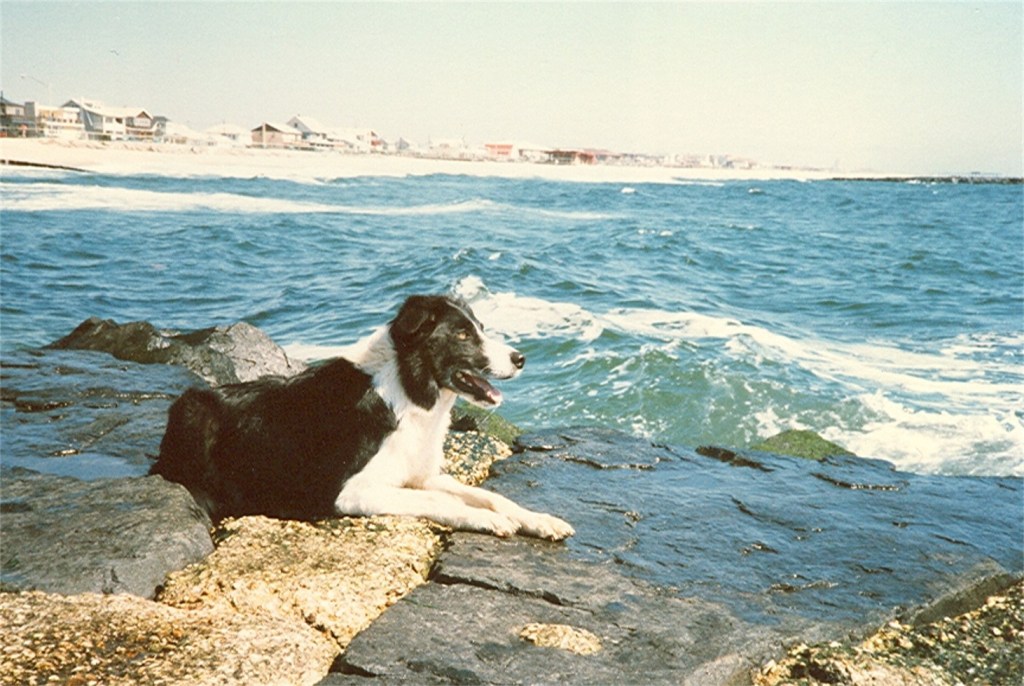
Ness
At the time few people heard of or even saw a Border Collie and all Border Collies were working dogs. Fast forward to today. Many people own Border Collies, they are a familiar breed in search and rescue (SAR) as well as sports and as pets.
As breeds became popular, many breeders were not educated or cared about genetics and how they relate to producing a good working line of dogs. In the case of the Border Collie, there was a split in the breed. The true working dogs were not generally registered with the American Kennel Club but rather with Border Collie registries such as the North American Sheepdog Society who focus only on working dogs. When the AKC closed their registry to non-AKC Border Collies, the gene pool became limited. Thus, the non-AKC Border Collies remained working dogs and many of the AKC Border Collies became show dogs. There is a huge difference in the ethics and goals of the breeders in each registry. Other breeds have experienced a drastic change in their working ability as well, such as the American Cocker Spaniel and the Irish Setter.
In terms of genetics, it only takes three generations to alter the quality of a breed of dog. This is because the breed instincts, such as a Pointers style of pointing, is not a single gene, but a collection of genes that must be present for the dog to have its style of pointing. What this means to the dog owner is if they return to the breeder of their previous pet or working dogs, there have been more than three generations since their dog was bred. Due to changes in the line of dogs, it is important to carefully evaluate the line to see what has happened over the years. Some breeders try to keep their lines strictly working lines, others are interested in conformation or looks.
As breeds become popular, a greater number of people get involved in breeding the popular breeds, often with less concern for health and genetic issues and more concern about making money. As a result, new health issues have developed in some breeds. One health issue that is important for dog owners to be aware of is the Border Collie Collapse Syndrome, (BCC). Although it first appeared in Border Collies, they are not the only breed that suffers from this problem. So far, the Australian Cattle Dog, Australian Kelpie, Australian Shepherd, the Bearded Collie, Collie, Shetland Sheepdog, and the Whippet have also shown this syndrome. Except for the Whippet, all these breeds are distantly related.
Unlike heat stroke, dogs that collapse from BCC have no laboratory abnormalities and recover quickly. They can collapse in all types of weather which means that it is not a heat related problem. They usually recover from 5 to 30 minutes. Excitement, intensity of exercise as well as heat can trigger an episode. Sometimes a dog can collapse five minutes after exercising.
Border Collies and some of the related breeds are popular for SAR and sport use which means they experience high excitement and intense activity This makes it important to be aware of this syndrome. Who knows what other breeds may develop BCC as breeding practices and the gene pool changes.
People who own and use these breeds must be careful since a dog can collapse in an environment that could be dangerous or even lethal. It is also important to know about BCC so that the handler does not panic if it happens. If you are not sure if your dog collapsed due to BCC a quick trip to a veterinarian clinic would be wise.
Please Note: I often hear from my clients, “but my dog has papers,” or “he is not from a breeder.” For clarity’s sake, the term breeder applies to anyone who produces a litter of dogs, no matter if they are an ethical or a puppy mill breeder. As for papers, every registry can only keep a record of the breeding and ancestry of a dog as reported to them. No registry can guarantee the quality of the dog or even if the papers issued with the dog belong to that dog. I had a client who called me and told me that they had a Rottweiler. When the breeder found out that the client was going to come to me for training, he confessed that the puppy was half Rottweiler and half German Shepherd. Yet this dog had AKC registration papers that claimed it was a Rottweiler. Some independent registries such as the Jack Russell Terrier Club require a photograph of all sides of a dog, witnessed and signed by a veterinarian to be submitted with a request to register a dog (at least one year of age) before they will issue registration papers.
Susan Taylor, Cindy Shmon, Lillian Su, Tasha Epp, Katie Minor, James Mickelson, Edward Patterson, and G. Diane Shelton (2016) Evaluation of Dogs with Border Collie Collapse, Including Response to Two Standardized Strenuous Exercise Protocols. Journal of the American Animal Hospital Association In-Press.
Susan Taylor, Katie Minor, Cindy L. Shmon, G. Diane Shelton, Edward E. Patterson, and James R. Mickelson (2016) Border Collie Collapse: Owner Survey Results and Veterinary Description of Videotaped Episodes. Journal of the American Animal Hospital Association In-Press.
Scientists at Staffordshire University conducted research on how caffeine impacts soccer players. They found that while ingesting caffeine before a game can improve the accuracy of passing the ball, it can have an adverse effect on tactical play.
The tests showed that participants who consumed caffeine scored 7.14% lower in decision making tests and their scores in the Loughborough Soccer Passing Test were 3.49% lower.
Researchers felt that more studies were necessary to fully understand the effects of caffeine on athletes.
Sue’s Note: I know you are all wondering why I would include this study on my animal related blog. Well, I am not worried about animals ingesting caffeine and scoring low on computer tests, however, what did come to mind is how it affects people who have to make decisions and students who drink caffeine before tests to stay awake. Think about it, how many people start their work or school day with a big mug of coffee? (tea also has caffeine as well as sodas)
Journal Reference:
Negar Jafari, Mohsen Salesi, Pooya Soltani, Davoud Fazeli. The effects of acute caffeine ingestion on decision-making and pass accuracy in young soccer players: A preliminary randomized controlled trial. Behavioural Brain Research, 2024; 457: 114732 DOI: 10.1016/j.bbr.2023.114732
Cite This Page:
Staffordshire University. “Caffeine highs and lows soccer players should be aware of.” ScienceDaily. ScienceDaily, 11 December 2023. <www.sciencedaily.com/releases/2023/12/231211114550.htm>.






 A Blog by Susan Bulanda