A recent study conducted by Dr. Emily Luisana of North Carolina State University in Raleigh and her colleagues demonstrated that many pet owners do not handle pet food and bowls safely. According to their study people did not handle their pet food or pet dishes in manner that reduces the bacteria that causes illness in both people and pets.
Pet food should not come in contact with surfaces where human food is prepared, bowls must be thoroughly cleaned and/or sanitized and people should wash their hands after handling food and bowls.
Sue’s Note: This is especially important where children are concerned because they will touch pet food and bowls, and possibly put their fingers in their mouths without washing them.
photo from freepic
Older pets whose digestive systems are weakened from age or illness may not be able to tolerate the bacteria buildup and suffer further health issues. Treats such as rawhide, natural bones, pig ears, cow hooves and other such products are a high risk due to the bacteria on them as well as a choking or intestine blockage risk for dogs.
Pet bowls and any utensils used with the pet food such as forks, spoons, etc. should be washed with very hot water and soap or run through a dishwasher after each use, this would include water bowls which should be cleaned at least daily.
Just a few short years ago, 2015 researchers at Penn’s School of Veterinary Medicine discovered that dogs could develop a form of inherited night blindness that is very similar to the same condition in people. Then in 2019 they identified the gene that is responsible for this condition.
Night blindness in people is referred to as congenital stationary night blindness (CSNB) and prevents people from distinguishing objects in dimly lit situations. This condition makes it nearly impossible for people with CSNB to drive at night or see when there is no artificial light.
The researchers have found that a group of cells deep in the retina called ON bipolar cells are the culprit. They have developed a single injection of gene therapy that has corrected night blindness in dogs that lasts a year or longer. They did observe that some dogs had better recovery than others.
The researchers are studying whether or not one injection will last a lifetime. They are also developing a therapy that can be used in a clinical trial for people.
The real estate market is probably the most active then it has been in many years. The job of the RE agent is a difficult one since they have to juggle negotiating between the seller and buyer. Often the seller has lived in their house for most of their adult life. They have invested thousands of dollars into their home. While most RE agents are honest and do their best, this book will help the seller understand what is taking place and enable them to make decisions that will benefit them. My book Real Estate Today: Seller Beware helps the seller understand these decisions.
Sometimes RE agents on both sides of the transaction lean toward helping the buyer instead of the seller. This book will save the seller thousands of dollars. It is well worth the investment.
They showed videos of cats who were in a positive frame of mine, such as soliciting petting or treats, and of cats in a negative state either due to health issues or in a situation where they wanted to retreat, to a group of people. None of the videos showed extreme fear such as flattened ears or bared fangs. The videos showed only the cat’s face.
The group consisted of men and women and not all of the people were cat lovers. Women, especially those who were veterinarians or vet technicians scored the highest. This finding is consistent with previous research that indicates women are better at decoding non-verbal displays of emotion than men.
The results of this study show that it is possible read a cat’s expressions and that it is possible to teach people how to do this, thus fostering a stronger bond between cats and people.
Some breeds, especially German Shepherd Dogs suffer from congenital idiopathic megaesophagus (CIM) disorder. This prevents puppies from swallowing food and they often must be euthanized as a result. Some dogs live past puppyhood but still must be euthanized. Labrador Retrievers, Great Danes, Dachshunds, and Miniature Schnauzers are some of the other breeds that suffer form megaesophagus.
CIM usually becomes apparent when a puppy is weaned from its mother and starts to eat solid food, at about four weeks of age. The only way to get food into a puppy who has this condition is to feed them while sitting upright. They must remain upright for at least 30 minutes. While some puppies outgrow the condition, many need symptomatic management for the rest of their lives. They must be fed small liquid meals multiple times a day, gelatin cubes and they require drug therapy.
The good news is that Leigh Anne Clark a researcher at the Clemson University Department of Genetics and Biochemistry and her team have developed a genetic test to determine if a dog has the gene responsible for this disorder. Responsible breeders who have produced puppies that had ICM should have their dogs tested and avoid breeding dogs who have the gene for ICM.
Researcher Mark Hauber a professor of evolution, ecology and behavior at the University of Illinois Urbana-Champaign and other scientists have made an unusual discovery. They found that Tufted Titmice and Chickadees will use animal hair to line their nests. While this may not seem unusual, what he found by studying videos, was that the birds braved landing on sleeping mammals to pluck out their hair. It seems the mammals did not mind having the birds do this and some did not wake up. The fact that these birds use animal hair was not new to the researchers, but it was always assumed that the birds obtained the hair from carcasses, not from live animals.
Tufted Titmouse
The researchers have named this behavior “kleptotrichy” which is Greek for “theft” and “hair.” As the researchers further studied this behavior, they found that the birds plucked hair from 47 humans, 45 dogs, three cats, three raccoons and a porcupine. I wonder if the humans were aware of the plucking birds.
Lily the Havanese
budgie who pulled Lily’s tail
What came to mind for me was a parakeet (budgie) that I owned years ago. While I was working in my office, I would let the bird fly around. My small Havanese would sleep in her bed next to my desk. The keet would sit on my lamp and watch the dog. Then he would fly down, landing on the floor and tilt his head back and forth as birds do, watching her sleep. He would take a few hops toward her until he reached her tail and then he would grab one hair and pull it. The dog would wake up, half rise and growl at the bird, who would squawk bird laughter, as he flew back to the lamp. When the dog went back to sleep, he would do it all over again. I always felt that he did it for fun but who knows?
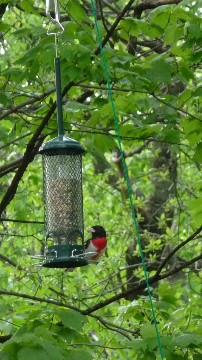
Many people love to offer seed in bird feeders and watch the birds who come to the feeders. I personally have gotten many great photos of unusual species that came to my feeders. Like many people, I worried when I was not able to fill the feeders, especially in the winter, that the birds would be hungry and not be able to find food.
A recent study conducted by animal ecologist Jim Rivers at Ohio State University found that feeding birds did not cause any negative effects. It was determined that there was enough natural food available for the birds to sustain themselves.
Since this study focused on Black Capped Chickadees, I would like to point out that Chickadees will store food, especially seeds from feeders, in tree crevices and other places, to eat later. The brain of Chickadees grows from late summer to fall in order to remember where they hid the food.
One of the major problems people have when they feed birds is that squirrels and other rodents eat the bird seed. As an avid bird feeder and watcher, I have tried every squirrel proof feeder on the market. As a result, I have found that there is only one truly squirrel proof feeder. These feeders are made by Brome. What I also like about these feeders is that they are guaranteed for life and that they are so well made that they last. Some of my Brome feeders are over fifteen years old. Three of my feeders even survived a black bear attack. I strongly suggest if you like to feed the birds to invest in these feeders.
If you live in an area where you have bears, you need to bring them in at night or only provide food in the winter. I have included some photos I have taken of birds at my feeders.
Within two years, 2018 – 2020 1.4 million EU citizens signed a petition to end the caging of farm animals. As a result, the European Parliament initiated a study conducted by Utrecht University researchers to study how to accomplish this goal.
The research included behavioral biologists, animal scientists, veterinarians and ethicists. Their main focus was on laying hens and pigs. However, they will look into other animals such as bovines used for milk and meat. In order to accomplish their goal to eliminate cages, the researchers must find a way to assist farmers in transitioning from traditional animal housing to more humane housing.
My chickens
I personally hope that they can reach this goal and that it will spread to the rest of the world. When I raised chickens, they were always free-ranged and had a hen house to stay in at night.
I was given an article to use for my blog site by Your Dog Advisor and it think it is a great article. Unfortunately, it is too long for my blog. I urge you to go to their link and read the whole article. It is very informative.
Global Positioning System or GPS made for dogs is a way to track your dog’s activity, and/or location. There are many kinds of GPS devices and this article explains, with excellent photos, the types available. Many people in K9 SAR use them to show where their dog has searched in an area.
The canine GPS system is critical if your dog gets lost. The GPS can locate your dog for you. Many times, a dog that is lost will wander or will hide if they are frightened. A small dog can be hidden under debris or brush within a few feet of where you are looking. If they are frightened, they may not come out even for their owner.
In all environments, rural, suburban and urban, it is almost impossible to search every place where a dog could go. It is time consuming and manpower intensive. The GPS tracker will allow you to find your dog quickly.
Here is a list of topics that the article covers. I strongly urge you to click on the link and read their article.
What is a Dog GPS Tracker?
How Does a Dog GPS Tracker Work?
Are There Different Types of Dog GPS Trackers Available?
Which Types of Dogs Should Have a Dog GPS Tracker?
Top 6 Dog GPS Tracker Products We Love
Whistle Go & Go Explore Dog GPS and Health Tracker
Tractive LTE GTPS Dog Tracker
PetFon Pet GPS Tracker
Link AKC Smart Dog Collar
4 Pack Smart Pet Finder GPS Tag
Black and Decker 2-Way Audio GPS Dog Tracker
Does a Dog GPS Tracker Take Place of a Microchip?
Other Tips for Keeping Your Dog Safe
Sue’s Note: A GPS tracker may also work for a cat if it is small enough.
Losing a dog can be devastating. A person’s first reaction is usually fear, confusion and panic. However, with a good plan in place, looking for a lost dog can be less stressful and more successful. There are a few simple points to consider when looking for a lost dog. However, prevention is the key ingredient. The most important thing you can do is have your dog microchipped and have a collar on your dog with his name tag that includes a way to contact you. If someone in your area finds your dog, they will not have a microchip reader and will rely on a name tag.
1) If you organize a group of people to look for the dog, use all safety precautions so that the volunteers do not become lost as well. Stay in touch using cell phones or handheld radios. The radios can be purchased for a nominal fee at any store that sells outdoor equipment. Radios will work in areas that cell phones may not, however, they have a limited range so be sure that a chain of people can relay messages over distance. Also, establish radio protocol so that one person does not tie up the frequency preventing communication with others. Communication is essential to let the other volunteers know what is going on, if the search is being suspended, or the dog has been found. Because people feel safer and calmer if they know what is going on, this will allow the volunteers to do a better job.
Be sure that volunteers wear the appropriate clothing, (long pants and long sleeves), hats, and substantial footwear. Each volunteer must carry a snack, water, leash, bath towel, bowl, enough water for themselves and the dog, canned cat food or treats and a flashlight. Flashlights are necessary during the day to check dark places.
The canned cat food should have the strongest aroma, (or a similar treat) to lure the dog. Small cans of cat food work well because they can be carried easily and kept fresh.
A bath towel can be used to carry the dog if he is injured, exhausted or to wipe the dog if he is wet or dirty. If the dog is cold, he can be wrapped in the towel.
Volunteers must always work in pairs for their own safety, and in the event two people are needed when the dog is found. A meeting area and time should be established in case communications break down. No one should leave until all are accounted for.
2) A dog that ran away because he is frightened will bolt in any direction, but usually to the least noisy, darkest area. Given the choice of an open field or woods, the dog will go for the woods. If the dog is lost in the city or suburbs, the dog will look for a dark, quite spot to hide after it has run to exhaustion.
Therefore, try to estimate how far the dog will run (this varies with the dog’s size and condition) and add a mile to that. On a map of the area mark where you last saw the dog as the center of a circle and draw a perimeter around that point, based on the furthest point where the dog could be. The circle will encompass the area to start looking for the dog. If you saw the dog run, you can focus in that direction. Be sure to check small dark areas: under porches, stairs, garages, sheds, etc. If you have several people helping to look, have some start at the perimeter of the circle and some from the center. Be sure to look for the dog, never assume that the dog will come when called.
3) If a dog runs away, they usually run into the wind. That means that the wind will be blowing toward the dog, into the dog’s face. Check with a local airport to see what the wind direction was when the dog ran away. Then start looking into the wind from the point where the dog was last seen.
Dogs who wander away will usually meander along unless they find something to chase or something that interests them. This means that the search area will be smaller. If searching in the woods or a park, look for a game trail and look for fresh dog tracks to see if the dog went that way. If you do find tracks, you will not be able to tell for certain if they are from your dog, so do not give up searching in the rest of the area. If you are searching in an urban or suburban area, listen carefully if neighborhood dogs are barking. Often, they will bark at a stray dog. If you hear a lot of barking in one direction, check that area first.
4) When searching for a dog, travel slowly and make frequent five to ten-minute-long stops. Many people will drive around in a vehicle, calling to the dog. Unless the dog is within a few seconds of your location, he will not be able to find you if you move too quickly. Keep in mind that a dog can hear you calling from quite a distance away. They need time to determine the direction of the sound and then get to it. Wind and other environmental elements can distort the direction of sound (tall buildings, large hills, etc.) making it difficult for the dog to find the source of the sound. By stopping and continuing to call for about five to ten minutes, the dog will have time to find you.
5) When you sight the dog, do not act excited and/or run toward the dog. Sit down or stand still and let the dog approach you, even if it is your dog. Sometimes a dog can become so frightened, hurt, or weary that they may not think straight. Their survival instincts may take over, making them more cautious than they would be at home. Depending upon the direction of the wind, you could be downwind, and the dog may not recognize you right away.
Give the dog time to feel safe. Running to the dog may make him run away from you and lose what little trust in humans that he has left. If you feel it will work, you can, at a distance, slowly move so that you are upwind of the dog, and then open the can of cat food, but still let the dog come to you. When the dog comes to you do not try to grab the dog. Let the dog stay there and relax. Slowly pet the dog until you can attach a leash without frightening the dog. If the dog does not want to be caught, you will most likely not be able to grab the dog fast enough to catch him, even if he is next to you.
6) If the dog does not approach you, do not give up. Stay in that area and/or return to that area. You can leave food etc. but do not try to catch the dog.
7) If you leave food for the dog, do not assume that because the food was eaten that it was eaten by the dog. Other animals may eat the food, so continue to search the area. If you can, spread sand around any food that you leave so that you can check for footprints to determine if a dog ate the food. If sand is not available, loose soil will work as well.
8) If you have to search for the dog over a period of time, keep a log of the weather and the location of water sources. The dog will generally head into the wind and seek water.
9) Never forget to advertise. Use every means possible to let the people in the area know that there is a lost dog. Contact all veterinarian clinics, shelters, pet supply stores, and rescue groups. Also post signs in stores with bulletin boards, on telephone poles, especially where children congregate, by public transportation and any other place that you can think of. Be sure to post on social media. If your dog is not found right away, about every two weeks call everyone you notified, such as the local rescue groups, to let them know that the dog is still missing. This will keep your dog fresh in the minds of the employees.
Always have an up-to-date photo of your dog. If the dog is a breed that looks like others in the breed, a similar picture will do. Remember, the average pet lover will not notice the fine differences between your dog and others of the same breed. So do not panic if you do not have a recent photo. Be sure to expand the area that you advertise to at least five miles from the point where you last saw your dog.
Keep all your bulletins up to date. If the lost signs that you post look old or weathered people will think the dog was found. When you find your dog, it is important to call all the organizations that you originally notified to let them know that the dog was found. Also remove all your postings.
10) Lastly, never give up. Dogs have been found months after they disappear.






 A Blog by Susan Bulanda