Are Chickens Really “Dumb Clucks?” New research says No.

Recent tests have shown that chickens have individual personalities, can function in a group, can reason by deduction and understand their place in the flock.  Not only that, but chickens have a sense of numbers and self-awareness.

It turns out that chicken communication is also much more complex than previously thought, including visual and auditory forms of communication. They are able to make decisions based on what they determine is best for themselves.

The study also showed that chickens experience both negative and positive emotions. Mother hens display maternal feelings for their chicks and influence how the chick behaves.

How interesting chickens are. Many people keep chickens for pets so this study should be of special interest to them. Chickens have been used for years to hone clicker skills for dog trainers and potential dog trainers.

img066

img065

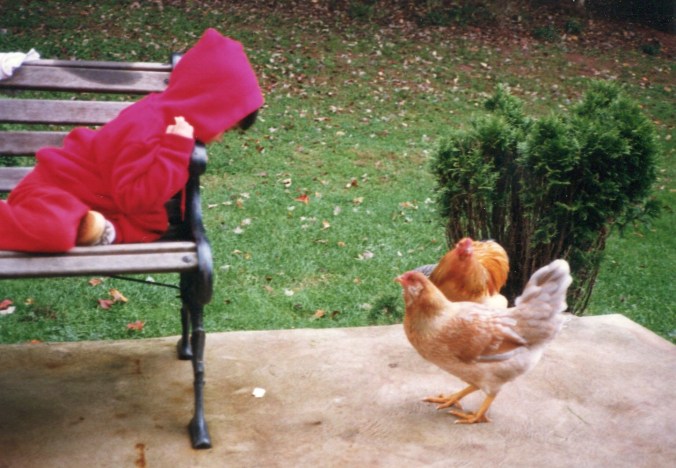
My son Tom and my araucana chickens (many years ago)

www.sciencedaily.com/releases/2017/01/170103091955.htm

The Amazing World of Plants – Some Trees Know When a Roe Deer Has Eaten a Shoot or Bud


Although plant neurobiology is not a new field new material is always a fascinating topic. In this case, Carolin Seele (Leipzig University) and Stefan Meldau (Max-Planck-Institute for Chemical Ecology) have discovered that young beech trees (Fagus sylvatica) and maple trees (Acer pseudoplatanus), can protect themselves from roe deer that love to eat their new shoots and buds.

This amazing discovery found that the trees can determine whether the shoot and/or bud was eaten by roe deer or damaged by other circumstances. The trees are able to detect roe deer saliva which triggers an increase in its production of salicylic acid. This hormone then signals an increase in the production of specific tannins which the deer do not like to eat. Not only that, but the growth hormone is also increased to compensate for the lost bud or shoot. If the damage is by other means, such as a storm, the trees only produce a growth hormone.

Many years ago people found that if they talked to their plants they would grow better. Maybe there was something to this. There are so many wonderful things yet to be discovered about plants. What a fun topic!

www.sciencedaily.com/releases/2016/09/160912132733.htm

dscn1824

Canine Hereditary Disorders Affect More Dogs Than Previously Thought

Good breeders typically do all of the genetic testing on the parents of a litter before they breed. Research has indicated that this is much more important than ever before.

Genoscoper Ltd. (a Finnish company specializing in animal genetics and gene testing) has published the most conclusive study ever on canine hereditary disorders. The study was done with researchers from the University of Helsinki and the University of Pennsylvania and published on PLOS ONE, 8/15/16.

They tested 7000 dogs in about 230 different breeds for a predisposition for about 100 genetic disorders. They found that 1 in 6 dogs carried at least one disease. Additionally, 1 in 6 breeds that never tested positive for one of the diseases had a predisposition for it.

This information will help dog owners understand and identify early signs of inherited disorders which may enable pet owners and veterinarians to better able  identify health issues earlier and perhaps prevent suffering for the dog.

This important study will lead to further research about inherited diseases in dogs that will help the overall health and well-being of both dogs and other pets.

www.sciencedalily.com/releases/2016/08/160822100703.htm

dempsey.jpg

K9 Professional Tracking: A Complete Manual for Theory and Training

K9 Professional Tracking: A Complete Manual for Theory and Training by Resi Gerritsen & Rudd Haak

Detselig Enterprises, Ltd.; Calgary, Alberta, Canada; 154 pgs; $32.95; ISBN:1-55059-223-8.

This is another great book by Gerritsen and Haak. It is well researched and offers many interesting points and tips about training the tracking dog. It covers many of the myths about odor and explains how a dog detects odor and what they detect. What is especially helpful is the way the authors explain why and how dogs fail to follow scent. They stress that handler error plays a large part, as well as faulty training.

The training methods are detailed with a thorough explanation about what works and what does not. Although this book focuses more on competition, it will help the SAR dog handler as well. There was one point that I did not agree with for SAR work, but I understand why they brought it up for competition. They mention in the chapter on Cross Tracks, that if the track is interrupted, for example the person gets on a bicycle and rides away, that the dog should be stopped because the track ended. In reality the scent from the person riding the bicycle may fall to the ground and a dog can still follow it.

51RzV5LmrjL._SX382_BO1,204,203,200_

K9 Professional Tracking

All in all, this is an excellent book that will help both the sport tracker and the SAR dog handler. The chapters are:

Preface; Introduction; Scent and Perception; The Dog’s Nose; The Odors of the Track; By the Sweat of One’s Feet; Equipment and Conditions; Common Training Methods; Asking for Trouble; History of Tracking Research; Scientific Aspects; Conditions for Success; Preliminary Exercises; Clean-scent Tracking; Weather Conditions; Cross-tracks; The Limits of Tracking; Epilogue: A Lack of Character; Bibliography; About the Authors.


Christmas Eve Kitten

December 24, 2015 was a chilly, foggy night. Larry, Tom, Jory and I were driving home from church when we turned the corner a block from our house. Tom was driving and saw a tiny kitten scoot across the road following an older cat.

“Did you see that?” he asked. None of us saw the black kitten. Tom stopped the car and lowered the window. We could hear the pitiful cry of the kitten. We got out of the car and walked around the wooded area where the cries were coming from. There was the kitten in a pile of brush. Nearby was a dead cat. Another older cat (about six months old) stood near, watching but would not approach us.

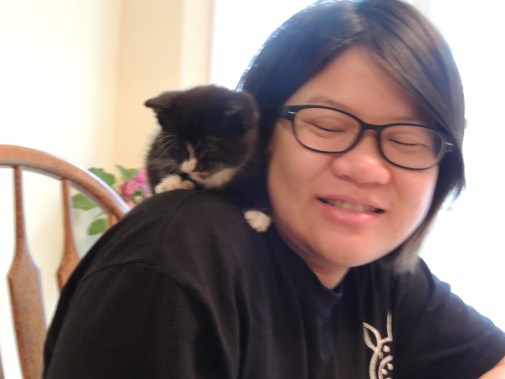
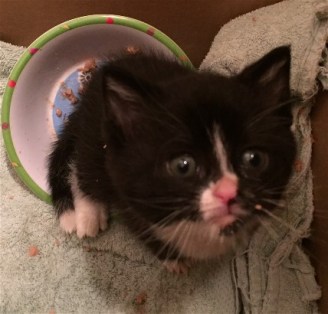
I gently picked up the kitten whose little body fit in the palm of my hand and held her against my chest. She was trembling from the cold. By the time we reached our home the kitten had stopped shaking. Inside in good light, I could see that she was about 3 weeks old. Her eyes still had that kitten just opened blue-gray color. Fortunately I had some small cans of wet cat food left over from my cat. I put the food in a dish and put it in the box with the kitten. She did not know how to eat or what it was. Gently, I took some of the food and put it on the end of my finger and touched it to the kitten’s mouth. She licked the food off of her face and after two tries, literally dove into the dish of food with her two front feet and face. She ate almost the whole thing.

Later I eye dropper fed her some milk and water which she readily took. Of course Tom and Jory kept asking me if I was going to keep the kitten. I told them I could not because of the dogs. Although my Parson’s Russell Terrier, Riley, was raised with a cat, our new Border Collie puppy Babs, was not. I did not think I could keep the kitten safe from the dogs. I fully expected Babs to want to play with the kitten and could injure or kill her with rough play.

The next day, as hard as it was, we took the kitten to our local humane shelter (Humane Society of Carroll County, Inc. Westminster, MD) which does a great job finding homes for them. They even have programs to socialize their cats. We were lucky that someone was at the shelter to take the kitten for us.

Update: January 8, 2015

I stopped by the shelter to see how the Christmas kitten was doing. Much to my delight, they had a mother cat who is nursing the kitten, along with another little older kitten. Although she was in the quarantine area and I could not see her, I knew that taking her to the shelter was the best thing for her. They confirmed that she was barely three weeks old. She is so cute that I know she will get a forever home.DSCN1504 image3 image8