Working with animals can cause mental issues

It may be surprising to learn that veterinarians and people who volunteer to help animals may be at a higher risk for mental health issues such as depression, anxiety and suicide.

Katherine Goldberg, DVM, LMSW, community consultation and intervention specialist at Cornell Health and Founder of Whole Animal Veterinary Geriatrics and Palliative Care Services has conducted a study to determine how and why this exists. She found that people who volunteer with animals are often confronted with the results of cruelty, and while they want to help animals, they are often faced with having to euthanize healthy animals due to a shortage of homes.

Veterinarians are faced with the same circumstances as well as high college debts, lower income and clients who may question the cost of care for their pets and be suspicious that their veterinarian is trying to push services that their pet doesn’t need.     

Goldberg feels that veterinarian colleges should include courses to help veterinary students deal with the pressures of caring for animals.

Author’s Note: With the advances in veterinary care, at times it has become more difficult to determine how much intervention a pet owner should do for their pet. Like human doctors, veterinarians want to save the life of a pet and will offer all of the options available. What helps the pet owner decide is to evaluate what quality of life the pet will have after treatments. Veterinarians will help make that decision.  

Human breast cancer drug helps dogs with lung cancer

The HER2 gene which is found in women with breast cancer, has been linked with canine pulmonary adenocarcinoma (CPAC) in dogs. Researchers at the Translational Genomics Research Institute (TGen) which is an affiliate of the City of Hope and Ohio State University found that a drug, neratinib, can help the over 40,000 dogs who develop CPAC each year.

CPAC is an aggressive cancer that is similar to the type of human lung cancer that non-smokers develop. This study has given researchers more information about the genetics of this disease and treatment options that can help both dogs and humans.

Raw meat diet in dogs associated with antibiotic-resistant bacteria

No matter what age the dog is, eating a raw meat diet causes them to pass antibiotic resistant Escherichia coli (E.coli) in their feces which can be transmitted to humans.

Researchers from the University of Bristol conducted an in-depth study of 823 dogs of all ages.

They found that dogs who lived in the country had a strong risk factor in passing antibiotic resistant E.coli but dogs who live in the city had more complicated risk factors that may be linked to the variety of lifestyles and exposure to other dogs.

E. coli is found in the intestines of both humans and animals and is a common cause of various diseases including urinary tract infection and can cause sepsis in other parts of the body.

The bottom line is that feeding raw meat to dogs is not safe for both the dog and humans. If a dog owner insists on feeding raw meat to their dog, they must be very careful of infection.

A link between a dog’s sense of smell and vision

Researchers at Cornell University have found that there is a neurological link between a dog’s sense of smell and their vision. This study shows that a dog perceives his environment using both vision and scent. This is the first time that scientists have found a neurological connection of this nature in any animal.

In addition, scientists have found that dogs have connections between areas in the brain that process memory and emotion which are similar to humans but that they also have connections between the spinal cord and the occipital lobe which are not found in humans.

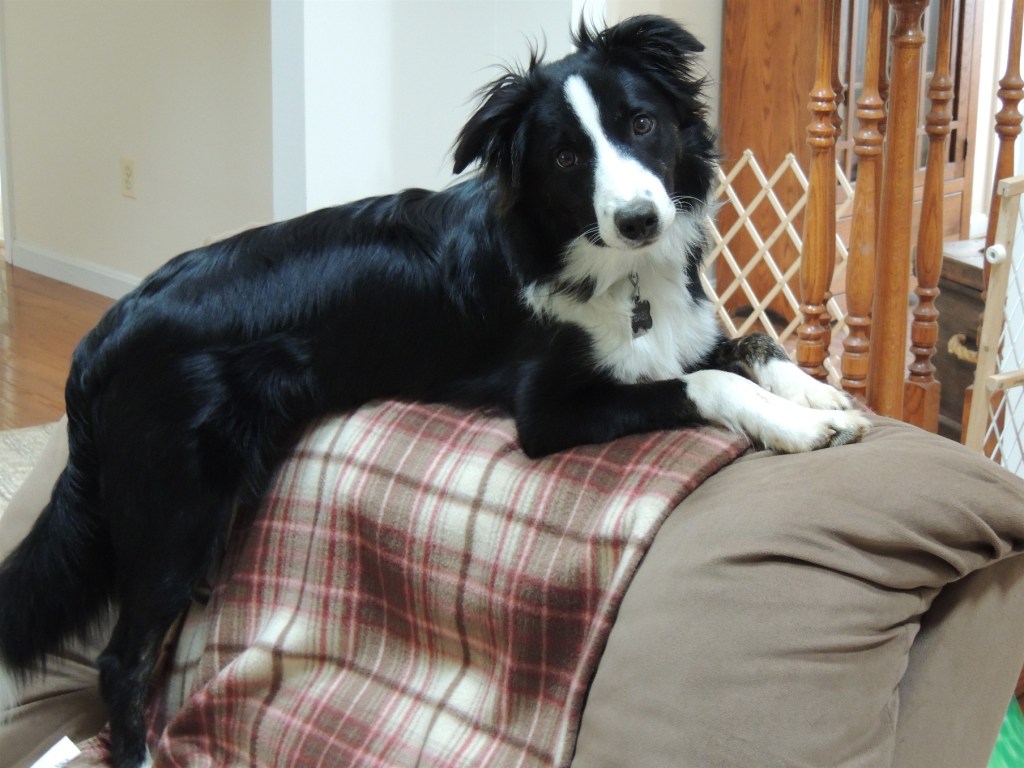
Riley

This finding explains why blind dogs are able to function, being able to play fetch and navigate their surroundings much better than people with similar blindness. That is comforting for people who own dogs who are blind or have gone blind.

Author’s Note: Although blind dogs can find their way around better than people, it is still a good idea to not move furniture around. If you have to move or add furniture, you can put a unique gentle scent on the corners of the furniture at the dog’s level to help the dog locate and identify the new or moved object.

We also have to think about how the relationship between scent and vision affects dogs in terms of training and their reaction to the environment, taking into consideration personality traits such as friendliness, fear, aggression etc. While we know that many of the personality traits of dogs are inherited, is it possible that these findings might explain further exactly how and what is inherited. Many people do not realize how complex dogs and perhaps other animals are.

Male dogs more likely to develop Transmissible Venereal Tumors

Researchers at the University of Cambridge’s Department of Veterinary Medicine discovered that male dogs, especially free roaming dogs, were four to five times likely to develop the Oro-nasal form of Canine Transmissible Venereal Tumors (CTVT) than female dogs.

CTVT is an unusual cancer that can spread between dogs that come in contact. This type of cancer is infectious because the living cancer cells can be physically transplanted from one animal to another. The researchers feel that the reason it is more prevalent in male dogs is because they spend more time sniffing and licking female dog genitalia.

The common symptoms are difficulty breathing, nasal deformation or bloody or other discharge from the nose and/or mouth. Fortunately, this type of cancer is treatable with Vincristine chemotherapy.  

The researchers noted that transmissible cancers are found in Tasmanian Devils as well as marine bivalves such as mussels and clams.

Finding a lost dog

Losing a dog can be devastating. A person’s first reaction is usually fear, confusion and panic. However, with a good plan in place, looking for a lost dog can be less stressful and more successful. There are a few simple points to consider when looking for a lost dog. However, prevention is the key ingredient. The most important thing you can do is have your dog microchipped and have a collar on your dog with his name tag that includes a way to contact you. If someone in your area finds your dog, they will not have a microchip reader and will rely on a name tag.

1) If you organize a group of people to look for the dog, use all safety precautions so that the volunteers do not become lost as well. Stay in touch using cell phones or handheld radios. The radios can be purchased for a nominal fee at any store that sells outdoor equipment. Radios will work in areas that cell phones may not, however, they have a limited range so be sure that a chain of people can relay messages over distance. Also, establish radio protocol so that one person does not tie up the frequency preventing communication with others. Communication is essential to let the other volunteers know what is going on, if the search is being suspended, or the dog has been found. Because people feel safer and calmer if they know what is going on, this will allow the volunteers to do a better job.

Be sure that volunteers wear the appropriate clothing, (long pants and long sleeves), hats, and substantial footwear. Each volunteer must carry a snack, water, leash, bath towel, bowl, enough water for themselves and the dog, canned cat food or treats and a flashlight. Flashlights are necessary during the day to check dark places.

The canned cat food should have the strongest aroma, (or a similar treat) to lure the dog. Small cans of cat food work well because they can be carried easily and kept fresh.

A bath towel can be used to carry the dog if he is injured, exhausted or to wipe the dog if he is wet or dirty. If the dog is cold, he can be wrapped in the towel.

Volunteers must always work in pairs for their own safety, and in the event two people are needed when the dog is found. A meeting area and time should be established in case communications break down. No one should leave the meeting area until all are accounted for.

2) A dog that ran away because he is frightened will bolt in any direction, but usually to the least noisy, darkest area. Given the choice of an open field or woods, the dog will go for the woods. If the dog is lost in the city or suburbs, the dog will look for a dark, quite spot to hide after it has run to exhaustion.

Therefore, try to estimate how far the dog will run (this varies with the dog’s size and condition) and add a mile to that. On a map of the area mark where you last saw the dog as the center of a circle and draw a perimeter around that point, based on the furthest point where the dog could be. The circle will encompass the area to start looking for the dog. If you saw the dog run, you can focus in that direction. Be sure to check small dark areas: under porches, stairs, garages, sheds, etc. If you have several people helping to look, have some start at the perimeter of the circle and some from the center. Be sure to look for the dog, never assume that the dog will come when called.

3) If a dog runs away, they usually run into the wind. That means that the wind will be blowing toward the dog, into the dog’s face. Check with a local airport to see what the wind direction was when the dog ran away. Then start looking into the wind from the point where the dog was last seen.  Often the wind will usually blow in the same direction in a given area. Check each day to see which way the wind blows.

Dogs who wander away will usually meander along unless they find something to chase or something that interests them. This means that the search area will be smaller. If searching in the woods or a park, look for a game trail and look for fresh dog tracks to see if the dog went that way. If you do find tracks, you will not be able to tell for certain if they are from your dog, so do not give up searching in the rest of the area. If you are searching in an urban or suburban area, listen carefully if neighborhood dogs are barking. Often, they will bark at a stray dog. If you hear a lot of barking in one direction, check that area first.

4) When searching for a dog, travel slowly and make frequent five to ten-minute-long stops. Many people will drive around in a vehicle, calling to the dog. Unless the dog is within a few seconds of your location, he will not be able to find you if you move too quickly. Keep in mind that a dog can hear you calling from quite a distance away. They need time to determine the direction of the sound and then get to it. Wind and other environmental elements can distort the direction of sound (tall buildings, large hills, etc.) making it difficult for the dog to find the source of the sound. By stopping and continuing to call for about five to ten minutes, the dog will have time to find you.

5) When you sight the dog, do not act excited and/or run toward the dog. Sit down or stand still and let the dog approach you, even if it is your dog. Sometimes a dog can become so frightened, hurt, or weary that they may not think straight. Their survival instincts may take over, making them more cautious than they would be at home. Depending upon the direction of the wind, you could be downwind, and the dog may not recognize you right away.

Give the dog time to feel safe. Running to the dog may make him run away from you and lose what little trust in humans that he has left. If you feel it will work, you can, at a distance, slowly move so that you are upwind of the dog, and then open the can of cat food, but still let the dog come to you. When the dog comes to you do not try to grab the dog. Let the dog stay there and relax. Slowly pet the dog until you can attach a leash without frightening the dog. If the dog does not want to be caught, you will most likely not be able to grab the dog fast enough to catch him, even if he is next to you.

6) If the dog does not approach you, do not give up. Stay in that area and/or return to that area. You can leave food etc. but do not try to catch the dog.

7) If you leave food for the dog, do not assume that because the food was eaten that it was eaten by the dog. Other animals may eat the food, so continue to search the area. If you can, spread sand around any food that you leave so that you can check for footprints to determine if a dog ate the food. If sand is not available, loose soil will work as well.

8) If you have to search for the dog over a period of time, keep a log of the weather and the location of water sources. The dog will generally head into the wind and seek water.

9) Never forget to advertise. Use every means possible to let the people in the area know that there is a lost dog. Contact all veterinarian clinics, shelters, pet supply stores, and rescue groups. Also post signs in stores with bulletin boards, on telephone poles, especially where children congregate, by public transportation and any other place that you can think of. Be sure to post on social media. If your dog is not found right away, about every two weeks call everyone you notified, such as the local rescue groups, to let them know that the dog is still missing. This will keep your dog fresh in the minds of the employees.

Always have an up-to-date photo of your dog. If the dog is a breed that looks like others in the breed, a similar picture will do. Remember, the average pet lover will not notice the fine differences between your dog and others of the same breed. So do not panic if you do not have a recent photo. Be sure to expand the area that you advertise to at least five miles from the point where you last saw your dog.

Keep all your bulletins up to date. If the lost signs that you post look old or weathered people will think the dog was found. When you find your dog, it is important to call all the organizations that you originally notified to let them know that the dog was found. Also remove all your postings.

10) Lastly, never give up. Dogs have been found months after they disappear.

Allergy shot for people allergic to dogs on the horizon

Researchers at the Osaka Prefecture University have identified potential candidates for those parts of the molecules that result in allergic reactions to dogs. If they develop this new finding, there could be an allergy shot to help people who otherwise cannot own or be near dogs enjoy dog ownership.

The long-range result may be that less dogs will be surrendered for adoption due to allergies to them and children may be able to grow up with that special companion.

The added benefit of this new discovery is that it could lead to other new allergy shots that will benefit people. Any progress in curing allergic reactions is a plus for overall health. Those people who suffer from allergies often suffer year-round. It is like having a constant cold. 

Pet Toys

Note: This article is my opinion, based on my experiences with many dogs, cats and birds.

Pet owners spend a considerable amount of money on toys for their pets. Toys are important for pets; they give pets something to do and, in some cases, build the bond between the pet and owner. While I will refer mostly to dogs, this article applies to all pets.

It is important to realize that there is no regulatory body for pet toys. What that means is that manufacturers can use whatever material they choose to make pet toys. Unfortunately, many of the products that are available are not safe, either because of a chewing or a toxic substance risk.

When picking a toy for your pet, you should consider the type of animal it is and what it likes to do. Dogs like to fetch, toss and chew and shred toys. This satisfies their natural hunting instinct. Cats like to chase, pounce, carry and sometimes tear up toys.

Birds generally like to tear apart, peck and toss toys. Although many birds play with toys in various ways. I had a budgie who liked to “herd” plastic balls into a tight group.

When considering a toy for a pet, keep in mind that if there is a risk associated with the toy, the risk increases if the pet is small. This is because it takes less material to block their intestines and less toxins to make them sick or kill them. This is why a pet owner should carefully evaluate what toy they give their pet.

I feel that toys for dogs pose the most risks because dogs tend to chew and eat pieces of their toys more than other pets. Know how your dog likes to play with a toy before you pick one out for him. Some dogs will totally destroy a stuffed toy or a plastic one. Other dogs like to carry a toy around and will not destroy it. Many dogs are obsessed with getting the squeaker out of a toy that has one. My Parsons Russell Terrier is a squeaker killer. He will work on a toy almost endlessly until he gets the squeaker out. Then for the most part, he loses interest in the toy.

Puppies almost always chew a toy until it is destroyed and they are more likely to eat the pieces of the toy. For this reason, plastic toys are a higher risk for puppies. Regardless if your dog is a puppy or an adult, plastic toys in general are the highest risk.

Because dogs like to chew and destroy toys, they are less likely to play with the chew-proof variety of toy. Some of the nylon toys are coated with a scent and when the coating wears off, the dog loses interest in the toy. Stuffed toys pose a problem because the stuffing, which can be ingested and not digested. The stuffing in most dog and cat toys are fiber fill which is a form of plastic.

If a dog owner is going to give their dog one of the many products on the market designed to clean the dog’s teeth while they chew the toy, be sure to check the ingredients. Most dental chews for dogs are only 96% digestible. What is the other 4%? Some of these products have plastic in them to make them last longer.

Those chew products that are designed to be eaten, should break down in five to ten minutes when placed in water, if not, it is a high risk for your dog. These types of products can block a dog’s intestines. Because of a dog’s short digestive tract, these products do not have enough time to break down if they can break down at all.

This is also true of any rawhide product. I personally do not approve of any animal product such as cow hooves, pig’s ears and rawhide. These products are often treated with formaldehyde as a preservative. Many people think that rawhide comes from a butcher, but in reality, rawhide comes from a tannery. Also, keep in mind that any wild domestic canine does not eat bones, skin or hooves.

This is evident when you see a dead deer along the roadside. After everything, animal, bird and insect are finished feeding on the carcass, the things left are hide, hooves and bones. The main risks for letting a dog eat rawhide are contamination, choking hazard, and intestinal blockage. A number of pet related organization discourage giving dogs rawhide. However, dried chicken feet and antlers are a better alternative than rawhide, pig’s ears and cow hooves.

Rope toys are acceptable if your dog does not chew them and swallow the threads. The safest rope toy is one made of cotton instead of nylon. Cotton has a better chance of breaking down if it is ingested whereas the nylon will not.

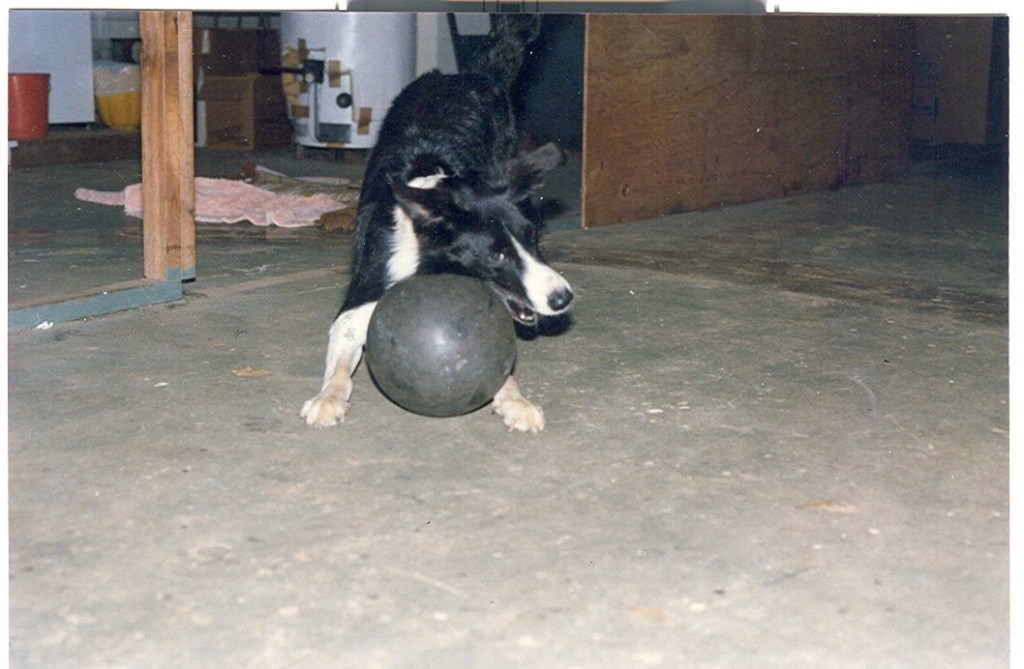
Ness’s favorite toy, an old bowling ball

It is never a good idea to give a dog old shoes or slippers because of the chemicals used to make them. It is especially difficult for a puppy to understand that old shoes and slippers, and rawhide products are OK to play with but new shoes and slippers are not. Keep in mind that rawhide comes from a tannery and dogs have a very sophisticated sense of smell. Therefore, a dog of any age can smell the similarity between rawhide and other leather products, which include furniture, gloves, jackets and briefcases.

Bones are not a good choice for dogs either. Again, it is not natural for dogs to eat bones. Many of the “natural” bones have bacteria on them that can harm both dogs and people who handle them. Some of the stuffed bones that are treated can be safer for a dog who likes bones. The danger associated with bones are splinters from the bone and bacteria.

The bottom line is knowing your dog. If a toy becomes small enough to swallow it should be taken away from the dog. By knowing your dog’s play habits you will be able to decide what toy is safe for them to play with. The best toy is one that allows you to interact with your dog, playing fetch games, chase games or whatever your dog likes. If you understand your dog’s breed, it will guide you to selecting the right toy for your dog. All dogs can benefit from puzzle toys and treat dispensing toys. Also think outside the box, you never know what a dog will take a fancy to as illustrated by our dog Ness.

The dogs of Siberia

An extensive research project led by palaeogeneticist Laurent Frantz from the Ludwig-Maximilian-Universität Müchen determined that dogs from Siberia resulted from cross-breeding with dogs from Eurasian populations over 2000 years ago. His findings along with artifacts found at ancient sites, shows extensive trading. Dogs were an important trade item between the Siberian people and people from the Eurasian steppe and Europe.

For example, he goes on to say that although a large percent of the Samoyed genome can be traced to original Artic bloodlines, it also shows more Western influence than the husky. This finding helps to explain why the Samoyed can herd reindeer yet the husky does not. According to his findings the Samoyed as a breed has had little changes since the Middle Ages.

It is also interesting to note that according to Frantz, although there was an exchange and inbreeding of Siberian dogs, there was no indication that the people intermarried. The human genomes stayed very stable over the same period.    

COVID in dogs and cats

A study in the Veterinary Record, has reported a few cases of dogs and cats contracting the SARS-CoV-2 variant in England. In these cases, the pets caught the variant from their owners who had shown symptoms several weeks before the pets became ill. Heart problems were manifested in the pets who contracted the variant.

While this is not widespread and actually rare, it is a good idea for pet owners to be aware of the possibility since COVID-19 is so widespread. At this point the research does not indicate that people can catch the variant from pets.