Dogs Can Understand Vocabulary and the Intonation of Human Speech

The world was amazed by the accomplishments of Chaser the Border Collie. Chaser can identify 1022 toys by their name and retrieve them by category.

She also knows common nouns such as house, ball, and tree. What is more amazing is that she can learn new words by inferential reasoning by exclusion.

This means she can pick out an object that she has not been taught the name of by eliminating all the objects she knows.  She also understands sentences with multiple elements and has learned by imitation.

scan0011

Border Collie “Ness”

Scientists have shown that Chaser is not unique in her ability to do these things. They have discovered that dogs understand both vocabulary and intonation of human speech using their left brain the same as people do. Prior to this research, it was thought that understanding words and intonations was something only humans could do, but that is not the case. The study also showed that dogs, like people, process words separately from intonation.

This is exciting because it shows us that our dogs (and possibly other animals) are far better able to understand what we say than many people realize. It also expands the horizon as far as how and what we can train our dogs to do.

However, does this mean that if we want to hide something from our dogs that we are talking about we will have to spell out the word? I can only imagine the conversation, “You know I made a v-e-t appointment for R-o-v-e-r for tomorrow.”

Genetic testing shows greater number of dogs have diseases then previously thought

Dr. Jonas Donner of Genoscoper Labratories, a Finnish company that specializes in animal genetics and testing has found that about 1 in 6 dogs carry the genetic predisposition for genetic disorders. They tested 7000 dogs that made up 230 different breeds. What was important about this research is that some of the diseases that showed up were in breeds that had not been previously reported as having that predisposition.

img096

Because many of the canine inherited disorders are more widespread than previously thought, it indicates that further investigation and testing is needed to help veterinarians and pet owners improve the health of canines.

It also shows that it is important for breeders to conduct genetic testing before they breed their dogs. With breeder and pet owner cooperation, the overall health of our dogs can be improved.

If you plan to purchase a purebred dog, be sure that the parents have been genetically or other wise tested for the diseases and disorders common for that breed. A good breeder will have done this for the dam and sire of a litter. For example, a German Shepherd should be Orthopedic Foundation (OFA) certified free of hip and elbow problems. A Rottweiler should be tested to be free of the canine bleeding disorder, VWD.

Noise sensitivity could be related to pain in dogs

Perhaps this is one of the more important discoveries in recent years. Researchers found that dogs who show noise fear and/or anxiety may be suffering from pain.

2lilya

Dogs who had underlying pain showed greater aversion to areas and a stronger reaction to noise. The researchers concluded that when the dog tenses or trembles from fear, the already underlying pain is made worse by the stress and pressure on the painful muscles and/or joints.

Often when this happens the dog associates the pain with the area or circumstances that he was in when the noise and pain occurred. They found that dogs who have pain associated with noise, associated the noise with a wider range of their environment. For example, if the dog associated pain with a piece of furniture in a room they may tend to avoid the entire room. They also tended to avoid other dogs.

What is very important to be aware of is that dogs who start to show noise fear or aversion later in life are more likely to also be suffering from underlying pain.

This study gives pet owners and veterinarians another tool to use to help diagnose pain that might otherwise be difficult to detect. Therefore, if you have an older dog who suddenly starts to react to noise, it is time for an in-depth examination by your veterinarian.

Angus, Canada’s infection sniffing dog

Angus is a Springer Spaniel, trained to sniff out Clostridium difficile (C. diff) an infection caused by a fecal bacterium that can make people very sick. Angus is used in hospitals to ensure that the spores from this illness are not present. He has effectively reduced the spread of infections in hospitals.

Surprisingly, even though rooms are thoroughly cleaned, Angus will sometimes find 5 -6 places where the bacteria are located a week. Hospitals have learned because of Angus, that staff locker rooms and cubby holes used to store items were found to have C. diff often transported on staff worker’s shoes. As a result of these findings, cleaning practices and prevention have been improved.

Although there is another dog in training, I would suspect that specially trained dogs to sniff C. diff would greatly improve cleanliness in nursing homes and other places such as assisted living quarters.

It is always exciting to find new jobs for our dogs that benefit the health and well-being of people.

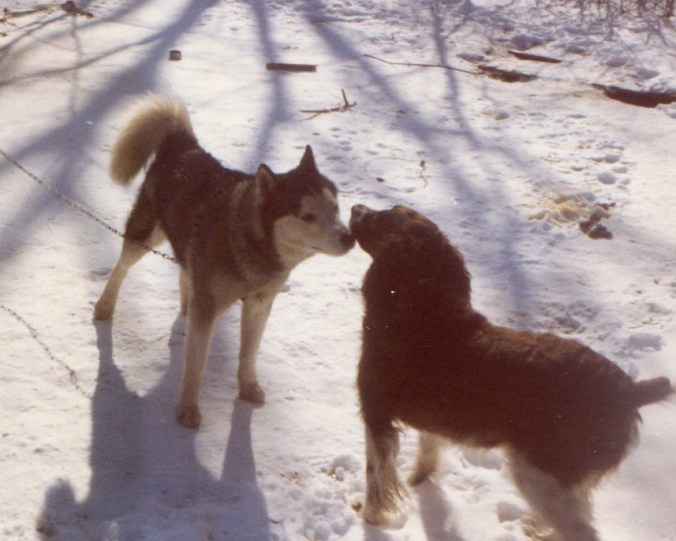
My Springer Spaniel and Siberian Husky saying “Hi” (many years ago)

Candy and Travis

Dogs anticipate what they will find at the end of a scent trail

A new test conducted by researchers at the Max Planck Institute for the Science of Human History and the Department for General Psychology and Cognitive Neuroscience (Institute of Psychology) at Friedrich Schiller University of Jena illustrated that dogs have a mental picture or an expectation of what they will find at the end of a scent trail based on the scent of the object.

The test was conducted on dogs (police and search and rescue dogs) trained to follow a scent as well as pets not trained to follow a scent. Both groups showed surprise when the object that they found was not the one used to lay the scent trail.

img107

Although this test was not intended to illustrate the mind of the dog, this is further evidence of the mental abilities of dogs showing that they anticipate what will happen in the future based on their surroundings. Many dog owners have seen this behavior in relation to other events. An example is the dog who can anticipate the arrival of a family member when that person comes home at about the same time every day.

It is exciting to anticipate what future studies will show us about the mind of animals.

Indoor dogs and cats have a higher rate of certain diseases

Keeping a dog mostly indoors and cats exclusively indoors typically benefits the pet by reducing their exposure to communicable diseases that can be caught from other animals and insects. Yet researchers have found that dogs and cats kept indoors suffer from a higher rate of diabetes, kidney disease and hypothyroidism compared with pets that are kept outdoors.

DSCN1407

The researchers tested 58 varieties of dog and cat food as well as 60 urine samples from dogs and cats and found certain parabens, which are a preservative, in the food and urine samples. They discovered that the highest level of parabens were methyl paraben and the metabolite called 4-hydroxybenzoic acid (4-HB). Parabens are used as preservatives both in human and pet food as well as cosmetics. The use of them is regulated by the FDA.

The researchers found that there were higher levels in dry dog food and less in wet food. Cat food had the highest levels. The researchers also determined that dogs are exposed to parabens through non-food sources as well as food, whereas a cat’s exposure was only from food.

This is the first study to consider the affects of paraben on diseases in dogs and cats. More research is needed to further examine the initial findings.

Female cats react differently to unrelated distressed kittens than male cats

Wiebke Konerding the lead researcher at the Hannover Medical School and the University of Veterinary Medicine Hannover, Germany studied the reaction of male vs female cats to distress calls of unrelated kittens.

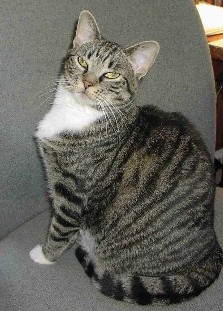
1pluskat

Interestingly, the more distressed the kittens were, the more the female cats reacted, even if they had not raised kittens themselves. The researchers found that there was no difference between the response of male or female cats to low arousal calls from kittens. But there was a difference to high arousal calls. Only female cats reacted differently.

The study implies that the ability of adult cats to react differently to emotional cues from kittens is ingrained and not due to experience. The kittens used in the experiment were not related to either the male or female cats.

Further research is needed to determine if adult cats react differently to their own kittens then they do to unrelated kittens.

http://www.sciencedaily.com/releases/2016/08/160812073702.htm

Limber Tail in Dogs

Limber tail primarily affects large working breeds of dogs, and especially Labrador Retrievers. It is a painful condition where the tail goes limp. It was initially thought to be a result of swimming, also known as “swimmers tail.” However, the researchers found that dogs who did not swim also suffered from this condition.

jeff lab 2

Another thought was that the condition resulted from exposure to the cold. Since many of the dogs studied lived in colder regions, it lends support to this theory. However, what researchers did find was that many of the dogs who suffered from limber tail were related, making genetics a strong suspect.

ron lab 2

The researchers hope to expand the study to learn what genetic connection there is to this painful condition in dogs. By doing so it will help breeders avoid breeding dogs that carry the gene.

Fortunately, the condition only lasts from a few days to a few weeks. But that means that many cases are not reported.

The study was conducted by Dr. Carys Pugh, at the University’s Roslin Institute and Royal (Dick) School of Veterinary Studies in Edinburgh. This was the first large-scale study of limber tail, using over 6000 Labrador Retrievers across the UK.

The study was published in the Veterinary Record and was funded by the Kennel Club Charitable Trust. The Roslin Institute receives strategic funding from the Biotechnology and Biological Sciences Research Council.

(thank you to Ron Hix and Jeff Dentler for letting me use photos of their dogs)

Canine aggression to family members and familiar dogs

A recent study by researchers at Nationwide Children’s Hospital showed that there are about 12 genes associated with canine aggression toward an owner or a familiar dog. They concluded that these genetic traits are distinct from the genetic predisposition toward aggression to unfamiliar people and dogs.

It has been found that the genetics involved are common to all breeds of dogs making it easier to study.

DSCN1776

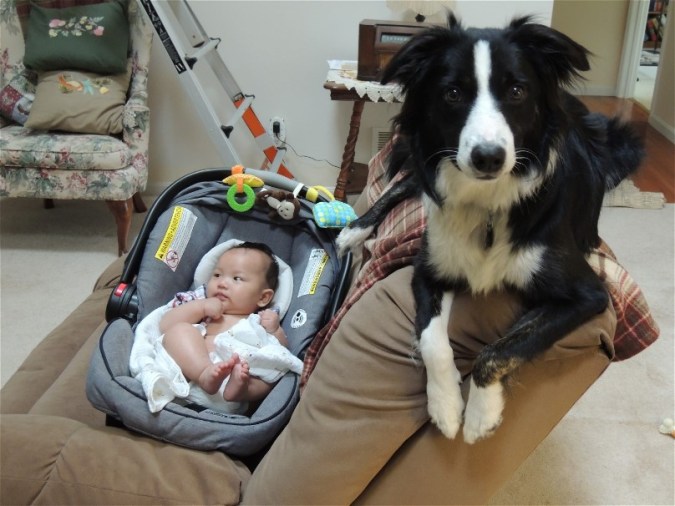
Photo: Babs watching over baby William

Carlos Alvarez, PhD, who is the main researcher at the Center for Molecular and Human Genetics in The Research Institute at Nationwide Children’s Hospital, feels that the genes are consistent with the neural pathway known as the amygdala to the hypothalamic-pituitary-adrenal axis.

Researchers feel that this genetic element is related to anxiety disorders in humans and hope that further research will show what kinds of medications will help both dogs and people.

This is an on-going research project. The fact that this type of aggression is genetically based is a good reason for people who plan to purchase a dog to investigate thoroughly the ethics of the breeder and the lines of the dog. If a person adopts a dog who shows this type of behavior they should immediately consult with a certified canine behavior consultant. You can find one at www.iaac.org. If my readers would like my brochure about how to find a good breeder and a quality dog, please emails me at sbulanda@gmail.com. There is no charge for the brochure.

Heartworms in dogs and cats

Some people feel it is safe to stop their pets (dog and cat) monthly heartworm preventative medicine in the fall and winter. This is not a good idea. Heartworms are transmitted by mosquitoes. The mosquito will bite an infected animal and ingest the heartworm microfilaria. It only takes 10-14 days for the larvae to develop. At that point if the mosquito bites an unaffected animal, it will transmit the larvae to that animal. What makes heartworm risky is that they can live in a dog for up to seven years and a cat for three.

Heartworm is a dangerous condition that can cause severe lung disease, heart failure and damage other organs in the host’s body.

heartworms Photo from Google images

At one-time heartworm was found only in the warmer states, but now it has been detected in all states. The warmer wetter environments that support mosquitoes have the most risk.

The symptoms for dogs include a mild but constant cough, a decrease in activity, fatigue, loss of appetite and weight loss.

Fortunately the medications for treating heartworms have become safer. They are an arsenic-based product called Immiticide. Before treating a dog for heartworm, it is necessary to do a thorough pre-treatment program. This will include x-rays, blood work and perhaps other tests to determine how much damage has been done to the dog’s organs. This way the veterinarian will know what to expect and what to look for which will help with the post-treatment care of the dog.

The post-treatment care is critical in saving the dog’s life. Although the treatment will kill the adult heartworms, their bodies will break up and the pieces can block the pulmonary vessels and/or lodge in the lungs. This is why a dog that has been treated for heartworm must be kept quiet for months after the treatment. This is also why pre-treatment tests can be critical for the dog’s survival.

Unfortunately there is no approved treatment for treating heartworm in cats. Some veterinarians have used a drug approved for dogs on cats, but with major side effects which include sudden lung failure and death. The other risk in treating cats is that they are more likely to die from a reaction to the dead pieces of heartworm in their heart and lungs.

One of the choices is to treat the symptoms from heartworm and hope that the cat outlives the worms. Heartworms only live in a cat for two or three years.

If a cat is treated for heartworms, it will need veterinarian supervision for several months. Often, they need oxygen, cortisone and sometimes a diuretic to remove fluid from the lungs. When they are stable, cats will continue to need corticosteroids either continuously or periodically. There is always a risk of sudden death.

The good news is that in some parts of Europe and Japan, veterinarians have been surgically removing the heartworms, however, the technique has yet to be improved and approved.

In the case of both dogs and cats, prevention is the better way to go. This is easily done with monthly heartworm preventative medicine for both dogs and cats.

Because heartworms can live in a dog or a cat for years, it is imperative that the pet be tested first before giving heartworm medicine. By giving the pet a monthly preventative year-round, you are doing the best you can to avoid these deadly worms.