Exercise, a benefit of owning a dog

Everyone knows that it is important to get exercise every day. However, for many people, especially elderly people, this can be difficult to do. Often motivation is the key factor to get people moving.

lar & jib

A new study shows that people in general, especially seniors, exercise more daily than people who do not own dogs. This is often because dogs have to be walked more than once a day.

What is even more significant is that even in bad weather, people who own dogs get at least 30 minutes more exercise a day than people that do not own dogs.

Owning a pet also helps people in many other ways. Pets tend to help people socially and help prevent mental distress. They relieve loneliness, give people a reason to live, and a sense of acceptance.

By adding physical exercise to this, pets, especially dogs, help keep us healthy.  And keep in mind that going for a walk benefits the dog as well.

For an excellent book get a copy of Walk a Hound, Lose a Pound by Dr. Phil Zeltzman.

www.sciencedaily.com/releases/2017/07/170724211648.htm

A Holiday Gift Giving Guide for Dog Owners

This article is contributed by Cindy Aldridge

It’s never easy to find the right gift for someone in your life. You want to give them something they’ll love, but with the holiday season already here, you don’t have a lot of time to wander the malls and hope inspiration strikes you.

Tess67

If you have a dog owner to buy for, it might be a good idea to find something both of them will love. Read on to find the right gifts for both dog and owner. You need to be careful, though. There are some gifts that can be unhealthy for the dog.

Dog Gifts To Never Buy

One common dog gift is a rawhide bone. Many people buy these for their pet dogs, which is a shame. As Dog.com shows, rawhide chews can break off and get swallowed, only to block the intestines as the dog tries to digest it. Some rawhide toys, such as those made outside the US, are also covered with a residue of dangerous chemicals that can sicken a dog.

Other classic dog toys you should avoid giving this year include:

  • Toys shaped like small animals since this teaches the dog to attack the real versions.
  • Dog mustaches, hats, or similar silly gifts.
  • Hard frisbees. (They make a special kind of disc just for dogs.)
  • Any cheaply made chew toys, as they tend to break apart.

What Dogs Love To Get

Then what should you buy for your friend’s cute furry friend? Dog treats are typically good, as almost every dog owner needs a box handy for training or treating their dog. But as Mashable shows, there are some unique dog gifts that can work even better.

  • Doggie cigars look like real cigars but they’re just a chew toy.
  • A pet sofa or bed gives the dog a comfortable place to rest.
  • For a safe stuffed animal the dog can enjoy, have one custom made that looks like the dog.
  • A “Pez” dog treat dispenser looks retro while giving the dog a fun place to store treats.
  • For active dogs, a hyper tennis ball launcher can finally tire them out.

Bored Panda has a great list of unusual gifts for the dog. One of these is the auto zip line. Dogs love car rides, but they can get annoyed as they bounce around the inside of the car. The zip line attaches near the roof and runs across seat. Once tethered to the line, the dog can stay active while staying in the back seat.

Gifts For Owners

Buying a gift for the dog can be fun, but don’t forget about its owner! Dog monitor cameras make a great holiday gift. Leaving a dog at home all day can make owners a bit sad, so being able to see that their pet is just fine can be invaluable.

Some other gifts for the dog lover in your life include:

  • A Paww Secret Agent leash that lets the owner easily attach it to a sign or parking meter.
  • Some black-and-white photo portraits of cute dogs.
  • Dognition, a series of games that helps humans understand how dogs view the world.
  • A GPS tracker for the dog, especially if it tends to get past the fence a lot.

Find The Right Holiday Gift

Buying gifts for others can be a hassle, but it helps when you know you got the right present. For dogs, skip the rawhide bones and go for beds, ball launchers, or auto zip lines. Just don’t forget about something for the owner or they might be jealous!


Herding dogs can suffer from a genetic mutation causing a reaction to certain drugs

Although it is rare, white footed herding breeds such as Border collies, Corgies and Australian shepherds can have a genetic mutation that makes them sensitive to ivermectin and several other drugs including some chemotherapy medicines.

jib

For example, a dog named Bristol who had the genetic mutation almost died as a result of the mutation. Bristol was barely responsive and suffering from seizures. It took months of treatment including a mechanical ventilator and rehabilitation to bring her back to normal health. Bristol had eaten the droppings of sheep that had been recently dewormed with ivermectin, which is what caused her health issue.

It is easy to determine if your dog has the genetic mutation by asking your veterinarian for a simple test to determine if your dog has the genetic mutation. The test involves using a small brush to swab the inside of your dog’s mouth. The swab is sent to a laboratory for the results.

This is an easy preventative way to protect your dog, especially if your dog is around barns, livestock or used for herding trials. All herding breeds should be tested to be safe. It would be a good idea to test all herding breeds whether they are white-footed or not. Rather be safe than sorry.


Excessive barking in dogs

A dog who barks excessively can be a nuisance to neighbors as well as the dog’s owners. Some breeds tend to bark more than others. Often the herding breeds can be barkers because some breeds have been bred to manage livestock by barking, such as the Bearded Collie. Other breeds are bred to bark or “sound” such as hounds. If excessive barking is a problem for your situation, consider the breed traits before you get a dog by researching whether or not that breed or type of dog tends to be a barker.

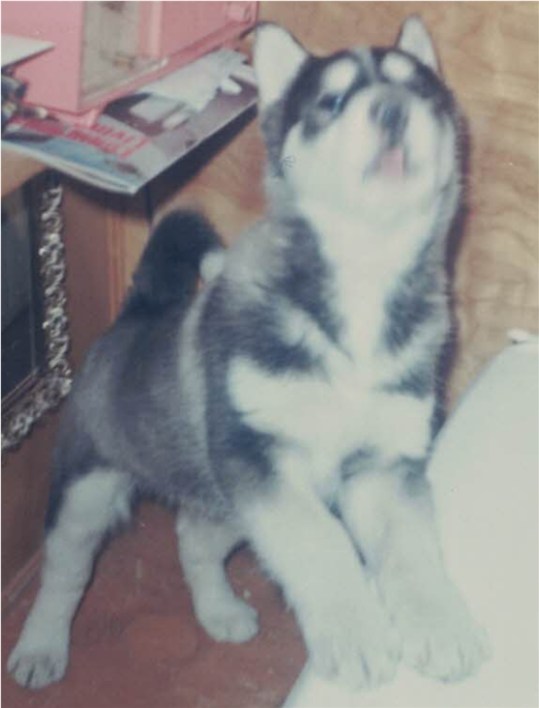
husky

If you already have a dog who barks, there are steps you can take to control the barking. Some people are concerned that if they teach their dog not to bark that the dog will not alert them when necessary. This is not true. If there is a real reason to bark a dog will do it even if he is taught not to bark.

The best time to start training a dog not to bark excessively is when they are puppies. But even if your dog is older, you can still teach the dog not to bark excessively. A good positive obedience program will help build the communication between you and your dog so that you can teach your dog to be quiet on command. An obedience program will help your dog understand what you want and will build the relationship between you and your dog.

To control excessive barking, start by determining why the dog is barking. Some dogs bark for attention, some out of boredom, sometimes there are wild animals (such as squirrels) or birds outside a window that tease the dog, and some dogs bark to lure another dog or pet to play.

The first step is to remove the stimulus that causes the dog to bark. Next exercise your dog to the point where he comes in and flops down for a nap. Depending on the breed you may have to do this a few times a day, especially for a younger dog.

Next when the dog is quiet, teach the dog to speak on command. Once the dog will speak offer a treat at the same time you give the command “quiet.” Give the treat as soon as the dog stops barking.

Note: If you hold the treat between your fingers while the dog is barking and then quickly put the treat under your dog’s nose, he will stop barking. He cannot sniff and bark at the same time.

Do not yell at the dog to be quiet without teaching the dog the command. Remember, dogs do not speak English, so they do not understand the words you are yelling at them. To a dog your yelling sounds like you are barking along with your dog and that will encourage him to bark more.

Although it may be difficult, totally ignore your dog when he barks. It may take awhile, but if you do not respond the dog will learn that barking does not get the results that he wants.

You can also try to divert the dog when he starts to bark by using a command that tells the dog to do something else such as fetching a toy which can divert the dog from barking.

When a dog barks, in most cases, he has a good reason for doing so even though that reason may not be an acceptable one to you. Dogs need to bark just as much as we need to talk. However, they can control their barking and learn when it is appropriate to bark and when it is not.

The key to success is to not give up and after your dog learns what the “quiet” command means, praise your dog for being quiet. Everyone will be happier, even your dog.

PTSD in dogs

Recently canine behaviorists and veterinarians have seen what appears to be a canine version of Post Traumatic Stress Syndrome in dogs (PTSD).

Some of the dogs are combat veterans and police dogs. However, it is possible that pet dogs who experience a traumatic event can also suffer from PTSD.

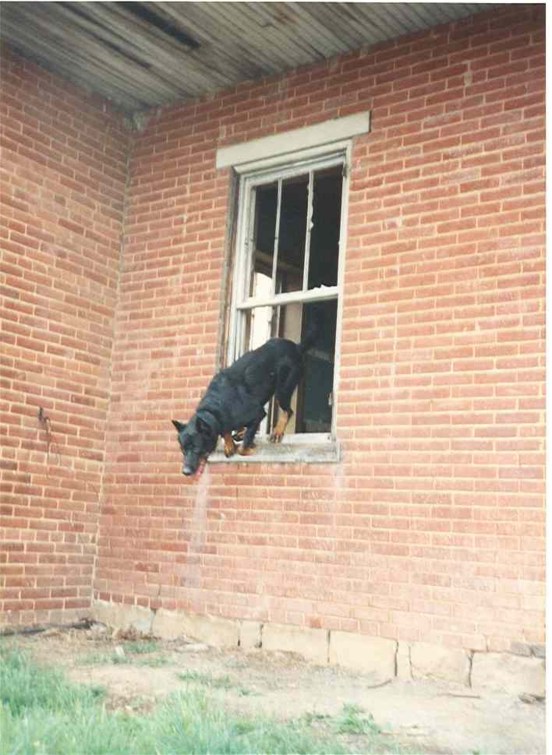
Scout SAR training window

Pet dogs who suffer from PTSD can include dogs that have been frightened by fireworks, are noise sensitive, or have been injured in some way. The symptoms usually vary from case to case. Some dogs will be over-responsive, showing extreme fear for example, while others change the way they interact with their owner/handler such as becoming aggressive or over clingy or timid.

Other symptoms can include attempting to escape certain environments or avoid those environments. In some cases, the dog in question who was a good working dog will suddenly fail to complete his tasks or shut down entirely.

Treatment for each case will vary. Sometimes a veterinarian will suggest an anti-anxiety medication to be used for the short term. This must be coupled with retraining, desensitizing to the environmental elements and situations that cause the problem and counter-conditioning to build the dog’s confidence. People who own or work with these dogs must understand that it takes time to work through the issues and that there is no magic pill to fix the problem.

Fortunately, there are certified canine behavior consultants who can help these dogs. There are also organizations dedicated to saving the dogs and finding suitable homes for them when necessary. One organization is Combat Canines: The DDoc Foundation.

It is important to keep in mind that rehabilitating these dogs takes time. No one knows for sure if they actually suffer from PTSD because the dogs cannot tell us. However, the symptoms strongly suggest that they do. Many of these dogs have served our country faithfully and deserve a second chance for a happy life.

Probiotics for humans and pets

Probiotics are a hot topic in both humans and pets. The gastrointestinal (GI) tract in both humans and animals is responsible for overall health.

DSCN0046

It is the largest immune organ in the body. It is also the home of trillions of microorganisms. The ratio of these microorganisms and their relationship to each other is what makes us healthy or unhealthy.

Probiotics are a supplement that both animals and humans can take to make sure that the balance as well as the presence of these microorganisms is correct. Although there is not enough conclusive research about the benefits for humans and animals, there are enough positive results to warrant taking them.

We do know more about how they work in humans than animals, but since animals often have the same results as humans, it is safe to assume that they help in the same ways. So let’s look at how they help in humans to understand the benefits of probiotics.

Mainly they help with diarrhea that is a result of taking antibiotics and they may help with traveler’s diarrhea.  People with ulcerative colitis sometimes benefit from the VSL#3 blend of probiotics. Interestingly there is also evidence that probiotics may help with depression and anxiety, and last but not least, they may reduce the risk of blood infections known as sepsis.

When purchasing probiotics is it important to consider the cost, since many are expensive. Also, certain groups of people such as the very young, elderly, those whose systems are immune-compromised because of health conditions (autoimmune disease, severe burns, on chemotherapy, or on immune suppressants) may experience gas and bloating if they take probiotics too quickly.

It is important to talk to your doctor, (or veterinarian for your pet), about the amount of probiotics needed to bring the results necessary. Research indicates that people may need from one to ten million daily.


Declawing a cat

Some people feel that they must declaw a cat in order to save their furniture, rugs and curtains. However, they fail to realize that declawing a cat is not the same a trimming their nails. It involves removing the end bone and claw on each of the cat’s toes. This is a painful procedure and the cat will need care and pain medications to recover. Many veterinarians will not declaw a cat.

OLYMPUS DIGITAL CAMERA

Declawing a cat will also take away the cat’s main defense mechanism. While you may feel that your cat will be an indoor cat, during the cat’s lifetime, he may accidently get outside and will be almost defenseless.

Scratching is a normal behavior for a cat. They mark their territory and sharpen their nails by scratching. It seems that they also enjoy the activity.

Rather than declaw a cat, you can teach a cat to use a scratching post. Provide a scratching post in the places the cat likes to scratch. If the cat starts to scratch furniture, simply say no and move the cat to a scratching post. They are capable of learning where to scratch. Clicker training can help a cat learn to use a scratching post.

There are different types of scratching posts for cats. Experiment with them to see which one appeals to your cat. Some of the types of scratching posts are ones made from rug, natural wood and cardboard like substance.

It is easier to train a young cat than an older cat, but the main thing is to not give up. With the right scratching post and encouragement, your cat will learn.

If you do consider declawing, consult with your veterinarian first to see what is involved in the procedure as well as the care that the cat will need after. It is always easier to declaw a young cat. Declawing an older cat or one that has medical issues can be riskier and cause health problems.

Understanding your cat can be easier than you think

Cats communicate in many ways. They use vocalizations, body language and spatial position to communicate.

For example, a cat will gently paw you to get your attention. While batting things around is a form of play, a hard swat without their claws out can be a warning. A swat with the claws out is a much more aggressive act, either in defense or as an attack. Of course there is the kneading action with their paws that cats do when they are happy.

cat on cage

(my cat who was taught not to bother the bird, note the bird is not afraid of the cat)

When a cat vocalizes a short meow is like a greeting, or a friendly “how are you doing?” A meow that is a bit louder and perhaps longer typically is a request for something, such as dinner or to get to a place that is inaccessible. A longer meow is a more demanding request, typically if you ignored the cat’s earlier request. A high pitch meow is a protest, such as if the cat does not like to be groomed or have its nails clipped. Then there is a long, almost sad meow that sounds as if the cat is confused.

If an old cat does this and seems to be lost or confused, it is time for an examination by your veterinarian. The cat may be suffering from or starting to get dementia. A hiss is usually a warning to move away from the cat. Purring is usually a sign of contentment but a cat that is in pain or stress will purr.

Facial expressions are important, including the ear set, eyes as well as the mouth. Flattened ears show that the cat is angry or frightened. Large dark eyes also can mean anger or fear. An opened mouth with a hiss is anger or fear and it can be difficult for a cat owner to tell the difference between anger and fear.

A cat’s tail is just as expressive as vocalizations. A happy cat will have its tail up and often with a small hook at the end. A swishing tail is a sign of annoyance and sometimes anger. Of course there are many positions in between the upright tail and the swishing tail. Some cats will appear to be contented but the tips of their tail flicks up and down or back and forth, it can mean that the cat is irritated. When some cats are very happy their tail will stand upright and shake with the hair at the base of the tail puffed out.

As most people know, when a cat is angry or frightened they will arch their back and raise the hair on their back and tail. The tail will usually be erect or curved down and sometimes tucked between their legs.

To help our cats understand us, we need to be consistent in our body language and tone of voice. You can train a cat if you are careful not to give the cat mixed signals. A treat with a happy face and voice will show a cat that you are pleased with their behavior. A firm no and a serious face will let them know that you do not approve of their actions.

Cats sometimes do not recognize our space. Therefore, if a cat gets on you, near you or goes where you do not want them to go, such as on the table at dinner time, you can give the cat a stern “no” and point to the floor while you gently push them away. It may take a few times but the cat will learn.

For behavior that you want, you can smile, tell the cat that it is good and give the cat a treat. The cat will learn that this is acceptable behavior. Of course, you can clicker train a cat. https://clickertraining.com/cat-training

With a little thought, planning, and careful observation, it is not as difficult to communicate with a cat or understand what they are trying to tell us as a person may think. Your cat will love you more for the effort and you will understand your cat better.

Hypertension in dogs

Most people are familiar with hypertension in people also known as “high blood pressure” but how many of us know that about 10% of dogs have it too? The problem is that our dogs cannot tell us if they are not feeling well. Therefore, it is our responsibility to look for symptoms that could be a result of high blood pressure.

dscn1701

There are two types of high blood pressure in dogs, primary and secondary. Humans are more likely to have primary high blood pressure, which is when there is no underlying cause.

Secondary high blood pressure is typically caused by a disease. Secondary high blood pressure is the most common one that affects dogs.

Unfortunately, the signs for high blood pressure can also be signs of other medical problems in your dog. For example, high blood pressure can affect the eyes, central nervous system, heart and kidneys.

Often dogs do not show early signs of high blood pressure, and sometimes the signs that we see are considered part of normal aging and could be overlooked.

Like humans, being obese is a cause of high blood pressure and is one thing we can control. Regular exercise and keeping your dog’s weight at a normal level can help prevent high blood pressure.

Because the symptoms can be related to other medical issues, if you notice any change in your dog’s behavior regardless of what age your dog is, a trip to the veterinarian is in order. In older dogs do not assume that behavior changes are due to old age.

Some of the changes to look for are excessive drinking. Sometimes a dog owner will not know if their dog is drinking more water so good way to tell is to see if the dog has to urinate more often and/or larger amounts.

Changes in the dog’s movement, how he walks, if he seems dizzy, or falls is another sign. The dog’s mental state, such as does he seem forgetful? Stand in a corner or seem to get lost?

Has the dog’s appetite changed? Is he less active? Does your dog pant excessively? Does he cough or seem short of breath? These are all symptoms that warrant an immediate visit to your veterinarian.

Sometimes changes happen gradually. It is a good idea if the dog is a senior to have your dog checked twice a year. Keep in mind that being a senior depends on the breed of dog. Some breeds can live to be 18 and some do not live past ten. Check with your veterinarian to determine what age your dog needs a twice a year checkup. The good news is that high blood pressure in dogs is treatable with medications.

Cats can catch canine influenza from dogs

A group of cats in a shelter in Northwest Indiana have tested positive for the canine influenza H3N2 virus. This was confirmed by Sandra Newbury the clinical assistant professor and also the director of the Shelter Medicine Program at the University of Wisconsin School of Veterinary Medicine in collaboration with Kathy Toohey-Kurth, virology section head at the Wisconsin Veterinary Diagnostic Laboratory.

scan0023

Although cases have been reported in South Korea, only a single case showed up in the United States in 2015. The cats that are infected shared a shelter with dogs that were also infected.

Tests have shown that the virus can reproduce in cats and spread from cat to cat, as well as from dog to cat. This means that dogs and cats must be housed separate from each other in shelters.

Cats exhibit upper respiratory symptoms such as runny nose, congestion and general malaise, as well as lip smacking and excessive salivation. Fortunately, the symptoms do not last long and so far, have not caused death in cats.

Dogs that have the virus often develop a persistent cough, runny nose and fever, although some dogs show no symptoms and some can get very sick. Canine flu has caused death in dogs but most recover if taken to a veterinarian and given the proper care.

Although there is a flu shot for dogs, there is no shot for cats. So far the canine virus has not infected a large number of cats. However, if a potential cat owner goes to a shelter and adopts a cat or visits a shelter and already owns a cat, they should be cautious when handling cats by using hand sanitizer before and after handling each individual cat or dog.
If your dog or cat shows flu symptoms, a trip to the veterinarian is in order. However, be sure to tell the receptionist when making an appointment that you suspect that your dog or cat has the canine influenza virus so that they make take proper precautions.

Proper treatment, care and handling of pets who may have the canine influenza virus, will go a long way to preventing it from spreading. Be sure not to make contact with other pets until your veterinarian says the virus is no longer contagious.