Dogs help children with a rare and severe form of epilepsy

Although Lafora disease only affects about 50 children worldwide, it is a deadly form of epilepsy that is common in Wirehaired Dachshunds.

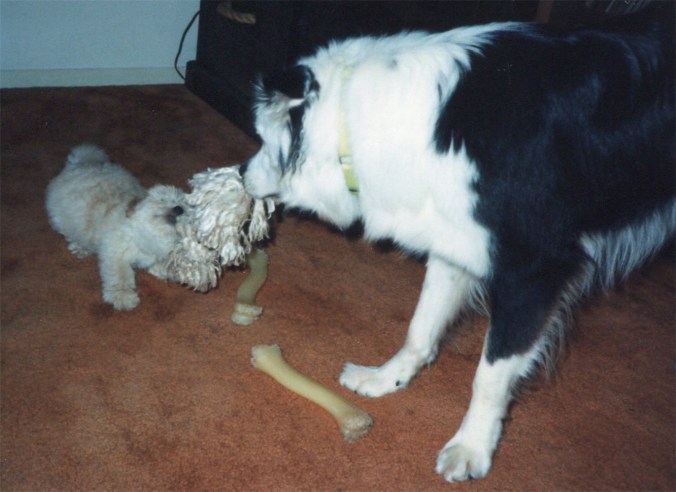
DSCN1407

(photo is not a Wirehaired Dachshund but it is cute!)

Many Wirehaired Dachshunds suffer from Lafora, and because the disease is the same in children as it is in dogs, veterinarians and human neurologists have teamed up to study the disease.

Dr. Clare Rusbridge, Reader in Veterinary Neurology at the University of Surrey and Chief Neurologist at Fitzpatrick Referrals, have been working with specialists of Lafora in children at The Hospital for Sick Children in Toronto and have identified a canine gene mutation that causes Lafora in dogs.

They were able to study the progression of the disease in dogs so that they could identify its early stages in children. By understanding the progression of the disease, scientists will be better able to identify it sooner in children and eventually find a cure.

The plus side of these studies is that over the past five years, with the help of the Wirehaired Dachshund Club and Dachshund Breed Council, breeders have tested breeding stock and as a result, have reduced the number of litters that are at risk of having Lafora from 55% to under 5%. Hopefully the continued research will benefit humans as well.
Tough love moms in dogs

Studies have been done about “tough love” moms and children and how letting children face minor adversities gives them the ability to cope better when they are adults. But now for the first time a study has been done to determine if the same applies to dogs.

scan0017

Emily Bray, a postdoctoral researcher in the Arizona Canine Cognition Center at the University of Arizona’s School of Anthropology studied litters of puppies at the Seeing Eye, the guide dog organization in Morristown, New Jersey, and published her report in the Proceedings of the National Academy of Sciences.

What she found is very interesting. After tracking the litters into adulthood, they found that the puppies with mothers who were more attentive were more likely to fail as guide dogs for the visually impaired.

Bray did stress that although her study highlights the connection between a mother’s behavior and puppies, she feels that more research is needed to see if genetics plays a part in the results of her study. It never ceases to amaze me how similar dog behavior is to human behavior in many ways.

www.sciencedaily.com/releases/2017/08/170807151706.htm

Almost half of Pugs, French Bulldogs and Bulldogs suffer from Brachycephalic Obstructive Airway Syndrome (BOAS)

Short nosed or Brachycephalic dogs such as Pugs, French Bulldogs and Bulldogs suffer from Brachycephalic Obstructive Airway Syndrome (BOAS) which can cause health problems, breathing difficulties and even death. Veterinarians have conducted research to try to determine if there is a way to predict which dogs will suffer from BOAS, (almost half the dogs in these breeds are affected). By determining which dogs will have BOAS, breeders can try to eradicate it from the breeds that suffer from it.

tumblr_l5o8w9V7Cl1qaa766

This photo shows a dog with closed nostrils making it difficult to breathe

In 2015 researchers at the Royal Veterinary College, University of London determined that dogs whose muzzles were less than half of their cranial length and dogs with thicker necks were more likely to have BOAS. However, they did not feel that this was a reliable way for breeders to select dogs for breeding.

More recently a new study by researchers at the University of Cambridge tried to compare neck girth with chest girth and muzzle length to see if that could predict BOAS. However, they found that it was not easy to measure dogs and it was not reliable. They did suggest that breeders should not use dog with very short muzzles, wide faces and thick necks for breeding.

Dr. Nai-Chieh Liu one of the researchers suggested that breeding for open nostrils is most likely the best and easiest way to improve these breeds. Researchers are going to try to find a genetic marker for BOAS to help improve  Brachycephalic dogs to improve breeding programs.

People who own one of these breeds should have their dogs checked yearly for difficulty breathing even if the dog appears to be OK.

www.sciencedaily.com/releases/2017/08/170801140548.htm

Study shows that breeding practices for the past decades has caused health problems in German Shepherd Dogs

According to the latest research in the UK, GSD’s are most likely to die from complications due to musculosketetal disorders.  Almost a half a million GSD’s were studied by the VetCompass™ Programme at the Royal Veterinary College.

img096

The dogs surveyed came from 430 veterinary clinics. They found a total of 263 disorders, the most common were, inflammation of the ear canal (7.89% of dogs), osteoarthritis (5.54%), diarrhea (5.24%), overweight and obesity (5.18%), and aggression (4.76%).

According to Dr. Dan O’Neill, from the Royal Veterinary College, GSD’s have the second highest number of health disorders, with Great Danes being the first.  According to the report, GSD’s suffer from an abnormal formation of the hip joint, cancer, and degenerative spinal disorders which he feels is a result of breeding for cosmetic features such as a sloping back and lower hindquarters.

This is the first study, which included 17 different breeds, whose goal is to help breeders improve the health of their dogs.

It would be interesting to see how the study compares with the health of GSD’s in other countries.

www.sciencedaily.com/releases/2017/07/170727221255.htm


High cholesterol in dogs may help fight bone cancer

In a recent study at Oregon State University by Haley Leeper, a veterinary oncology resident at the OSU College of Veterinary Medicine as well as Craig Ruaux and Shay Bracha, colleagues of Leeper in the Department of Veterinary Clinical Sciences, and Austin Viall of the Department of Veterinary Pathology at the Iowa State University College of Veterinary Medicine showed that higher cholesterol seemed to help dogs survive bone cancer longer.

dempsey

They found that dogs with the malignant tumor, osteosarcoma, which is also diagnosed in humans, typically afflicting teenagers and young adults, that had high serum cholesterol lived on the average of 200 days longer than dogs who did not have high cholesterol.

Researchers plan to study why the high cholesterol helped dogs survive longer and perhaps learn ways to cure this type of cancer in dogs and humans alike.

I personally hope they come up with a cure for bone cancer, I lost my beloved Rottweiler to bone cancer many years ago.

www.sciencedaily.com/releases/2017/07/170725122245.htm

The gene that causes epidermolysis bullosa in the Central Asian Shepherd Dog and Humans has been identified

The genetic defect that causes hereditary blistering disorders of the skin, known as epidermolysis bullosa, in both humans and the Central Asian Shepherd Dog has been identified as being the same. The defective gene causes the skin to be easily damaged resulting in abrasion and blistering. There are four different types of the disorder, simplex, junctional, dystrophic and Kindler syndrome.

The defective gene causes a lack of collagen between two layers of skin.  Without the collagen, the skin will blister.

Thanks to the gene researchers at the University of Helsinki, Marjo Hytönen, a member of the research group led by Professor Hannes Lohi and pathological tests conducted by the Finnish Food Safety Authority Evira, the defective gene was confirmed.

As a result, tests can be conducted on members of the Central Asian Shepherd Dog allowing breeders to select only those dogs that do not have the defective gene as part of a breeding program. Hopefully, researchers will be able to find a cure for humans.

www.sciencedaily.com/releases/2017/06/170601124155.htm

New discovery may help cure dogs and humans with heart disease

Myxomatous mitral valve disease (MMVD) and congestive heart failure in older dogs is age related and often affects small dogs. MMVD is the most common cardiac disease in dogs. Once a dog has congestive heart failure they are only expected to live between one and nine months.

img092

Researchers at the Cummings School of Veterinary Medicine at Tufts University have discovered biomarkers in the extracellular vesicles of dogs with MMVD in the form of microRNA (miRNA) which circulate in the blood and urine. What is exciting is that this is the first biomarker based on extracellular vesicles in a veterinary disease.

MMVD is similar to mitral valve prolapse in humans, so this finding can eventually benefit humans with heart disease. While further research is needed, this is a wonderful finding that has potential to help monitor the progression of the disease as well as lead the way to developing treatment for both humans and dogs.

www.sciencedaily.com/releases/2017/07/170714140437.htm

http://www.acvim.org/Portals/0/PDF/Animal%20Owner%20Fact%20Sheets/Cardiology/Cardio%20Myxomatous%20Mitral%20Valve%20Degeneration.pdf

https://www.ncbi.nlm.nih.gov/pmc/articles/PMC4048944/


It may be possible in the future, for humans to regenerate a new heart

As futuristic as it sounds, a recent study of the sea anemone shows that if you cut the anemone into multiple parts, each part will regenerate into a new animal. Scientists learned that if they can discover how to make the genes talk to each other, they may discover how to treat heart conditions and stimulate regenerative healing in humans.

scan0011

The genes in vertebrates and flies have what is referred to as lockdown loops. That means that once the genes are active, they tell each other to stay where they are. By learning how to unlock the genes or make them talk to each other, scientists hope to be able to imitate the sea anemone’s ability to regenerate.

Of course, if they succeed in doing this, all animals will benefit, including our beloved pets.

www.sciencedaily.com/releases/2017/06/170626190625.htm

Rat lungworm can cause meningitis in humans and animals

Rat lungworm, a parasitic nematode, has been found in five Florida counties so far. The lungworm depends on rat and snail hosts to complete its life-cycle. To become infected, both humans and animals must eat the snails or infected frogs or crustaceans.

Although the fatality rate in infected humans is low, the parasite can cause eosinophilic meningitis if it dies in a person’s brain which can lead to a coma and/or death.

Adults who become infected suffer from headaches, stiff neck, fever, vomiting, nausea, and paralysis. Children suffer from nausea, vomiting and fever.

Animals that are infected can get meningitis, weakness in their limbs or even paralysis, neck pain and central nervous system problems.

Prevention involves washing produce since snails can be very small. Children should be taught not to handle or eat snails. If they handle a snail they must wash their hands. To prevent infection in pets, check their living area including watering troughs or dishes, and watch to make sure that your animals do not eat snails.

www.sciencedaily.com/releases/2017/06/170628131625.htm

A new device to help train explosives detection dogs

We depend upon bomb dogs to help protect us from terrorist attacks. Training them can be tricky. To help trainers and handlers, researchers have developed a real-time vapor analysis device called a Vapor Analysis Mass Spectrometer to help trainers and handlers understand what a dog detects when searching for explosive materials. When training a dog for any kind of scent work, it is important to hide items that are not scented as well as items with the target scent on them. Bomb dog trainers and handlers found that in some cases the dogs were indicating scent on the non-scented items. What the Vapor Analysis Mass Spectrometer showed in these cases that the dogs were correct because the non-scented items had picked up scent that drifted from the scented items.

lar & jib

By using the Vapor Analysis Mass Spectrometer during training, handlers and trainers will better be able to determine how accurate the dogs are in detecting explosive material.

The lesson from this research applies to all types of scent work with dogs. It shows us that items handlers think are not contaminated may be contaminated. Ultimately, it means that whoever handles scented items and non-scented items for training must take extra precautions to ensure that non-scented items are not contaminated. This can be especially tricky when training dogs in search and rescue where the handler has no control over the elements (weather, etc.) that can cause scent to drift.

www.sciencedaily.com/releases/2017/06/170628131349.htm