Always Something To Be Thankful For – No Bones About It by guest blogger, Vi Shaffer

Yes, times are tough right now. But there is always something to be thankful for.
So, on this Thanksgiving, why not give thanks for everything you have – regardless
of how little – instead of dwelling on what you don’t have? If you are missing
someone or something, be thankful they, or it, are or have been a part of your
life. Among the things to be thankful for, many people include their dogs or other
pets. Nevertheless, some people don’t like dogs for whatever reason(s) they may
have. But an individual doesn’t have to be a “dog person” to be kind to them and
recognize and appreciate all the ways they contribute to human welfare. Just
think of the service animals, detection dogs, patrol dogs, cattle and sheep dogs,
search dogs, and those dogs who give comfort or alleviate the loneliness of
others.

Yes, dogs come with needs, as does every living thing. Along with food, shelter,
and affection, caring for your dog includes protecting them from harmful things.
That brings up the double usage of “no bones about it” in my column heading.
Not all bones, whether cooked or uncooked, are good for dogs – especially bones
from turkey, chicken, and other fowl. Those types can cause choking, indigestion,
or obstructions in their digestive system, or worse – splinter and perforate the
dog’s organs.

As difficult as it is for some to ignore those sweet pleading eyes of a pooch while a
Thanksgiving meal is being prepared or served – don’t give in to them. Giving in to
their wants of nibbles may be unhealthy, and counter-surfers can be sneaky and
grab things they shouldn’t have. So be wary. However, you can include your dog
in the festivities with a Thanksgiving dinner – only not one the same as yours.
Instead, give them a plate with small amounts of boneless white turkey meat,
unseasoned potatoes, and vegetables – but no onions or stuffing/dressing. For
those dog lovers who want to give them dessert too – a small amount of
unseasoned pumpkin is good for them – but not that spiced pie filling, and do not
give them chocolate, things that have a lot of sugar – or anything that contains the
artificial sweetener Xylitol. Xylitol can be deadly for your dog!
Afterward, it might be tempting to scrape the scraps off all the plates into your
dog’s food dish – don’t. That also pertains to adding dark meat, the skin of the

turkey or chicken, or rich gravy to their kibble. Although your dog will gobble it up
and enjoy every bite – too much fat can cause stomach pain and digestive issues –
possibly serious pancreatitis.
Remember to emphasize to your family members and guests, including children,
the dangers of giving your dog unsafe food.
It’s easy to be distracted by everything going on in your household, so if children
are present, for safety, it is wise to ask a specific person to keep an eye on them –
especially since kids tend to run in and out of the house playing. You don’t want
to spend your afternoon worried, walking or driving around looking for your pet
that escaped because someone left the door open – or got out of the yard
because it was frightened by all the commotion. It is also important that guests
who bring their dog make sure it is wearing a collar with contact information. If
possible, have them include your contact number if they are from out of town.
Too many dogs manage to get out and become lost when visiting at this time of
year.

In addition, children playing with your dog need watching so they don’t do
anything that will possibly hurt the dog or make the dog snap at them or worse.
And speaking of snapping – arguments have erupted between family members
and friends because of so many opinions in one place. From family matters to
football to politics – raised voices may put your dog in a protective mode,
believing you are being threatened. If that occurs, it’s wise to put your dog in
another room or his kennel where he is away from the ruckus and will feel safe.
That way, you can partake in the “discussions” or scream and cheer without
worry, and your dog will be relieved from the noise. Happy Thanksgiving.
Separation anxiety in dogs

Researchers have recently determined that separation anxiety is a symptom of various frustrations rather than a diagnosis. The key symptoms of separation anxiety are: destruction of household items, urinating or defecating indoors and excessive barking.

The team of scientists from the University of Lincoln, UK found that there are four main forms of distress when dogs are separated from their owners. These include when the dog wants to get away from something in the house, or they want to get to something outside. It can also be a reaction to external noises or events as well as simple boredom.   

A combination of factors such as the dog’s temperament and the type of relationship it has with the owner will determine whether or not a dog will develop separation anxiety.

Sue’s Note: Dog owners often create separation anxiety in dogs by making dramatic arrivals and departures from their home. It helps to prevent this problem by making arrivals and departures as calm and non-specific as possible. If a dog owner notices any of the behaviors listed above, do not wait to engage the help of a certified canine behavior consultant. The longer the behavior is allowed to continue the harder it will be to cure. Cats can also suffer from separation anxiety. To find a qualified behavior consultant go to iaabc.org

Because of the unique combination of issues that contribute or cause separation anxiety, diagnosing the problem is difficult therefore a dog owner should not try to solve the problem themselves or go to a dog trainer since this is not a training issue.

Dog’s eyes are different than wolves

Dr Kaminski and co-author, evolutionary psychologist Professor Bridget Waller, also at the University of Portsmouth conducted an interesting research project which found that dogs have a small muscle above their eyes that allow them to noticeably raise their inner eyebrow. Wolves do not have this ability. The purpose of this muscle is to allow dogs to better communicate with people. The expression that results makes the dog’s eyes appear larger and resembles the movement that people produce when they are sad. It also makes the dog’s eyes appear more infant like. People seem to want to look after dogs more when they exhibit this expression.

The researchers found that dogs will raise their eyebrows more when people are looking at them indicating that dogs are trying to communicate with people. This study illustrates how important and powerful facial expressions are in social interaction.

Working with animals can cause mental issues

It may be surprising to learn that veterinarians and people who volunteer to help animals may be at a higher risk for mental health issues such as depression, anxiety and suicide.

Katherine Goldberg, DVM, LMSW, community consultation and intervention specialist at Cornell Health and Founder of Whole Animal Veterinary Geriatrics and Palliative Care Services has conducted a study to determine how and why this exists. She found that people who volunteer with animals are often confronted with the results of cruelty, and while they want to help animals, they are often faced with having to euthanize healthy animals due to a shortage of homes.

Veterinarians are faced with the same circumstances as well as high college debts, lower income and clients who may question the cost of care for their pets and be suspicious that their veterinarian is trying to push services that their pet doesn’t need.     

Goldberg feels that veterinarian colleges should include courses to help veterinary students deal with the pressures of caring for animals.

Author’s Note: With the advances in veterinary care, at times it has become more difficult to determine how much intervention a pet owner should do for their pet. Like human doctors, veterinarians want to save the life of a pet and will offer all of the options available. What helps the pet owner decide is to evaluate what quality of life the pet will have after treatments. Veterinarians will help make that decision.  

Being in the Pet Care Business Could Help You Make a Lot of Money Each Month

guest blogger Brandon Butler

According to research, Americans spend an average of $100 on their pet each month. So, it comes as no surprise that the pet care industry is a profitable industry to be in, especially if you are thinking of starting up your own pet care business.

Check out Susan Bulanda’s blog  and website for more insightful content like this article.

Pick a niche business idea

There is a plethora of opportunities for entrepreneurs who want to enter the pet care business such as opening an e-commerce pet store, pet training, pet grooming, pet sitting, and much more. It is important to first decide on which business appeals to you and that ideally matches your strengths so that you have a great start.

image from pexels

Next, create a business plan

Creating a business plan is a vital step in establishing any business, and a pet care business is no different. It is a blueprint that details all the steps to get to where you want to be. Essentially, a business plan is your go-to plan that will involve all of the details of every aspect of your business. This will help you stay on course. Some of the details of a well-put-together business plan include your mission statement, the products or services you offer, your goals, sales and marketing objectives, your financial projections, etc.

Of course, one section of your business plan that’s going to require a fair amount of detail is the marketing plan. Moreover, you’re probably going to have to use many marketing channels and marketing tools to market your new business effectively. For example, business cards still work really well today (despite being around for decades) for marketing purposes. Business cards are also perhaps more memorable than email marketing because they are a tangible reminder of what you have to offer. With an online business card maker, you can customize your own business card using a premade template.

Getting the business basics in place

Creating a name for your business that is catchy, but that also speaks volumes about what you do can be a tricky thing to do. Also, it should be memorable enough so that your business instantly comes to mind when your services are needed. Next you have to decide on a business structure and start the filing process for that. You will need an EIN number, open a separate business bank account and apply for any licenses or permits if you need one.

Examine your financials

This can often be a complicated step if numbers aren’t your forte. However, it is vitally important if you need startup capital to achieving your business dream. That said, if you’re looking for additional capital, then a business loan isn’t your only option. Of course, you can also acquire start-up capital through other means such as bootstrapping, angel investors, venture capital, etc.

In conclusion, starting your own pet care business should be fairly given the high demand for pet care products and services. A genuine love for animals and a carefully thought-out plan will  make your new business venture a success.

Allergy shot for people allergic to dogs on the horizon

Researchers at the Osaka Prefecture University have identified potential candidates for those parts of the molecules that result in allergic reactions to dogs. If they develop this new finding, there could be an allergy shot to help people who otherwise cannot own or be near dogs enjoy dog ownership.

The long-range result may be that less dogs will be surrendered for adoption due to allergies to them and children may be able to grow up with that special companion.

The added benefit of this new discovery is that it could lead to other new allergy shots that will benefit people. Any progress in curing allergic reactions is a plus for overall health. Those people who suffer from allergies often suffer year-round. It is like having a constant cold. 

Pet Toys

Note: This article is my opinion, based on my experiences with many dogs, cats and birds.

Pet owners spend a considerable amount of money on toys for their pets. Toys are important for pets; they give pets something to do and, in some cases, build the bond between the pet and owner. While I will refer mostly to dogs, this article applies to all pets.

It is important to realize that there is no regulatory body for pet toys. What that means is that manufacturers can use whatever material they choose to make pet toys. Unfortunately, many of the products that are available are not safe, either because of a chewing or a toxic substance risk.

When picking a toy for your pet, you should consider the type of animal it is and what it likes to do. Dogs like to fetch, toss and chew and shred toys. This satisfies their natural hunting instinct. Cats like to chase, pounce, carry and sometimes tear up toys.

Birds generally like to tear apart, peck and toss toys. Although many birds play with toys in various ways. I had a budgie who liked to “herd” plastic balls into a tight group.

When considering a toy for a pet, keep in mind that if there is a risk associated with the toy, the risk increases if the pet is small. This is because it takes less material to block their intestines and less toxins to make them sick or kill them. This is why a pet owner should carefully evaluate what toy they give their pet.

I feel that toys for dogs pose the most risks because dogs tend to chew and eat pieces of their toys more than other pets. Know how your dog likes to play with a toy before you pick one out for him. Some dogs will totally destroy a stuffed toy or a plastic one. Other dogs like to carry a toy around and will not destroy it. Many dogs are obsessed with getting the squeaker out of a toy that has one. My Parsons Russell Terrier is a squeaker killer. He will work on a toy almost endlessly until he gets the squeaker out. Then for the most part, he loses interest in the toy.

Puppies almost always chew a toy until it is destroyed and they are more likely to eat the pieces of the toy. For this reason, plastic toys are a higher risk for puppies. Regardless if your dog is a puppy or an adult, plastic toys in general are the highest risk.

Because dogs like to chew and destroy toys, they are less likely to play with the chew-proof variety of toy. Some of the nylon toys are coated with a scent and when the coating wears off, the dog loses interest in the toy. Stuffed toys pose a problem because the stuffing, which can be ingested and not digested. The stuffing in most dog and cat toys are fiber fill which is a form of plastic.

If a dog owner is going to give their dog one of the many products on the market designed to clean the dog’s teeth while they chew the toy, be sure to check the ingredients. Most dental chews for dogs are only 96% digestible. What is the other 4%? Some of these products have plastic in them to make them last longer.

Those chew products that are designed to be eaten, should break down in five to ten minutes when placed in water, if not, it is a high risk for your dog. These types of products can block a dog’s intestines. Because of a dog’s short digestive tract, these products do not have enough time to break down if they can break down at all.

This is also true of any rawhide product. I personally do not approve of any animal product such as cow hooves, pig’s ears and rawhide. These products are often treated with formaldehyde as a preservative. Many people think that rawhide comes from a butcher, but in reality, rawhide comes from a tannery. Also, keep in mind that any wild domestic canine does not eat bones, skin or hooves.

This is evident when you see a dead deer along the roadside. After everything, animal, bird and insect are finished feeding on the carcass, the things left are hide, hooves and bones. The main risks for letting a dog eat rawhide are contamination, choking hazard, and intestinal blockage. A number of pet related organization discourage giving dogs rawhide. However, dried chicken feet and antlers are a better alternative than rawhide, pig’s ears and cow hooves.

Rope toys are acceptable if your dog does not chew them and swallow the threads. The safest rope toy is one made of cotton instead of nylon. Cotton has a better chance of breaking down if it is ingested whereas the nylon will not.

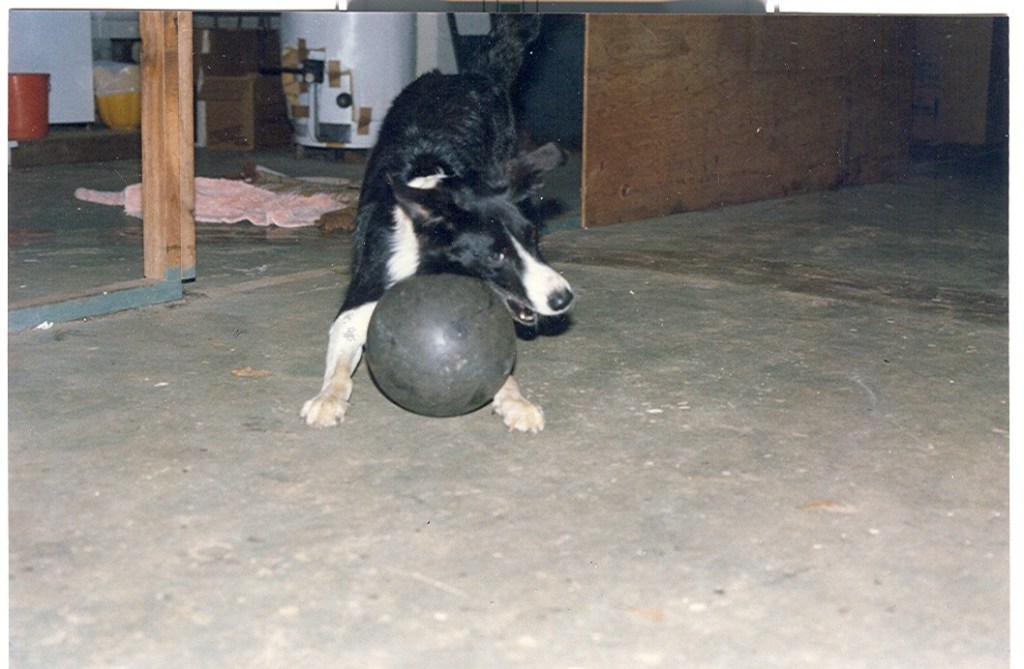
Ness’s favorite toy, an old bowling ball

It is never a good idea to give a dog old shoes or slippers because of the chemicals used to make them. It is especially difficult for a puppy to understand that old shoes and slippers, and rawhide products are OK to play with but new shoes and slippers are not. Keep in mind that rawhide comes from a tannery and dogs have a very sophisticated sense of smell. Therefore, a dog of any age can smell the similarity between rawhide and other leather products, which include furniture, gloves, jackets and briefcases.

Bones are not a good choice for dogs either. Again, it is not natural for dogs to eat bones. Many of the “natural” bones have bacteria on them that can harm both dogs and people who handle them. Some of the stuffed bones that are treated can be safer for a dog who likes bones. The danger associated with bones are splinters from the bone and bacteria.

The bottom line is knowing your dog. If a toy becomes small enough to swallow it should be taken away from the dog. By knowing your dog’s play habits you will be able to decide what toy is safe for them to play with. The best toy is one that allows you to interact with your dog, playing fetch games, chase games or whatever your dog likes. If you understand your dog’s breed, it will guide you to selecting the right toy for your dog. All dogs can benefit from puzzle toys and treat dispensing toys. Also think outside the box, you never know what a dog will take a fancy to as illustrated by our dog Ness.

The dogs of Siberia

An extensive research project led by palaeogeneticist Laurent Frantz from the Ludwig-Maximilian-Universität Müchen determined that dogs from Siberia resulted from cross-breeding with dogs from Eurasian populations over 2000 years ago. His findings along with artifacts found at ancient sites, shows extensive trading. Dogs were an important trade item between the Siberian people and people from the Eurasian steppe and Europe.

For example, he goes on to say that although a large percent of the Samoyed genome can be traced to original Artic bloodlines, it also shows more Western influence than the husky. This finding helps to explain why the Samoyed can herd reindeer yet the husky does not. According to his findings the Samoyed as a breed has had little changes since the Middle Ages.

It is also interesting to note that according to Frantz, although there was an exchange and inbreeding of Siberian dogs, there was no indication that the people intermarried. The human genomes stayed very stable over the same period.    

Separation anxiety in first year college students

Researchers at Washington State University conducted a study of first year (freshmen) college students who owned pets and their level of separation anxiety. What they found is not surprising to those of us who are pet owners and lovers.

The students were tested before leaving for college and during their first two weeks on campus. Prior mental issues were accounted for so that they did not influence the results of the study. What the researchers found was that students who treated their pets more like people suffered more. It also seems that dog owners suffered the most rather than cat owners and people with other types of pets.

My soul mate, Scout

The importance of this study shows that programs that allow pets to visit campus to help students that are stressed, are beneficial. What this study made me think of are all of the elderly people who are forced to give up their pets, who were their companions for many years, because they had to move to a care facility. Young people are active and seem to be able to adjust more readily than the elderly. This also brings to mind how important it is to bring certified therapy pets to nursing homes and assisted living facilities. No matter how young or old a person is, losing a pet for any reason is often very traumatic. Your heart can ache for the loss for many years.

Early childhood adversity lasts a lifetime

A study by scientists at theUniversity of Notre Dame on baboons has shown that early adverse conditions such as famine, abuse, neglect or the death of a parent in early childhood are not reversed by support in adulthood. They feel that things such as elevated stress hormones take a physiological toll on the body, and remain, even with a healthy, supportive relationships in adulthood.

scan0023

Because the subjects of the study were baboons, scientists measured life experience against levels of glucocorticoids (fGCs) — hormones that regulate physiological functions such as metabolism and immune function, and moderate the body’s response to stress. They found that the levels of fGC’s were 9% higher in subjects that had three or more adverse experiences and 21% higher than subjects that had no harsh experiences.

I have to wonder how this study relates to other animals. Does this mean that pets who are abused or experience harsh situations as youths, will not ever fully respond to kind treatment when they are adults? Will the stress always be with them? What comes to mind are children who are given up for adoption at birth and then suffer from attachment disorder. While further research is needed and on a wider subject base (other animals) this is important information to keep in mind when trying to rehabilitate abused pets. This may mean that failure is not the result of poor rehabilitation techniques, but is a result of the chemical changes in the subject.