Puppies and adult dogs will often swallow a foreign object that can potentially harm them. If they ingest an object that is sharp, and they seem normal and are not gagging, or choking, immediately give them Metamucil or another psyllium fiber product and then call your veterinarian. I keep unflavored psyllium fiber on hand so that if necessary, I can add broth to it so the dog will eat/drink it. If you don’t have psyllium fiber on hand the old-time remedy was to give the dog bread and milk or bread and water. The purpose of doing this is to form bulk or a coating around the object to prevent it from injuring the dog until a veterinarian can evaluate the situation and treat the dog. It is a first aid measure, not a cure.
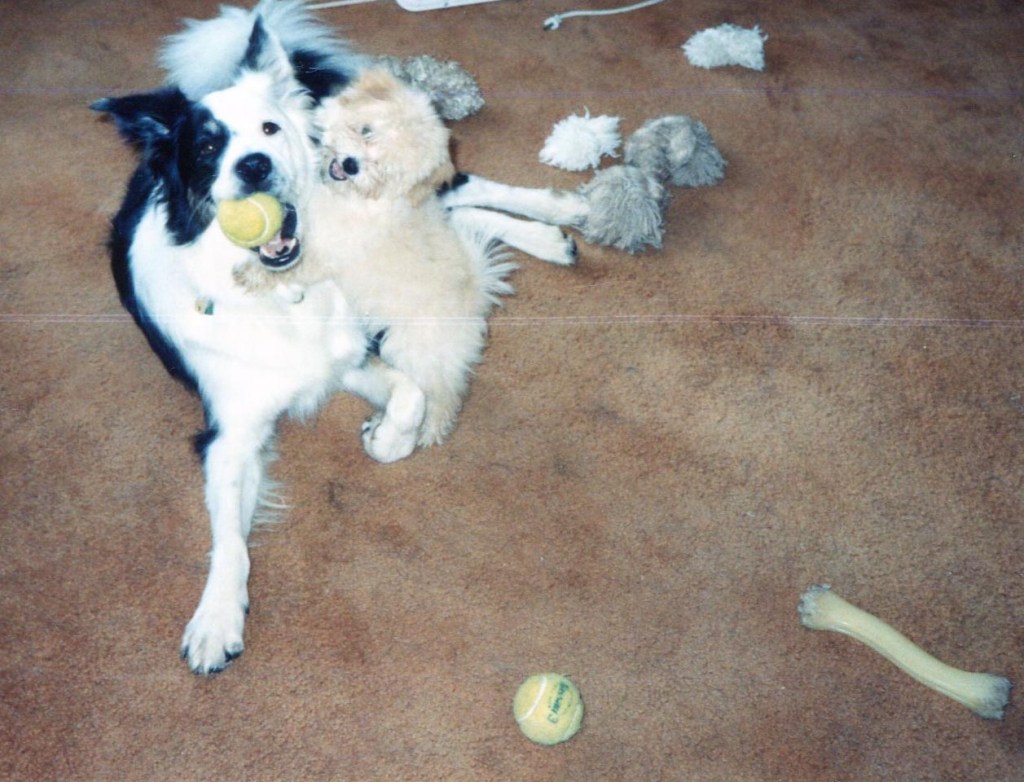
Woody and Lily playing with toys under supervision
Dogs should not be given any product that can be chewed into small undigestible pieces. Such items would be bones, both real and fake, plastic toys, balls, sticks, some of the teeth cleaning chews/products, rawhide, pig ears, and cow hooves. If you are in doubt as to whether or not a product is safe for your dog to eat, put it in a bowl of water. If it does not break down and dissolve in five to ten minutes it is most likely not safe for your dog to ingest.
Many people like to play tug-of-war with their dog and use rope toys. These are OK for this type of play, but a dog should not be allowed to chew and swallow any type of rope. The strands can block the intestines, they are not digestible. Also be careful of stuffed toys and any product made of cloth. These also can block the dog’s intestines and are not digestible. Many stuffed toys are stuffed with batting that is made of synthetic material, again, not digestible.
If your dog likes to play with stuffed toys, watch him carefully to see if he rips the toy apart to pull out the stuffing or if he is the type of dog that will not destroy the stuffed toy. The key with any type of toy is to know your dog. With care and observation, a dog can play safely with toys.
The question came up about why some animals such as cats, dogs and ferrets as well as humans can get the virus but bovine and swine do not. Researchers led by Professor Singh and his team which included Professor Rajinder Dhindsa (McGill University), Professor Baljit Singh (University of Calgary) and Professor Vikram Misra (University of Saskatchewan) decided to explore this question.
What they found is that those animals who can get the virus have two cycteine amino acids while those who do not only have one. This discovery will most likely lead to a cure for the virus. This is exciting news. Please read the whole article for a more in-depth explanation of how this works.
A recent study conducted by the University of South Australiaexplored how important touch is to humans and animals. This phenomenon was recognized in early studies of children in orphanages who fared better with as little as ten minutes of cuddling. Pets fill the need for touch for many people.
The researchers found that during the COVID19 restrictions, more people have adopted pets of all kinds. Even breeders having long waiting lists. Many people have reported that touching a pet gives them comfort. They have even stated that their pets seem to know when they are depressed or sad and will comfort them.
The isolation caused by the virus has brought to light how important touch is to people. In the study lead author Dr. Janette Young stated that physical touch is a sense that has been taken for granted and often overlooked. The isolation due to the virus has brought to light how important touch is to people, their pets fill the void.
Today we have wonderful methods to teach young puppies. The best method is clicker training. This is a way to communicate exactly what you want the puppy (or older dog) to learn. It is also fun and a great way to motivate a dog to want to work with you. Clicker training is a successful, positive training method. Unfortunately, many people do not understand the technique. Note: although I refer to dogs, clicker training applies to almost all animals. I have clicker trained birds and cats.
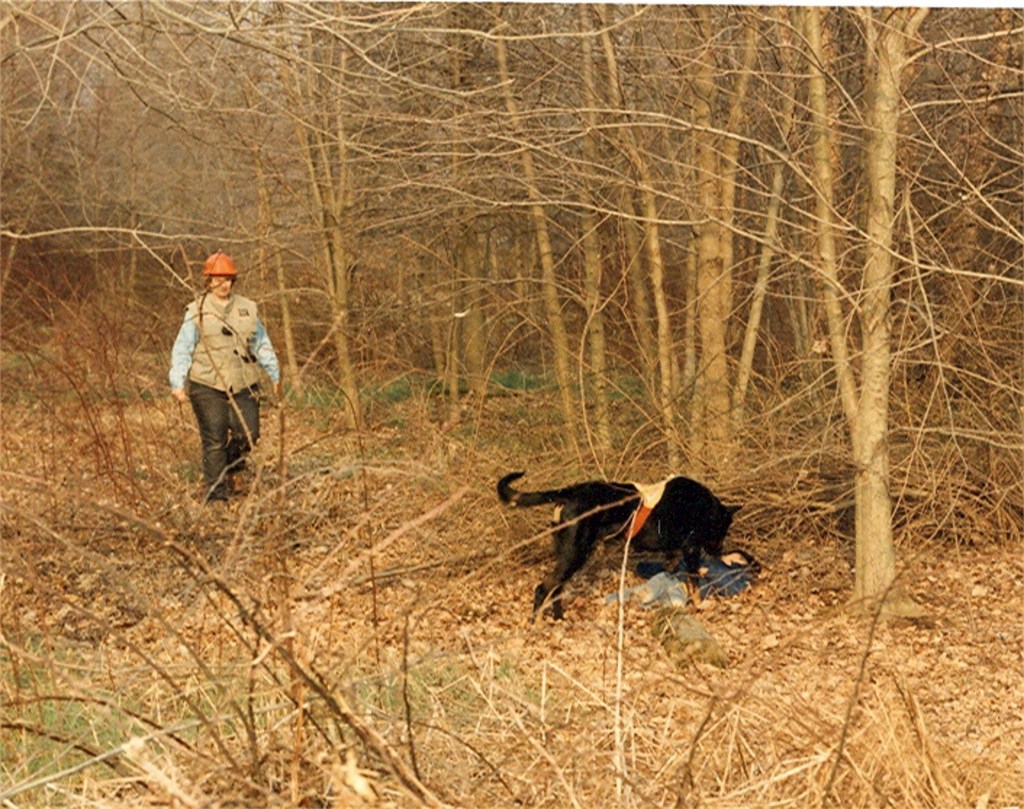
Scout finding the missing child (training)
It is very sad that many trainers still use harsh punishment methods that cause pain. Imagine if an instructor gave you a complex mathematical problem and told you to solve it. The teaching method was to jerk a rope around your neck or shock you every time you got it wrong. Eventually you would either get it right or have a complete mental breakdown from fear and frustration. Whether you got it right or wrong, how would feel about mathematics? How willing would you be to do the next problem even if you were rewarded for finally getting it right? How well would you like your instructor?
Because people are deeply bonded to their dogs, they forget that dogs do not speak our language. They have an amazing ability to watch our body language, couple it with what we say and seem to understand. But in reality, they interpret what we do based on canine language and meaning first, even though they can learn what our body and spoken language means.
Dogs love to do things with us. They want to understand us, but we can make it difficult for them. When training a dog, you must teach and show them what you want. You cannot tell them. You must not expect your dog to “get it” immediately. Puppies can be especially frustrating because they may seem to learn quickly but in a short time, sometimes hours, they act as though they forgot the lesson entirely. In reality they have not completely forgotten, they have not had enough time to practice the lesson to have it go from short term memory to long term memory. Life for a puppy and a young dog is fascinating, everything is new, exciting and distracting. It can be hard for them to focus on a lesson. This is no different than it is for young children. Like us, the more a dog learns the easier it is for them to learn new lessons. This is because the young dog has not had enough life experience to relate the new lesson to something he already knows, but the older dog has learned how to learn. They can relate it to other lessons. This is no different than the way people learn.
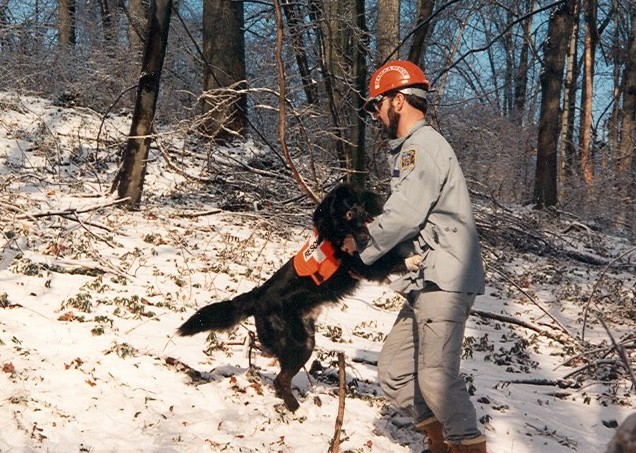
Jib alerting that he found someone
If you show your dog what you want and then reward him for doing it, he will be willing and happy to work with you. Most dogs try very hard to do what we want them to do. Each dog has a different personality and drive to obey. Some breeds are not as willing to obey (being biddable) as others. It is important to recognize this. Before you train your dog, be sure to understand the dynamics of his breed. If he is a mixed breed a DNA test will help you understand the genetics that are dictating his behavior.
For example, if there were a flock of sheep in a pasture and a rabbit hidden in the brush. A Border Collie would focus on the sheep even though he knows the rabbit is there. On the other hand, if a Beagle were taken to the field, he would ignore the sheep and focus on the rabbit. This is a simple example of how genetics affects behavior.
Clicker training is a way to communicate to your dog what you want him to do. The click only says “Yes, that is correct.” What is very important to remember about obedience is this: Once a dog is trained and knows what the command is, the ability to obey depends entirely on how well the dog can exercise self-control, not on how well he knows the exercise. Even people have difficulty with self-control. Think about it.
In conclusion keep these points in mind.
Understand the genetics that drive your dog.
Teach and show your dog what you want.
Do not use harsh methods.
Give your dog time to learn what you want.
Obedience depends on self-control–no one is 100%.
Self-control comes with practice.
Puppies need more time to relate to the lessons.
Reliable obedience depends on positive motivation, not fear.
A study by researchers at the University of Helsinki have determined that there is a benefit to feeding dogs a raw food diet. They found that dogs eating raw food had better immune systems, more antioxidants and less inflammation of the skin.
The researchers stressed that the study was conducted on a limited number of Staffordshire Bull Terriers only and that more research is a necessity. However, the results of this study are promising.
Note: There are many advocates for feeding dogs a raw diet. Making your own can be a challenge as well as having a ready supply on hand to meet your dog’s needs. Many people claim that a raw diet has improved their dog’s health and even cured various medical issues.
There are a number of manufacturers who make a balanced raw food for dogs. Some people elect to make their own. This can be a challenge since the homemade food must meet all of your dog’s nutritional needs. As your dog ages those needs will change and so must the dog food. Dogs who have health issues must monitored by a veterinarian to be sure that their particular needs are being met.
After falling in love at your local animal shelter, you’re thinking about adopting your first pet. Whether it has four legs or two, fur or feathers, a pet is a great addition to any home — but it’s not a decision to take lightly. Pet ownership is a big responsibility, so it’s important to prepare!
image via unsplash
How Do I Know If a Pet Is Right for Me?
Instead of paying attention to how a pet looks, think about how its needs fit into your lifestyle.
Small Mammals
Small pets such as hamsters and guinea pigs are a great choice for people with limited space. Since many small pets tend to get stressed if they live alone, it’s usually best to adopt small mammals in pairs. Keep in mind, however, that not all small mammals like to be handled — luckily, they’re very entertaining to watch!
Birds
Birds are beautiful, bright, and exotic. They’re also high maintenance. Birds need a lot of interaction and some species live 20 to 30 years or more, making a pet bird a major commitment! Birds aren’t the best choice for first-time pet owners, but if you’re set on a feathered companion, consider a budgie or even backyard chickens.
Cats
Cats have a reputation as low-maintenance pets, but don’t be fooled: Cats like to exercise, play, and even go outdoors with a leash or catio! If you want a companion but can’t keep up with the exercise needs of a dog, a cat may be the right choice for you.
Dogs
Dogs are the most popular pet: 38 percent of all households in the US own a dog. However, dog ownership can be difficult for people with full-time jobs. If you do have the time and energy to devote to a dog, you’ll never have a more loyal companion!
What Does a Pet Cost? Do I Need Pet Insurance?
Between adoption fees, vaccinations, and spay or neuter, the first year of pet ownership is expensive. However, the costs don’t stop there. Cats cost $92.98 a month on average, while dogs run $139.80 monthly. Pet insurance defrays costs in veterinary emergencies, but most policies don’t cover routine care. For that reason, every pet owner should have a pet fund.
You should also factor the costs of pet sitting into your budget. A trusted sitter is a great resource when traveling, but the costs can be hard to swallow if you don’t budget for it. Research local pet sitters and learn their costs to estimate what you’ll pay for pet care.
What Type of Veterinary Care Does My New Pet Need?
New pet owners should schedule a vet appointment within a week of adoption. Your pet’s first vet visit is an opportunity to meet your vet, get vaccines, and make sure your pet is healthy. If your pet isn’t spayed or neutered and microchipped, schedule those services too. Spaying and neutering not only prevent unwanted puppies and kittens, but it’s also good for your pet’s health.
How Can I Protect My Home from Pet Damage?
Some first-time pet owners wonder if they should declaw their cat or keep their dog outdoors, but there are more humane ways to protect your home from damage.
Provide cats with some appropriate scratching surfaces such as cat trees, scratching posts, and cardboard scratches.
Clean furniture regularly to prevent fur and odor build-up. If you don’t want to tackle this job yourself, outsource to a professional upholstery cleaner who will typically charge $150 to $200 for this service.
Groom pets regularly. A shedding brush is a dog owner’s best friend!
Keep cleaning supplies handy. Even well-trained pets have occasional house accidents. Keep pet stain remover on hand and always blot, don’t rub, when cleaning urine out of furniture and carpets.
These tips will help you be the best pet parent you can be, but there’s one more thing you can do to be a responsible pet owner: Adopt, don’t shop! Adopting a pet isn’t just cheaper than buying, it also saves lives, reduces pet overpopulation, and improves your local community. The Humane Society of Tampa Bay saves 87% of the more than 10,000 animals it intakes every year. By choosing to adopt love, you can help save even more!
NOTE: An excellent article, thank you Brandon. Before getting a dog, cat or bird, it is a good idea to locate a competent dog trainer and/or cat and bird behavior consultant in the event that you need help. You can find one at iaabc.org It is also important to select the veterinary hospital in your area and establish yourself with them. Various clinics handle a variety of pets from dogs, cats, birds and exotics.
It is not surprising that researchers at the Francis Crick Institute have discovered that as far back as the Ice Age, there were different types of dogs with distinct types of DNA. They were able to extract DNA from ancient bones.
Their research has posed new questions about the history of dogs. For example, often the type of dog that lived with people reflect the changes in the human lifestyle. But in some cases, the dog history does not reflect or mirror the lifestyle of humans. This mystery has yet to be solved.
The study also points out that scientists have not been able to determine where and in which cultural context, dogs were first domesticated.
Is it possible that God created dogs as dogs, domestic from the beginning? Some people believe in Creationism rather than evolution. The Institute for Creation Research has some very interesting material. Whatever you believe, the mystery continues.
Researchers have found that a gene mutation is responsible for breathing difficulties in Norwich Terries and Bulldogs that is not related to brachycephalic faces. Brachycephalic faces can cause Brachycephalic Obstructive Airway Syndrome or BOAS. Researchers found that Norwich Terriers can suffer from Upper Airway Syndrome or UAS which is similar to BOAS.
stockfreeimages
The team from the University of Edinburgh’s Royal (Dick) School of Veterinary Studies, led by Jeffrey Schoenebeck found that a mutation of the ADATS3 gene was linked to the breathing problems. This mutation is also found in French and English Bulldogs. The gene has been linked to edema, (swelling and fluid retention) which is a problem with UAS and BOAS causing breathing difficulties.
Once the researchers develop a test to determine which dogs have the gene mutation, breeders can better control breeding practices. What is important to recognize is that the mutation may occur in other breeds as well shedding a whole new light on breathing issues in dogs.
In a recent study conducted by the University of Sussex, Dr Tasmin Humphrey and Professor Karen McComb, animal behaviorists discovered that it is possible to communicate with cats through a slow eye blink. The blink creates a bond with a cat. They found that strange cats are more likely to approach a human who slow blinks first.
They also found that cats attract and manipulate human attention through purring. Cats also know their names even if someone other than the owner calls them and cats are sensitive to human emotions and may head butt an owner who feels sad.
Keep in mind that cats have a range of personalities just like other animals and humans. Some cats show more affection than others. Some cats like to be held and others do not. But no matter what personality your cat has, they still bond with their families and show affection in their own way.
The Finland program to rehome laboratory Beagles has generally been a success. The program consisted of giving the dogs socialization and training for approximately six months. However, this was not enough time for some dogs who remained timid and suffered from separation anxiety.
Sparky
The dogs were used to study animal cognition and the basic workings of the canine mind. The dogs lived in packs of eight from two to eight years.
While this program is to be commended for rehoming the dogs, the question that comes up in my mind is how can researchers study the workings of the canine mind when these dogs are not living in a normal environment without normal experiences? This is food for thought about the research that makes claims about what dogs feel and how they interpret their world.